Guide
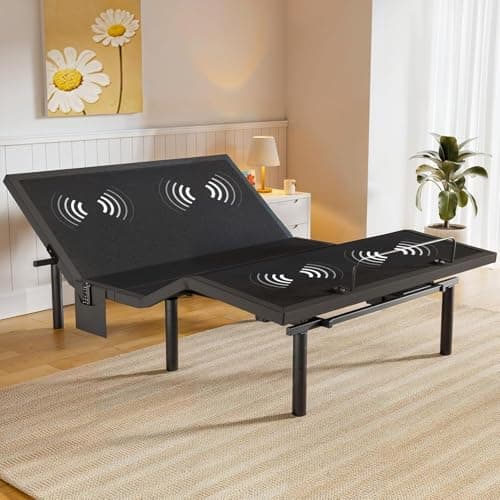
Adjustable bed weight capacity
The rating has to cover the mattress, the bedding and you sitting hard on one corner. Most listings do not publish a rating at all.
By Stephen V.Published Updated How we pick
This should be a short page with a table of numbers in it. It is getting closer. Of the fourteen adjustable bases we currently track, twelve now publish a weight capacity — up from one when we first read these listings — and every one of the twelve publishes the same figure: 750 lb per sleeping surface. Two still publish nothing. That is the finding, and it is more useful than a table of invented figures would be.
What the rating has to carry
A bed's weight rating is not just the person in it. Work through what is actually resting on the frame.
| Item | Notes |
|---|---|
| The mattress | A 12-inch all-foam queen is not light, and it sits there permanently |
| Bedding | Sheets, blankets, a comforter — modest, but constant |
| The sleeper or sleepers | The obvious one |
| Anyone sitting on the edge | The hard case. All of that load lands on one corner of one hinged section |
| A carer leaning in | Routinely forgotten, and it happens at the same corner |
The fourth row is the one that matters on this site. Getting out of bed means putting your entire weight on the very edge of the deck, at a point furthest from the frame's supports, usually on the head section which is the part that hinges. A rating that assumes weight spread evenly across the whole deck is not describing that load at all.
What the published record actually looks like
Here is every capacity claim across the bases we track. The blanks are not gaps in our research — they are what the manufacturers publish. Note how uniform the published figures are: seven different brands, one number between them, which tells you the figure is a category convention as much as an engineering result.
| Base | Published capacity |
|---|---|
| Mixcous King Heavy Duty | 750 lb |
| Amada 01B-Q1 Queen | 750 lb |
| Amada Split King | 750 lb |
| Marsail Queen | 750 lb |
| Marsail NS0 Split King | 750 lb per twin XL half |
| FlexiSpot S3K-Lite King | 750 lb |
| Best Choice Products Queen | 750 lb |
| Best Choice Products Split King | 750 lb |
| Tami Tami T600 Split King | 750 lb per half; 1,500 lb printed for the pair |
| Tami Tami T450 Split King | 750 lb |
| DUMOS Split King | 750 lb per half; 1,500 lb printed for the pair |
| DOMIA T600 Queen | 750 lb |
| Pipishell Twin XL | Not published |
| Serta baselogic Bronze | Not published |
We treat an unpublished capacity as a neutral score rather than a failure, because the absence of a number is not evidence of a weak frame. And a published one is not proof of a strong one: not a single listing here says whether its 750 lb is a distributed rating or an edge rating, which is the distinction that decides whether the figure describes the load this site cares about. Our full rubric is here.
What to do about it
- Ask, in writing, before you buy. Sellers on Amazon answer product questions, and an answer in writing is worth more than a number in a bullet list.
- Add up your own load. Your weight, plus a mattress that will be somewhere between 60 and 120 lb for a queen, plus bedding. If the total is anywhere near a published figure, buy the heavier-rated base.
- Do not assume a split king doubles it. Each half carries its own load, and lying across the middle is the load case nobody rated — two split-king listings print 1,500 lb in the specification table while their own bullets say 750 lb per twin XL. Which listing says which, and the Tami Tami T600 is one of the two.
- Prefer the base that published a number, all else equal. Publishing a capacity is a small signal that somebody engineered to a spec rather than to a price. In our comparison that is the Mixcous king.
Risers are the other place this bites
Flat frames are the striking contrast here. Five of the six low bed frames we track publish a load rating between over 2,000 lb and 3,500 lb — several times the figure every adjustable base publishes — on products costing a fraction of a base. What those frame ratings do and do not tell you.
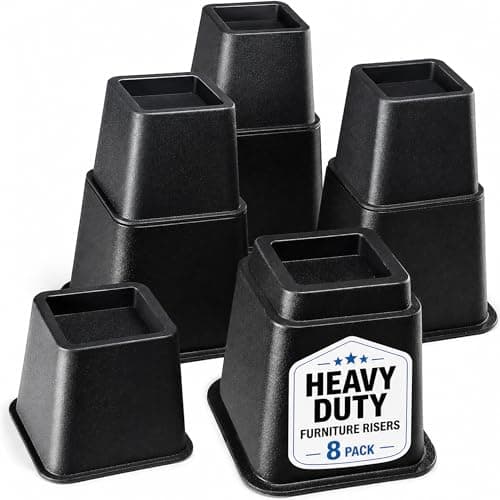
If you raise a bed on risers, the entire load now passes through four small plastic sockets. Riser listings are much better about publishing ratings than bed listings — figures from 1,300 lb up to 6,000 lb per set are stated openly — but the same edge-loading problem applies, and it applies harder, because a riser under one corner takes a disproportionate share when you sit down. Our riser comparison scores load rating as its own criterion for exactly this reason.
Questions people actually ask
How much weight can an adjustable bed hold?
It varies, and a listing that says nothing is telling you nothing. Twelve of the fourteen bases in our comparison now publish a figure, and every one of the twelve publishes the same one: 750 lb per sleeping surface. Two publish nothing — the Pipishell twin XL and the Serta baselogic — and where no figure is published we score that criterion neutral rather than guessing.
Does the weight limit include the mattress?
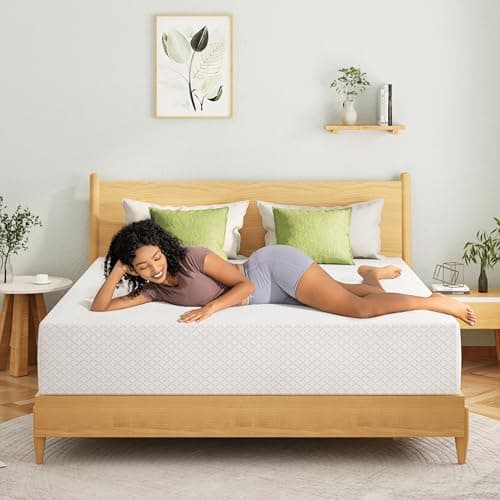
It should. A 12-inch queen memory foam mattress is a substantial share of a rating on its own, so a limit quoted without saying whether the mattress counts is not a usable number. Ask the seller in writing.
Is a split king rated per side or in total?
Per side, in practice, because each half is a separate base — and two of the split-king listings we track show how easily that gets muddled: their specification tables print 1,500 lb while their own feature bullets say 750 lb per twin XL. The 1,500 is the pair. Two 750 lb halves are not a 1,500 lb bed for one person lying across the middle, which is exactly the load case the rating does not cover. Our split king comparison sets out which listing states which.
What happens if you exceed the weight limit?
Usually nothing dramatic and immediately. The realistic failure is a stalling actuator, a sagging deck over months, and a warranty claim that gets refused. The rating is about service life as much as about safety.
Read next
Comparison
Best Adjustable Beds for Seniors
Ranked on leg height, controls and published capacity — not on how the marketing photo looks.
Our top pick — Amada 01B-Q1 Queen Adjustable Bed Frame
Guide
How They Work
What is inside the frame, what the buttons do, and which parts fail first. No sales pitch, just the mechanism.
Single review
Tami Tami T600 Review
Five years, under 45 dB, 8,000 newtons and 30,000 cycles. Reviewed on what the listing publishes, what it leaves blank, and the one line that catches people who wanted a lower bed.
Comparison
Best Bed Risers
The cheapest fix in this subject, scored on the two specs that matter: how much lift, and how much load.
Our top pick — Home It Adjustable Bed Risers, 3/5/8 in
$25.99 · Check priceAs of October 20, 2026. #ad How we’re funded
Comparison
Best Mattresses for Seniors
Scored on published height, flex and certification — not on how they feel, because we have not slept on them.
Our top pick — EGOHOME 12 Inch Queen Memory Foam Mattress
$249.99 · Check priceAs of October 20, 2026. #ad How we’re funded


Nothing here is medical advice. Prices are pulled live and stamped with the date they were checked; scores are our published spec rubric, not a test result. How we pick · How we make money · Corrections