Guide
Adjustable bed sleeping positions
Every position, what it changes, and how to test each one tonight with pillows before you spend anything.
By Stephen V.Published How we pick
Adjustable bed listings name their positions like features. Most of them are saved angles that any base with head and foot lift can reach by hand. This page is the plain reference: what each position is, what it changes, and how to test it before you buy the bed that does it automatically.
The positions
| Position | What it is | Test it tonight with |
|---|---|---|
| Flat | The default. Most people sleep here most of the time | Nothing |
| Head raised, slight | A few degrees. Reduces snoring for some people; marketed as anti-snore | One firm pillow under the shoulders, not the head |
| Head raised, moderate | Enough to keep the upper body clearly above the stomach — the reflux position | A wedge pillow — the cheapest test there is |
| Head near-vertical | For reading, eating, or as the first stage of getting out of bed | Sitting up against the headboard |
| Feet raised | Elevation for swollen legs and ankles | Pillows under the calves — for an hour, not a night |
| Knees raised, head slightly raised | The zero-gravity preset. Lets the lower back settle | A pillow under the knees and one behind the shoulders |
| Both raised, deeply | A contoured position some people use for lower back pain | Two pillows under the knees, two behind the shoulders |
The right-hand column is the point of this page. Every position worth having can be approximated tonight with things already in the house. What a base adds is that the approximation stops sliding away at two in the morning.
Raise from the hips, not the neck
The most common mistake with elevation is stacking pillows so the head is pushed forward while the chest stays flat. That folds the neck, does very little for reflux or breathing, and is uncomfortable enough that most people abandon it and conclude elevation does not work for them.
A wedge or a base hinges the whole upper body from around the hips, so the spine stays in a line and the chest genuinely rises. If you are testing with pillows, put them under your shoulders and upper back rather than under your head. More on angles.
The presets, demystified
- Zero gravity. Knees slightly above the heart, head slightly raised. Named after the posture astronauts sit in at launch. It is a saved position, nothing more.
- Anti-snore. A small head raise, usually around seven degrees. Mild positional help for some snorers. Not a treatment for sleep apnea, which is a medical diagnosis with medical treatments — more on beds and apnea.
- Memory 1 and 2. Your own saved positions. Genuinely the most useful buttons on the remote, because the angle that suits you is rarely the one the factory chose.
- Flat / all down. The one button you want to be able to find in the dark.
The position that helps you get out of bed
This one is a technique rather than a preset, and it is the single most useful thing on this page for anyone who finds mornings hard.
- Raise the head of the bed to near vertical before trying to get up. The bed does the sitting-up for you.
- Slide or turn so your legs come off the side while your torso is already upright.
- Plant both feet flat. If they do not reach the floor easily, the bed is the wrong height — and that is fixable.
- Lean forward over your feet, then push up with your legs, using a grab handle if you have one.
Going from flat to sitting in one movement needs abdominal strength and a twist, and it is the movement most people lose first. Splitting it in two removes the hard part entirely — and it works on any base with head lift, including the cheapest.
Questions people actually ask
What is the best position to sleep in on an adjustable bed?
There is no single best position — it depends what you are trying to change. Head raised for reflux and breathing, feet raised for swelling, a slight knee raise for lower back load, and near-flat for most people most of the time.
Is it bad to sleep with the head of the bed raised every night?
For most people it is simply a preference. What is worth avoiding is a folded position — head raised sharply while the hips stay flat — because that compresses rather than supports. Raise from the hips, not from the neck.
What angle is the anti-snore position?
A small head raise, typically in the region of seven degrees, saved as a preset. It is a mild positional adjustment, not a treatment for sleep apnea, which is a medical diagnosis.
Can I set my own positions?
Most bases with memory buttons let you save two. That is more useful than the branded presets, because the angle that suits you is unlikely to be the one the factory saved.
Sources
Every factual claim on this page traces to one of these, or to a product listing cited in the specification table beside it.
Read next
Guide
Elevation Angles
Thirty degrees is not a wedge height and a wedge height is not an angle. Here is the arithmetic that connects them.
Guide
How They Work
What is inside the frame, what the buttons do, and which parts fail first. No sales pitch, just the mechanism.
Comparison
Back Pain
There is a free test that tells you whether a base would help. Run it tonight before spending anything.
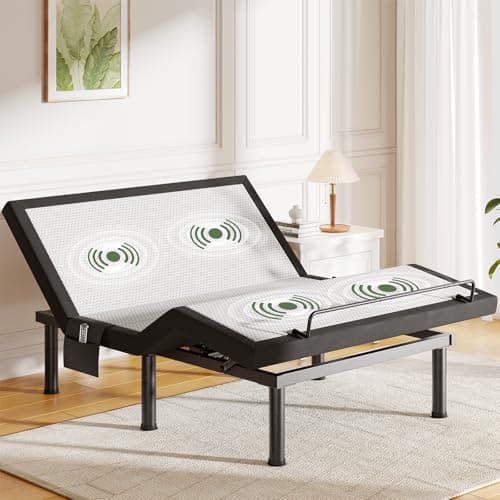
Our top pick — DOMIA T600 Queen Adjustable Bed Frame
$389.99 · Check priceAs of October 21, 2026. #ad How we’re funded
Guide
Swelling and Circulation
Above the heart is the phrase everyone uses. Here is what that means in a bed, and why pillows stop working after an hour.
Guide
Parkinson's and Mobility
Bed mobility is often the hard part. A higher firmer edge, a head raise and a grip help you move, with your therapy team, not instead of it.




Nothing here is medical advice. Prices are pulled live and stamped with the date they were checked; scores are our published spec rubric, not a test result. How we pick · How we make money · Corrections