Guide
Are bed rails safe for elderly adults?
The federal rule, the seven entrapment zones, and the measurements to take on your own bed. The page to read before you buy anything.
By Stephen V.Published How we pick
The honest answer is: it depends on three things, and only one of them is the product. It depends on the rail, on the bed it is fitted to, and on the person using it. A great rail on the wrong mattress is unsafe. A compliant rail used by someone who will try to climb over it is unsafe. This page is about all three.
What changed in 2023
For years, adult portable bed rails were sold in the United States against a voluntary standard, ASTM F3186-17. That ended on 21 July 2023, when the Consumer Product Safety Commission published a final rule establishing a mandatory safety standard at 16 CFR part 1270. It took effect on 21 August 2023 and applies to rails manufactured after that date.
The rule matters because of how broadly it defines the product.
An adjacent type bed rail, grab bar, assistive bar, transfer aid, cane or rail intended by the manufacturer to be installed on, against, or adjacent to an adult bed to provide assistance to the bed occupant in moving on the bed surface, in entering or exiting the bed, to minimize the possibility of falling out of bed, or for other similar purposes.
Read that list again: grab bar, assistive bar, transfer aid, cane. A product marketed as a bedside handle rather than a rail is covered identically. There is no unregulated corner of this category, and a seller who does not mention the standard is not thereby exempt from it.
Entrapment: what the risk actually is
The hazard a bed rail introduces is not that it fails to hold. It is that it creates spaces, and a person who slides or rolls can become caught in one and be unable to get out. The FDA, working with the Hospital Bed Safety Workgroup, mapped seven potential entrapment zones in bed systems and published dimensional guidance for zones one through four — the four where roughly 80% of reported entrapments occurred.
| Zone | Where | Guidance |
|---|---|---|
| 1 | Within the rail itself, between its bars | Under 120 mm — about 4¾ inches |
| 2 | Under the rail, between its supports | Under 120 mm — about 4¾ inches |
| 3 | Between the rail and the mattress | Under 120 mm — about 4¾ inches |
| 4 | Under the rail at the ends of the rail | Under 60 mm — about 2⅜ inches |
| 5, 6, 7 | Identified by the workgroup | No dimensional guidance or test method developed |
The tool the workgroup developed to test those gaps is a cone and cylinder sized to represent the head and compressed neck of a small adult. That is what those numbers are describing. It is not a comfortable thing to write and it is the reason this page exists.
Two things follow. First, zone three is the one you control, because it depends on your mattress rather than on the rail's manufacture. Second, the gaps are dynamic: a soft mattress compresses under body weight and opens a gap that was not there when you measured an empty bed, and an adjustable base changes the geometry every time it moves.
How to check your own bed
- Fit the rail exactly as the instructions say. Not approximately.
- Press down firmly on the mattress next to the rail, the way a body would, and measure the gap between mattress and rail while it is compressed.
- Measure inside the rail, between its bars.
- Measure under the rail, both between the supports and at each end.
- On an adjustable base, repeat every measurement with the head raised to its steepest angle.
- Compare against the table above. If any gap is larger than the guidance, the combination of that rail and that mattress is wrong — change the mattress, change the rail, or do not use one.
The fitting guide goes through this with the practical detail, including what to do when the mattress is the problem.
The person matters as much as the product
A rail is a reasonable tool for someone who can deliberately move away from it, understands it is there, and wants it. It is a poor tool — sometimes an actively dangerous one — for someone who is confused at night, who cannot reposition themselves, or who will try to climb over it. Climbing over a rail converts a low roll-out into a fall from a greater height onto a harder landing.
That deserves its own page rather than a paragraph: who should not use a bed rail, including what to use instead.
Rails are one part of falls prevention, not the whole of it
The CDC reports that around one in four adults aged 65 and older falls each year, that about 37% of those who fall report an injury needing treatment or restricting activity, and that falling once roughly doubles the chance of falling again. Against numbers like that, no single product is a solution.
The things that reliably help are unglamorous and mostly free: a light you can reach before your feet touch the floor, a clear path to the bathroom, no loose rugs, footwear rather than socks on hard floors, and a bed at the right height so standing up is a step rather than a lurch. Bed height is the one we can help with arithmetically, and it is where we would start.
Facilities work to a second rulebook on top of the consumer standard, and it is worth reading even if the bed in question is at home: federal regulation requires a nursing home to try alternatives first, assess entrapment risk, obtain informed consent and follow the manufacturer's specifications before a rail goes on. The regulation, quoted, and how to borrow it for a bed at home.
Questions people actually ask
Are bed rails safe?
A rail built to the current federal standard, fitted correctly, on a firm mattress, for a person who can move away from it deliberately, is a reasonable tool. A loose rail on a soft mattress, or a rail used with someone who is confused or cannot reposition themselves, is a hazard. The product is not the whole answer — the fit and the person are.
When did bed rails become regulated in the United States?
The CPSC published its final rule at 16 CFR part 1270 on 21 July 2023. It took effect on 21 August 2023 and applies to adult portable bed rails manufactured after that date. Before then, ASTM F3186-17 was voluntary.
What is bed rail entrapment?
A person becoming caught in a gap in the bed system — inside the rail, under it, between the rail and the mattress, or under the rail at its ends. The FDA and the Hospital Bed Safety Workgroup identified seven such zones and published dimensional guidance for the four where most reported entrapments occurred.
How do I check whether my bed rail is safe?
Measure the gaps with the mattress compressed as it would be with a person on it, and with an adjustable bed both flat and raised. FDA guidance for zones one to three is under 120 mm, about 4¾ inches; zone four is under 60 mm, about 2⅜ inches.
Should I use a second-hand bed rail?
We would not. A rail manufactured before 21 August 2023 was not built to a mandatory standard, and older, looser designs are precisely what the rule was written about. A new compliant rail costs less than most people expect.
Sources
Every factual claim on this page traces to one of these, or to a product listing cited in the specification table beside it.
- Federal Register — Safety Standard for Adult Portable Bed Rails, final rule, 21 July 2023
- CPSC — Adult Portable Bed Rails business guidance (16 CFR part 1270)
- FDA — Hospital Bed Safety Workgroup FAQ on entrapment issues
- FDA — Hospital Bed System Dimensional and Assessment Guidance to Reduce Entrapment (guidance document)
- CDC — Facts About Falls
Read next
Guide
Who Should Not Use One
Four situations where a rail makes things worse, and the alternatives that work better in each.
Guide
Fitting a Bed Rail
Fitting takes twenty minutes. The measuring afterwards is the part that decides whether it is safe.
Comparison
Best Bed Rails
Scored on whether the listing states compliance with the standard that became federal law in 2023 — and four other things.
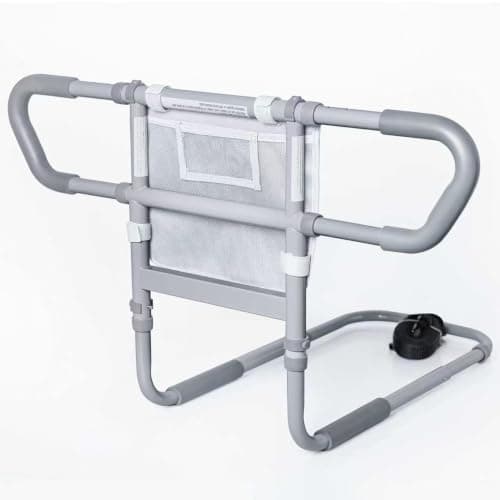
Our top pick — Lesamediio HC035 Bed Assist Rail
$69.99 · Check priceAs of October 20, 2026. #ad How we’re funded
Head to head
Rail vs Assist Handle
Two products, one search term, completely different jobs. Most people searching for the first one need the second.



Nothing here is medical advice. Prices are pulled live and stamped with the date they were checked; scores are our published spec rubric, not a test result. How we pick · How we make money · Corrections