Guide
How adjustable beds work
What is inside the frame, what the buttons do, and which parts fail first. No sales pitch, just the mechanism.
By Stephen V.Published Updated How we pick
There is less inside an adjustable bed than the marketing suggests, and knowing what is in there makes the buying decision much easier — because you stop paying attention to the features that are just software and start paying attention to the parts that can strand you.
The mechanism
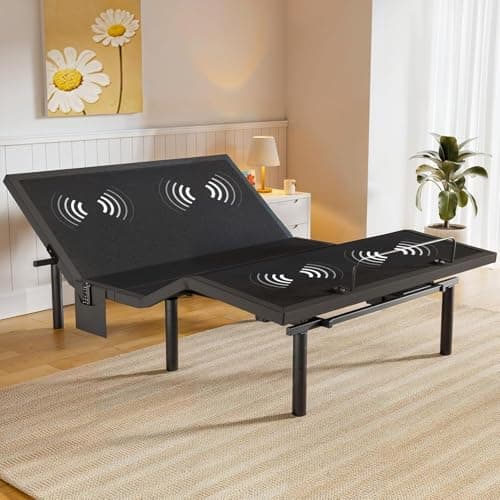
The deck of the bed — the surface the mattress lies on — is hinged into sections. A typical base has a head section, a fixed middle, and a leg section that often hinges twice so the knees bend before the feet rise.
Each moving section is pushed by a linear actuator: a small electric motor turning a threaded rod inside a tube, so that the tube extends and retracts. It is the same mechanism as a standing desk. There is no hydraulic fluid, nothing under pressure, and nothing that can drop suddenly if it fails — a stalled actuator simply stops.
- Single motor — head and feet move together on one actuator, or only the head moves. Cheaper, less useful.
- Dual motor — head and feet move independently. This is what most bases in our comparison have, and it is what you want.
- Split configurations — each half of the bed has its own pair. See king versus split king.
The control box, and why it matters more than the frame
Every base has a control box: a small sealed unit under the frame that takes mains power, receives the remote's signal and drives the actuators. It is the brain, it is the part that is easiest to break, and it is the part nobody asks about.
What the buttons actually do
| What it is called | What it does |
|---|---|
| Head up / down | Runs the head actuator. Nothing else. |
| Foot up / down | Runs the leg actuator. |
| Zero gravity | Drives both actuators to one saved position — knees slightly above the heart, head slightly raised. A memory preset, not a function. |
| Anti-snore | Another saved position: a small head raise, typically around 7 degrees. Also just a preset. |
| Flat / all down | Returns both actuators to zero. The one button worth having on the remote. |
| Memory 1 / 2 | Saves your own positions. Genuinely useful once you find the angle that suits you. |
| Massage | A vibration motor in the deck. Unrelated to the actuators. Most people stop using it. |
| Under-bed light | An LED strip on the underside. Small feature, disproportionate value at 3am. |
The point of that table is that zero-gravity and anti-snore are positions with names. Any base with head and foot lift can reach both by hand. A base that lists them as features is telling you it has memory presets, not that it does something another base cannot.
Power, batteries and getting stuck
The bed needs a mains outlet within reach. During a power cut the bed stays exactly where it is — the actuator is a screw, so it holds position without power. Many bases include a small battery pack whose only job is to drive the bed back to flat once, which is the emergency you would actually care about.
The cable run deserves thought. A power lead trailing across the floor beside a bed is a trip hazard, and the CDC's own figures put falls at one in four adults over 65 every year. Route the cable behind furniture, clip it to the frame, and make sure the remote has somewhere to live that is not the floor.
The stack: what actually sits between you and the floor
Understanding the assembly makes the height problem obvious, which is why we put it here rather than in a sales page.
- The floor.
- The legs — the part almost nobody publishes a measurement for, and the only part that is adjustable on some bases.
- The frame and deck.
- The mattress, which on most models in our comparison is 12 inches.
- You, sitting on the edge.
One consequence of that hinge geometry surprises almost everybody on the first night: as the head rises, the top edge of the mattress swings away from the headboard and a gap opens. Why it happens and what fills it.
Knowing how the mechanism works is most useful at the point of buying one, where it turns into a short list of things to read off the listing. The seven checks, in buying order is that list, with the count of how many of the fourteen bases publish each one.
Add those together and you have your sleep-surface height, which is the number that decides whether you can stand up unaided. Most people never calculate it, and most listings make it impossible to calculate before delivery. Our calculator does the arithmetic against your own leg length, so you know what you are aiming for before the boxes arrive.
Questions people actually ask
How does an adjustable bed frame move?
An electric linear actuator — a motor driving a threaded rod inside a tube — pushes a hinged section of the deck up or down. Most bases have one actuator for the head and one for the feet. There are no hydraulics and nothing under pressure.
What happens to an adjustable bed in a power cut?
It stays where it is. Many bases include a battery backup that will return the bed to flat once, which is the function you actually want — being stuck sitting upright is uncomfortable but being stuck at an angle you cannot get out of is a problem.
Do adjustable beds use much electricity?
Almost none. The motors only draw power while the bed is moving, which is a few seconds a day. The standby draw of the control board is small and continuous.
What usually breaks first on an adjustable bed?
The remote, then the control box, then an actuator. All three are replaceable parts on most bases, which is worth confirming before you buy — a bed whose parts are not sold separately is a bed that becomes scrap when one small component fails. What to check, and what to do, when one of them fails.
Read next
Comparison
Best Adjustable Beds for Seniors
Ranked on leg height, controls and published capacity — not on how the marketing photo looks.
Our top pick — Amada 01B-Q1 Queen Adjustable Bed Frame
Guide
Weight Capacity
The rating has to cover the mattress, the bedding and you sitting hard on one corner. Most listings do not publish a rating at all.
Guide
Are They Worth It?
Sometimes. Here are the four cheaper things to rule out first, and the three situations where a base is genuinely the right purchase.
Guide
Sleep Positions
Every position, what it changes, and how to test each one tonight with pillows before you spend anything.
Single review
Marsail Queen Review
A queen base that now publishes the same four leg heights as the base we rank first, for less. Reviewed on what the listing states and what it does not.
Head to head
Adjustable Base vs Box Spring
They are not really rivals — one quietly replaces the other. Here is what each does, what it does to your mattress, and what it does to your height.



Nothing here is medical advice. Prices are pulled live and stamped with the date they were checked; scores are our published spec rubric, not a test result. How we pick · How we make money · Corrections