Single review
Home It adjustable bed risers, 3/5/8 in
The set we reach for when the right lift is still a guess - three heights from one box, read on what the listing publishes.
By Stephen V.Published Updated How we pick
We earn a commission if you buy through the links on this page, at no extra cost to you. It does not change what we recommend, and we have not tested these products — here is what we do instead.
This is the riser set we rank first in our roundup, and the reason is narrow but real: it publishes three lift heights from a single box. When you are not yet sure how much lift you need - which is most people, before they work out the number - a set that covers 3, 5 and 8 inches means one purchase instead of two or three.
1 · Trying a height first
Home It Adjustable Bed Risers, 3/5/8 in
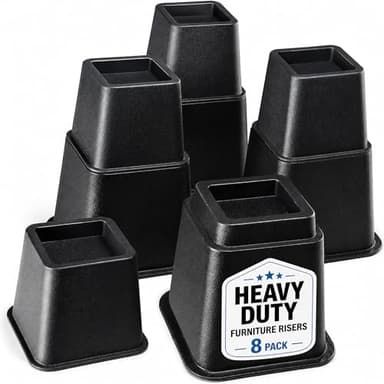
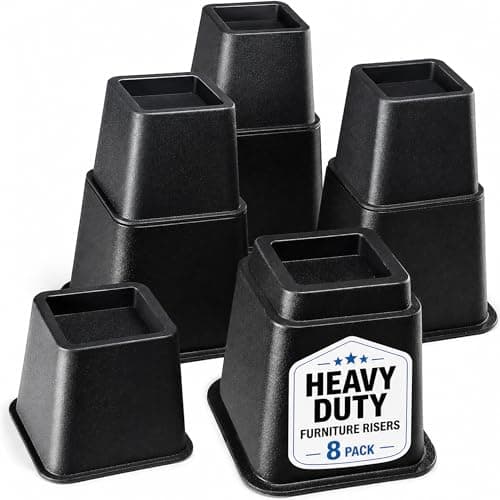
Three published lift heights from one set and a published 1,300 lb rating — the most flexible way to test a height before committing to it.
- Lift
- 3, 5 or 8 in
- Our spec score
- 8.5/10
- Best for
- Trying a height first
What works
- Three heights out of one box, so you can try 3 inches, decide it is not enough, and go to 5 without buying twice
- A published 1,300 lb rating for the set, and a published material — polypropylene, not an unnamed plastic
- Cheap enough that testing a height costs less than being wrong about one
What doesn’t
- Stacked risers are less stable than a single-piece riser of the same height — stack at your own judgment
- No published socket depth, and socket depth is what decides whether your bed leg actually sits in it
- Raising a bed raises the fall distance. Height helps you stand; it does not help you land
Published specifications
| Lift heights | 3, 5 or 8 inches (stackable) |
|---|---|
| Load rating | 1,300 lb |
| Pack | 4 |
| Material | Polypropylene |
| Socket depth | Not published |
Read from the product listing on 2026-08-26. Blanks are specifications the manufacturer does not publish, not figures we could not be bothered to find.
How the score was reached
| Lift rangeThree published heights from 3 to 8 inches. | 10 |
|---|---|
| Load rating1,300 lb published for the set. | 9 |
| StabilityPolypropylene with a broad base published; stackable by design, and no socket depth. | 7 |
| Set sizeFour-pack — one per bed leg. | 8 |
| Mean, rounded to one decimal | 8.5 |
The case for it: three heights from one box
The listing publishes 3, 5 or 8 inches, stackable, in a four-pack. That is the whole argument for this set over a fixed-height one. The single most common mistake in raising a bed is buying 8 inches when 3 was the answer, and a set that lets you start at 3, live with it for a week and step up if it is genuinely too low takes that mistake off the table. It is cheap enough that testing a height costs less than being wrong about one.
Most people, once they measure, need far less lift than they assumed - which is exactly the situation this set is built for. Start low. You can always add height; taking it back off means a second order.
How it reaches eight inches, and why that matters
The 8-inch setting is not a single tall block - it is reached by stacking. That is worth understanding rather than skimming past, because a stack of two pieces is less stable than one piece of the same height. Every join is a place that can shift, and a riser under a bed you lean on is not where you want a join working loose over months.
So the honest guidance is this: if you know you need 8 inches, a single-piece 8-inch riser with a wide base is the steadier structure, and the roundup names one. If you need 3 or 5 inches, or you are still guessing, the Home It set is the flexible, sensible choice and the stacking never comes into it. The set earns its ranking on range; it does not pretend the stack is as solid as a monolith.
The 1,300 lb rating, in context
The listing publishes a 1,300 lb rating for the set of four. In isolation that sounds like enormous headroom for a bed, and it is - but the headroom is the reassurance, not the plan. Two things about it are worth holding in mind.
What the listing does not tell you
- Polypropylene, and that is all it says. The listing names the material now, which is more than most riser listings manage, but it gives no wall thickness or rib detail - so how it behaves on a hard floor over years is still a judgment call.
- Socket depth - not published. Socket depth is what decides whether your bed leg sits properly inside the riser or perches on the rim, and it is the specification we would most like on every riser listing. This set does not publish it; only the Utopia set does, at 0.7 inches. Measure your leg and eyeball the socket on arrival.
- Base dimensions - not published as a figure. Tipping resistance comes from base width, and the listing does not give one. A wider base resists tipping better; you will have to judge it in the box.
Raising a bed is also raising a fall
This is the caveat that applies to every riser and belongs in every honest riser review. Lifting a bed makes standing up easier and makes falling out of it worse - the surface you might roll off is now further from the floor. The CDC's falls data is a reminder that a fall from bed is not a trivial event for an older adult, and height helps you stand up; it does nothing to help you land.
So when a bed goes up, re-check the things attached to it. If a bed rail is fitted, its geometry changes and the gaps need re-measuring. A fitted sheet can pull tight at the corners on a raised bed. And if a roll-out is a real risk for the person, raising the bed is a decision to make with that risk in view, not a pure win.
When a riser is the wrong fix entirely
- On most adjustable bases. Wide feet, bar feet and casters do not seat in a socket. Use the base's own leg settings first - here is how.
- Under a solid platform or plinth bed with no legs. There is nowhere for the socket to sit.
- When the real problem is a soft mattress edge. If the edge collapses as you sit, you are sinking below your target every time, and no lift under the frame corrects that. That is a mattress problem.
- When the bed is too high, not too low. A riser only goes one way. For a too-high bed the levers are a thinner mattress or removing a topper.
How to test a height with a set like this
The whole value of a three-height set is that you can experiment without buying twice, so experiment deliberately rather than committing on the first night.
- Fit the set at the lowest height first - almost always 3 inches, which is the amount most people turn out to need once they have actually measured.
- Sit on the edge and run the test that matters: both feet flat on the floor, knees at roughly a right angle, your weight already over your feet.
- Live with it for a few days. A height that feels marginal on the first night is often exactly right once it stops being new.
- Step up to 5 inches only if you are still sliding down off the edge to find the floor. If 3 inches works, you are finished and the stacking never comes into it.
- Re-measure the sleep surface against your target at whatever height you settle on - that number was the point of the whole exercise.
Because a riser set costs a small fraction of anything else in this subject, the extra heights are nearly free insurance against guessing wrong. That is the real argument for this set over a cheaper single-height one: not that you will use all three heights, but that you do not have to know which you need before you order.
And if you settle at 3 or 5 inches, keep the pieces you are not using. Beds change - a new mattress, a move, a second person's needs - and a spare height already sitting in a drawer is one future problem you have quietly solved in advance.
Fitting them without tipping the bed
Getting risers under a bed is a two-person job, and more so with a stackable set, where the tall setting has to be assembled square or it works loose. Clear the bed and get help - an empty frame with a mattress on it is still awkward, and this is not a job to do alone at seventy. Lift one corner at a time, place the riser, and set the leg fully inside the socket rather than on its rim. Confirm all four corners are at the same height, rock the bed before you make it, and treat any movement as a leg that is not seated or a stack that is not square.
Who should buy it, and who should not
Buy it if you have an ordinary frame with four legs, you want a modest lift, and you are not yet certain of the exact number - the three-height range is worth more than any single-height set when the answer is still a guess. Measure first, the calculator is here, then start at the lowest setting that meets your target.
Skip it if you already know you need a full 8 inches and want it in one solid piece, or if your bed's feet will not seat in a socket. For the fixed 8-inch case a single-piece riser is steadier; for the seating problem, no riser is the answer. Both routes are covered in the roundup, which scores this set against the alternatives on the two specs that decide it: how much lift, and how much load.
Questions people actually ask
Are Home It bed risers any good?
On the specification they publish, yes - three lift heights from a single box and a 1,300 lb rating for the set of four. That flexibility is why we rank them first for trying a height. The caveat is that the tallest setting is reached by stacking, and a stack is less stable than a single piece of the same height.
How much do Home It risers raise a bed?
The listing publishes 3, 5 or 8 inches, stackable. You get all three heights out of one four-pack, which is the point of them - you can try 3 inches, decide it is short, and move to 5 without buying twice.
How much weight do Home It bed risers hold?
The listing publishes a 1,300 lb rating for the set of four. That is far beyond what any bed asks of it, but the load is not shared evenly - sitting on the edge puts a disproportionate share through the riser nearest you, so the headroom is there for the edge case, not the average.
Can you stack Home It bed risers?
Yes - the set is stackable by design, and stacking is how it reaches 8 inches. A stack is always less stable than a single piece of the same height, so if you know you need 8 inches, a single-piece 8-inch riser is the steadier buy. The roundup covers the alternatives.
Do Home It risers work under an adjustable bed?
Only if the base stands on conventional legs that seat fully inside the socket. Many adjustable bases have wide feet or casters that will not, and a foot perched on the rim is balanced, not supported. Raising an adjustable bed covers what to do instead.
Sources
Every factual claim on this page traces to one of these, or to a product listing cited in the specification table beside it.
Read next
Comparison
Best Bed Risers
The cheapest fix in this subject, scored on the two specs that matter: how much lift, and how much load.
Our top pick — Home It Adjustable Bed Risers, 3/5/8 in
Guide
Raising an Adjustable Bed
Four ways to fix a base that sits too low, in order of how safe they are on a motorized frame.
Guide
Measuring Your Bed
Two minutes, one tape measure, and the mistake nearly everyone makes with a soft mattress.
Guide
Best Bed Height for Seniors
A calculator that shows its working, because the right answer depends on your legs and not on an average.

Nothing here is medical advice. Prices are pulled live and stamped with the date they were checked; scores are our published spec rubric, not a test result. How we pick · How we make money · Corrections