Guide
Bed height for a wheelchair transfer
A sideways transfer works best when the two surfaces are level. The ADA never set a bed height, but it did publish what a typical wheelchair seat is.
By Stephen V.Published How we pick
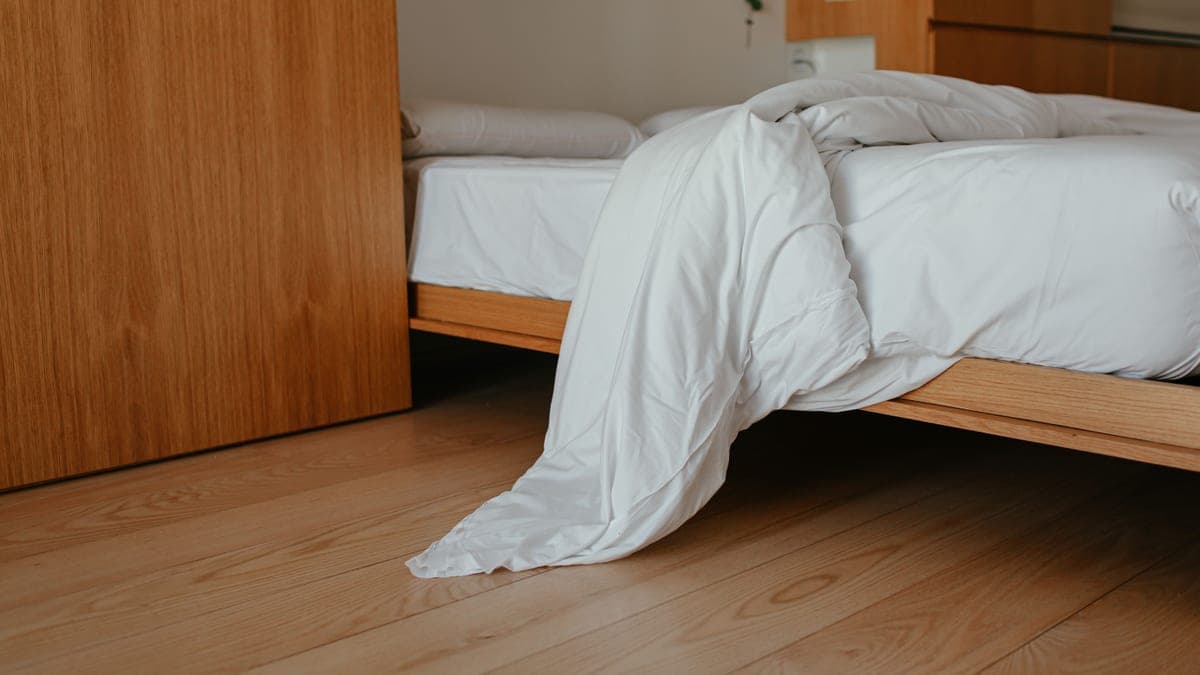
A transfer from a wheelchair to a bed is a sideways move between two surfaces, and the single thing that makes it easier or harder is how level those surfaces are. That is a different question from the one the rest of this section answers. Everywhere else here, the target height comes from the length of your lower leg, because you are standing up from the edge. For a seated lateral transfer, your legs are not doing the work and your own measurements are not the target. The chair is.
There is no bed-height rule, and that is worth knowing
People search for a regulation here and there is not one. The 2010 ADA Standards deal with accessible sleeping areas by requiring clear floor space beside the bed so a chair can get alongside it; they set no height for the bed itself. Hotels are not obliged to provide a bed at any particular height, which is why an accessible hotel room can still have a bed you cannot transfer onto. For a house, nothing applies at all.
What does exist is a published federal figure for the other half of the equation - what a wheelchair seat is assumed to be. It appears in the advisory to the fitting-room requirements, where a bench has to be set at the height somebody can slide onto from a chair.
Section 903.5 requires dressing room bench seats to be installed so that they are at the same height as a typical wheelchair seat, 17 inches (430 mm) to 19 inches (485 mm). However, wheelchair seats can be lower than dressing room benches for people of short stature or children using wheelchairs.
The same 17-to-19-inch figure turns up in the Department of Justice's guidance on accessible medical care, which says an accessible exam table should have the ability to lower to the height of the wheelchair seat, 17 to 19 inches from the floor. Two federal documents, one number, and in both of them it describes a typical chair rather than a required bed.
Measure both surfaces, the same way
Two numbers, taken in the room the transfer happens in, on the floor surface it happens on. Carpet compresses under a wheelchair differently than it does under a bed leg, and a rug under one and not the other is a real difference.
- The chair. Floor to the top of the seat cushion, measured at the front edge of the seat, with the cushion compressed as it is when occupied. Most cushions slope from front to back, and the front edge is the part your body leaves from.
- The bed. Floor to the top of the mattress, compressed. Sit on the edge for a few seconds before you read the tape - an uncompressed mattress reads one to two inches taller than the surface you actually land on. The full method, and the mistake most people make.
- Subtract. The difference is what you have to close, and it is the number to buy against. Write it down before you shop, because every product below changes height by a published amount and the arithmetic is the entire decision.
Which way the gap should fall
If the two surfaces cannot be identical - and they usually cannot, because bed height comes in the steps the products come in - make the bed a little lower than the chair rather than a little higher. Sliding slightly downhill is a controlled movement; lifting yourself uphill is a press from a seated position with nothing to push against except the chair you are leaving. Keep the difference small either way. A large drop makes the landing uncontrolled and puts more work on a transfer board or on whoever is assisting.
If somebody assists with the transfer, there is a second interest in the room and it pulls the other way. A bed set low for an easy slide is a bed an assistant has to bend over, and the Department of Justice's own medical-access guidance is written around the fact that transfers are safer for everybody when the surfaces are set up properly rather than improvised. There is no product answer to that tension in a home: a hospital bed changes height at the push of a button and a consumer bed does not. What you can do is set the bed for the person making the transfer and get the technique taught properly.
What to look for when you close the gap
Before any product, the criteria. They are narrower here than on the rest of this site, because you are matching a measurement rather than finding a comfortable range.
- Published steps in inches, not a vague range. You are closing a specific gap. A product that publishes 3 or 5 inches lets you plan; one that says height-adjustable tells you nothing.
- Small steps beat big ones. An 8-inch riser is the wrong tool for a 2-inch problem, and there is no way to use part of one. This is the one place on this site where the smallest published increment is the most valuable specification.
- Stability under a sideways load. A transfer pushes the bed sideways, which is not the direction a bed frame expects to be pushed. Published load ratings and a wide base matter more here than they do for a bed somebody only sleeps in, and a riser whose socket is too shallow for the leg is the thing that walks out from under it.
- Clear floor space beside the bed. This one the ADA does specify, and for good reason - the chair has to get square alongside the mattress. A bed frame with a protruding foot or a wide leg at the transfer corner can make an otherwise correct height unusable.
- Nothing that adds thickness on top. A mattress topper raises the sleep surface by its full thickness and undoes whatever you just set. If a topper is going on, do the measuring afterwards.
The three products that change a bed's height by a known amount
One to raise an ordinary frame, one to replace a frame with a lower deck, and one to bring a motorized base down. Live prices and full published specifications follow.
| # | Pick | Key spec | Score | Price |
|---|---|---|---|---|
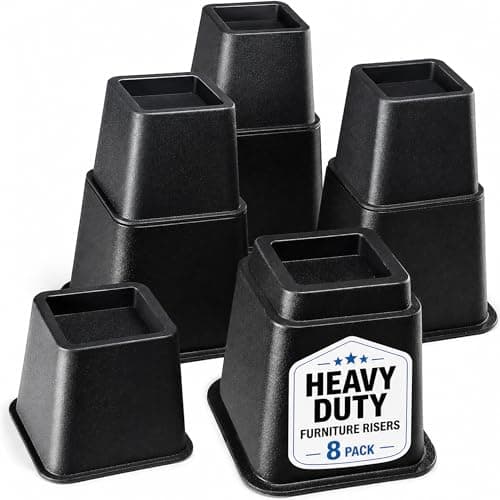
| Rank1 |  Utopia Bedding Adjustable Bed Risers, 3 & 5 in Finest published steps | Key spec3 or 5 inLift | Score8.3/10 | |
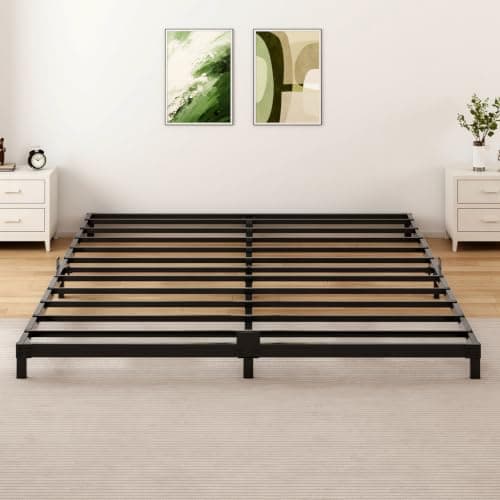
| Rank2 | 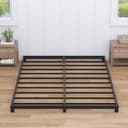 Nailsong 4 Inch Low Profile Bed Frame, Queen Lowest published deck | Key spec4 inDeck height | Score8.8/10 | |
| Rank3 |  Benbuoo 4 Inch Metal Bed Base Leg Replacement, Set of 4 Best way to lower a base | Key spec4 inHeight | Score7.0/10 |
Prices checked September 17, 2026. Scores are our published spec rubric, not a test result — here is exactly how they are calculated.
1 · Finest published steps
Utopia Bedding Adjustable Bed Risers, 3 & 5 in
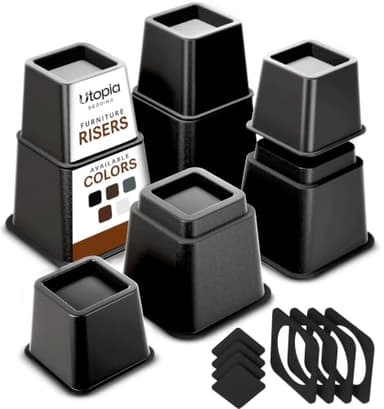
Two heights, the same published 1,300 lb rating, and the only riser here that publishes how deep the socket is.
- Lift
- 3 or 5 in
- Our spec score
- 8.3/10
- Best for
- A small, sure lift
What works
- 1,300 lb published rating in a two-height set
- It publishes a 0.7-inch recessed cup depth and a 2.8-inch leg size — the two figures that decide whether your bed leg actually seats, and the only riser here that prints either
- Most people who need a lift need 3 to 5 inches, not 8 — this covers the common case
What doesn’t
- No single-piece 8-inch option; getting to 8 means stacking, and a stack is always less steady than one piece
- No published material — 'premium materials' is not a specification
- Same caveat as any riser: it raises the bed and the fall
Published specifications
| Lift heights | 3 or 5 inches (stackable to 8) |
|---|---|
| Load rating | 1,300 lb |
| Pack | 4 |
| Material | Not published |
| Socket depth | 0.7 in recessed cup, for legs up to 2.8 in |
Read from the product listing on 2026-08-26. Blanks are specifications the manufacturer does not publish, not figures we could not be bothered to find.
How the score was reached
| Lift rangeTwo published heights, 3 and 5 inches, stackable to 8. | 8 |
|---|---|
| Load rating1,300 lb published for the set. | 9 |
| StabilityA published 0.7 in socket depth and 2.8 in leg fit; material still unnamed. | 8 |
| Set sizeFour-pack — one per bed leg. | 8 |
| Mean, rounded to one decimal | 8.3 |
2 · Lowest published deck
Nailsong 4 Inch Low Profile Bed Frame, Queen
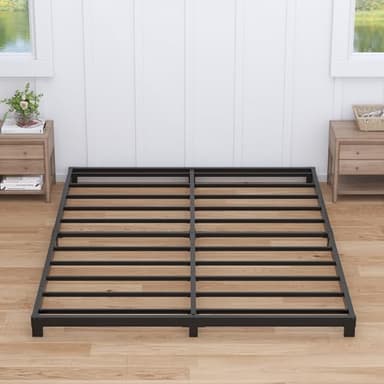
Four inches is the lowest deck we found published, and this is the only frame here that says how many legs carry the load — nine of them.
- Deck height
- 4 in
- Our spec score
- 8.8/10
- Best for
- The thickest mattress
What works
- The lowest published deck on this page at 4 inches, which is the frame to reach for when the mattress is 14 inches or more and the bed is currently too tall
- Nine reinforced legs published — the only frame here that states how many points carry the load, and the middle of a queen frame is exactly where a cheap frame sags
- 3,000 lb published and anti-slip foot pads, at the low end of this page's price range
What doesn’t
- Neither the frame weight nor an assembly time is published, so you cannot plan the delivery or the afternoon around it
- Nothing published to stop the mattress sliding, and a 4-inch deck gives it very little edge to catch on
- Four inches is low enough to be the wrong answer for most people. Under a 12-inch mattress this bed finishes at 16 inches
Published specifications
| Deck height | 4 inches |
|---|---|
| Frame dimensions | 79.5" L x 59.5" W x 4" H, for an 80 x 60 in mattress |
| Under-bed clearance | Not published |
| Load rating | 3,000 lb |
| Leg design | Slats, side rails and reinforced legs |
| Leg count | 9 reinforced legs |
| Slat spacing | Not published |
| Floor protection | Anti-slip foot pads |
| Mattress retention | Not published |
| Assembly | Tools, hardware and installation manual included |
| Frame weight | Not published |
| Sizes listed | Queen |
| Warranty | Not published |
Read from the product listing on 2026-08-28. Blanks are specifications the manufacturer does not publish, not figures we could not be bothered to find.
How the score was reached
| Deck height publishedDeck height and full frame dimensions published; no under-bed clearance. | 9 |
|---|---|
| Load rating3,000 lb published — the top band on /methodology. | 10 |
| Stability and floor contactTwo of the four: a published leg count and anti-slip foot pads. | 8 |
| Handling and assemblyTools and hardware included; neither a frame weight nor an assembly time is published. | 8 |
| Mean, rounded to one decimal | 8.8 |
3 · Best way to lower a base
Benbuoo 4 Inch Metal Bed Base Leg Replacement, Set of 4
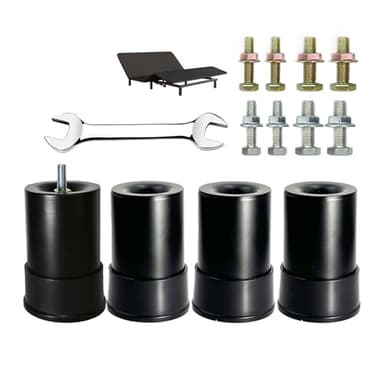
The only entry here that makes a bed lower rather than higher, and the only one that puts a wrench in the box.
- Height
- 4 in
- Our spec score
- 7.0/10
- Best for
- Taking height off a base
As of September 17, 2026. #ad How we’re funded
What works
- Four inches is the only published height on this page that goes DOWN, and a base that is too tall is a real problem this category otherwise ignores entirely
- A wrench in the box — the only set here that includes the tool, which matters when the job is done kneeling beside a bed you have just propped up
- Four threads named at two diameters, and the listing names the exact M12 screw to search for if yours turns out to be the odd size rather than leaving you guessing
What doesn’t
- Four legs, not six. Queen and king adjustable bases commonly stand on six, and this listing does not say which frames it is counting — count your own legs before ordering, because two short is two short
- No load rating and nothing published about the foot that meets the floor
- Its compatibility headline is a bare percentage — compatible with 90 percent of frameworks — with nothing behind it. The named thread list underneath is the useful part; the percentage is not a specification
Published specifications
| Heights published | 4 inches, fixed |
|---|---|
| How the height changes | It does not — the listing states the height is fixed |
| Threads named | M8, M10, 5/16 in and 3/8 in, at 8 mm and 10 mm diameters |
| Adapter bolts included | Four thread types supplied; an M12 screw is sold separately and named |
| Screw length | Not published |
| Load rating | Not published |
| Floor protection | Not published |
| Joint security | Anti-slip bolts published as securing the top structure against loosening |
| Leg diameter | 2.36 inches (listing item dimensions) |
| Set size | 4 legs |
| Tool included | Wrench |
| Assembly time | Not published |
| Warranty | Not published |
Read from the product listing on 2026-09-15. Blanks are specifications the manufacturer does not publish, not figures we could not be bothered to find.
How the score was reached
| Heights from one boxOne published height, stated as fixed. | 6 |
|---|---|
| Thread compatibilityFour threads named at two diameters, with the out-of-range M12 route named; no screw length. | 9 |
| Load rating and floor contactA published anti-loosening bolt at the top joint; no load rating and nothing about the floor. | 6 |
| Set size and installationA wrench included, but four legs rather than six, and no assembly time published. | 7 |
| Mean, rounded to one decimal | 7.0 |
The Utopia risers are first for a reason specific to this page: they publish 3 and 5-inch heights and they are the only riser set we track that publishes how deep the socket is, at 0.7 inches for legs up to 2.8 inches. When the bed is going to be pushed sideways every day, how well the leg sits inside the cup is the specification that matters. The Nailsong frame publishes a 4-inch deck, the lowest we found published, which is the tool when a bed with a thick mattress needs to come down to chair height. The Benbuoo legs are the only entry in our leg-extension category that makes a bed lower rather than higher, which is the unusual requirement a wheelchair transfer creates. If you need to go the other way instead, the full riser comparison and the low frame comparison have the rest of the range.
What this page cannot tell you
It cannot tell you how to do the transfer. Technique - where the board goes, which way you lead, how an assistant should stand - is taught by an occupational or physical therapist who can see the actual chair, the actual bed and the actual person, and nothing on this site is a substitute for that. Many transfers also involve equipment this site does not cover at all, including transfer boards and patient lifts, which the Department of Justice guidance names as aids for exactly this move.
What it can tell you is the arithmetic, and the arithmetic is genuinely most of the problem. A bed three inches out from the chair makes every transfer harder for as long as it stays three inches out, and the fix costs less than a takeaway. Measure both surfaces, close the gap with a product that publishes its number, and then have the technique taught by somebody qualified to teach it.
Questions people actually ask
What height should a bed be for a wheelchair transfer?
Level with the wheelchair's own seat, or a fraction below it. A sideways transfer is easiest slightly downhill and hardest uphill, so if the two surfaces cannot be identical, the bed being a touch lower than the chair is the better error. Measure your own chair rather than working from a standard - seat heights vary with the cushion.
Does the ADA specify a bed height?
No. The 2010 ADA Standards address accessible sleeping areas by requiring clear floor space beside the bed, not by setting a height. The only published federal figure in this neighborhood is the one used for dressing room benches, which are required to sit at the height of a typical wheelchair seat, 17 to 19 inches. That is a useful anchor, not a rule for your bedroom.
How do I measure my wheelchair seat height?
Floor to the top of the cushion, with the cushion compressed as it is when you sit on it. Measure at the front edge of the seat rather than at the back, because most cushions slope. Do it with the chair on the bedroom floor surface - carpet changes the answer by a useful amount.
Should the bed be higher or lower than the wheelchair?
Slightly lower, if the two cannot match. Sliding down a small step is easier and more controlled than lifting yourself up one. The difference should stay small: a large drop is its own hazard, and the board or the person assisting has to bridge it.
How do I change the bed's height to match the chair?
Risers under the legs raise an ordinary frame by a published amount, shorter legs or a low-deck frame bring one down, and on a motorized base the legs themselves are usually the adjustment. Measure the gap first and change the bed by the difference - how to measure what you have.
Sources
Every factual claim on this page traces to one of these, or to a product listing cited in the specification table beside it.
Read next
Guide
Best Bed Height for Seniors
A calculator that shows its working, because the right answer depends on your legs and not on an average.
Guide
Measuring Your Bed
Two minutes, one tape measure, and the mistake nearly everyone makes with a soft mattress.
Comparison
Best Low Bed Frames
Deck height plus mattress thickness is the whole decision. Six frames from 4 to 7 inches, scored on what each one actually publishes.
Our top pick — Samhapyrom 6 Inch Low Profile Bed Frame, Queen
$85.99 · Check priceAs of September 17, 2026. #ad How we’re funded
Comparison
Best Bed Risers
The cheapest fix in this subject, scored on the two specs that matter: how much lift, and how much load.
Our top pick — Home It Adjustable Bed Risers, 3/5/8 in
Guide
Getting Up With a Walker
The walker is not a handhold for standing up - AAOS says so plainly. What to push from instead, and why the bed's height does most of the work.
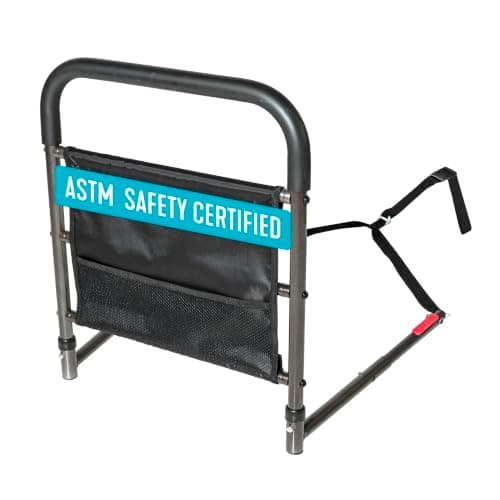
Our top pick — Able Life Bedside Safety Handle
$49.99 · Check priceAs of September 17, 2026. #ad How we’re funded

Nothing here is medical advice. Prices are pulled live and stamped with the date they were checked; scores are our published spec rubric, not a test result. How we pick · How we make money · Corrections