Guide
Getting out of bed with a walker
The walker is not a handhold for standing up - AAOS says so plainly. What to push from instead, and why the bed's height does most of the work.
By Stephen V.Published How we pick
Most guidance about walkers covers walking. The hard part, for a lot of people, is the ten seconds before the walking starts: getting from lying down to standing, in the dark, with a walking frame parked somewhere nearby that must not be leaned on. This page is about those ten seconds - what the sequence should be, what the bed needs to be, and the small number of things worth buying.
The one rule everything else follows from
Push yourself up using the strength of your arms and grasp the walker's handgrips. Do not pull on or tilt the walker to help you stand up.
That instruction is written for standing up from a chair, and it applies with more force at the edge of a bed, because a mattress gives way under your hand and a chair arm does not. A walker is a stability aid for when you are already upright. It is not an anchor. Wheeled walkers roll away from you when you pull; standard walkers tilt toward you. Both turn a controlled stand into an uncontrolled one, and both do it at the exact moment your weight is furthest forward.
So the whole problem becomes: what do you push down on instead? There are only three honest answers - the mattress, the bed frame, or something fixed beside the bed that was put there for the purpose. The first two are unreliable, because a soft mattress edge sinks under a pushing hand and most bed frames give you nothing at the right height. The third is a product, and it is a cheap one.
The sequence, in order
This is the general sequence taught for a log-roll exit, which is the one most physical therapists teach because it keeps the spine from twisting. Your own therapist may teach you something different for your own reasons, and if so, theirs wins.
- Park the walker before you get in, not before you get out. It should be on the side you leave from, within reach from sitting, brakes on, and not directly in the path your feet will take. Deciding this at bedtime is easier than deciding it half asleep.
- Roll onto your side, facing the edge. Knees bent, arms in front of you. Shoulders and hips turn together rather than one at a time.
- Drop your legs, push your torso up. The legs swinging down and the arms pushing up happen together - the weight of the legs does some of the work of lifting the upper body. Push into the mattress with the lower elbow and then the hand.
- Sit on the edge and stop. Feet flat on the floor, both hands resting beside you. Wait for any lightheadedness to pass; standing up too fast after lying down is a common reason older adults fall, and it costs nothing to wait fifteen seconds.
- Stand by pushing down, from the bed or from a fixed handle beside it - never by pulling on the walker.
- Take the walker last. Once you are upright and steady, reach for the handgrips. All four feet or wheels stay on the floor as you move it.
What to look for in a handhold
Before any product, the criteria - because the right thing to buy falls out of these, and because a walker user has one requirement that changes the answer.
- It must be fixed, and it must be at the right height. You are pushing down on it from sitting, so it needs to be solid at roughly hand height beside your hip. A padded grip is not a luxury for anyone with arthritic hands.
- It must not be in the walker's way. This is the requirement that rules things out. A full-length guard rail occupies the side of the bed you are trying to stand and turn in. A compact stand-assist handle occupies about a foot of it.
- The load rating has to be published. Every assist handle and rail we track publishes one except the Stander, and the figures run from 300 to 400 pounds. A handhold whose rating is not published is a handhold you are guessing about at the worst possible moment.
- A light is worth more than it sounds. Most bedroom falls happen on the way to the bathroom in the dark. A motion-activated light on the handhold means the floor is lit before your feet reach it - and for a walker user, seeing where the walker actually is matters as much as seeing the floor.
- Check the mattress-thickness range. Every one of these products publishes one and they are narrow. A rail or handle outside its stated range is not merely loose, it is a fitting the manufacturer has told you not to make - the measurements.
The three things worth buying
In the order they solve the problem: something fixed to push from, the right bed height, and light. Live prices and full specifications follow.
| # | Pick | Key spec | Score | Price |
|---|---|---|---|---|
| Rank1 | 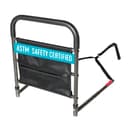 Able Life Bedside Safety Handle Best to push up from | Key specStand assistType | Score8.0/10 | |
| Rank2 | 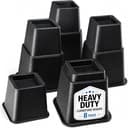 Home It Adjustable Bed Risers, 3/5/8 in Best way to fix the height | Key spec3, 5 or 8 inLift | Score8.5/10 | |
| Rank3 | 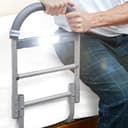 Lunderg Bed Assist Rail with Motion-Activated Light Best lit handhold | Key specMotion-activatedLight | Score8.0/10 |
Prices checked September 17, 2026. Scores are our published spec rubric, not a test result — here is exactly how they are calculated.
1 · Best to push up from
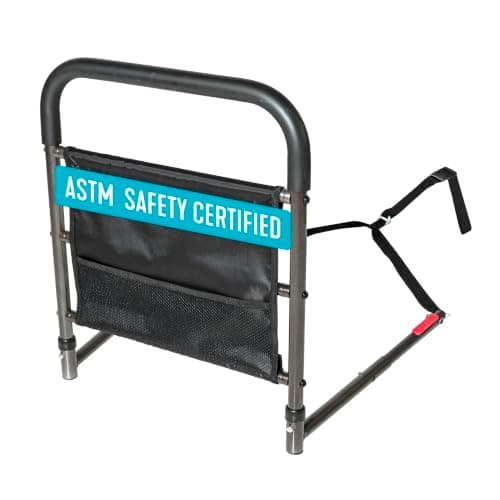
Able Life Bedside Safety Handle
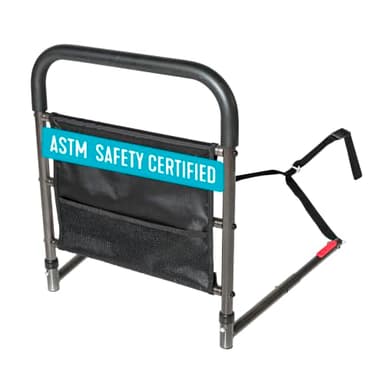
A padded stand-assist handle rather than a guard rail — the right tool if the problem is standing up, not rolling out.
- Type
- Stand assist
- Our spec score
- 8.0/10
- Best for
- Standing up, not staying in
As of September 17, 2026. #ad How we’re funded
What works
- Height adjustable, so the grip can sit where your hand naturally reaches from sitting
- Padded grip, which matters if arthritis makes a bare steel tube unpleasant to hold hard
- A published 300 lb load rating and a published fit across king, queen, full and twin
What doesn’t
- It is a handle, not a rail. It will not stop anyone rolling out of bed, and it is not meant to
- 300 lb is the lowest published rating of the rails here, and standing up loads a handle harder than sitting on it does
- No light, and the listing rules out adjustable beds and extra-soft mattresses
Published specifications
| Type | Stand-assist handle (not a full-length guard rail) |
|---|---|
| Standard claimed | ASTM safety approved |
| Height adjustable | Yes |
| Padding | Padded grip |
| Load rating | 300 lb |
| Fits | King, queen, full and twin beds; mattresses 6–14 in thick |
| Light | Not published |
Read from the product listing on 2026-08-26. Blanks are specifications the manufacturer does not publish, not figures we could not be bothered to find.
How the score was reached
| Standard complianceASTM compliance stated on the listing. | 9 |
|---|---|
| Grip and reachHeight adjustable with a published padded grip. | 9 |
| Load rating300 lb published — the lowest published figure of the rails here. | 8 |
| FitKing, queen, full and twin all published, with a 6–14 in mattress window. | 9 |
| Night useNo light published — neutral score. | 5 |
| Mean, rounded to one decimal | 8.0 |
2 · Best way to fix the height
Home It Adjustable Bed Risers, 3/5/8 in
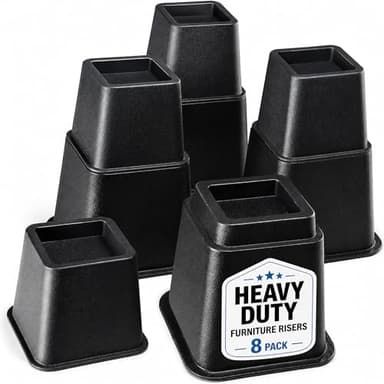
Three published lift heights from one set and a published 1,300 lb rating — the most flexible way to test a height before committing to it.
- Lift
- 3, 5 or 8 in
- Our spec score
- 8.5/10
- Best for
- Trying a height first
What works
- Three heights out of one box, so you can try 3 inches, decide it is not enough, and go to 5 without buying twice
- A published 1,300 lb rating for the set, and a published material — polypropylene, not an unnamed plastic
- Cheap enough that testing a height costs less than being wrong about one
What doesn’t
- Stacked risers are less stable than a single-piece riser of the same height — stack at your own judgment
- No published socket depth, and socket depth is what decides whether your bed leg actually sits in it
- Raising a bed raises the fall distance. Height helps you stand; it does not help you land
Published specifications
| Lift heights | 3, 5 or 8 inches (stackable) |
|---|---|
| Load rating | 1,300 lb |
| Pack | 4 |
| Material | Polypropylene |
| Socket depth | Not published |
Read from the product listing on 2026-08-26. Blanks are specifications the manufacturer does not publish, not figures we could not be bothered to find.
How the score was reached
| Lift rangeThree published heights from 3 to 8 inches. | 10 |
|---|---|
| Load rating1,300 lb published for the set. | 9 |
| StabilityPolypropylene with a broad base published; stackable by design, and no socket depth. | 7 |
| Set sizeFour-pack — one per bed leg. | 8 |
| Mean, rounded to one decimal | 8.5 |
3 · Best lit handhold
Lunderg Bed Assist Rail with Motion-Activated Light
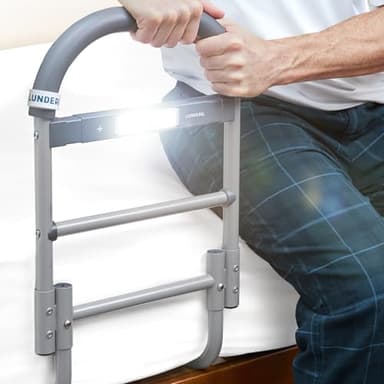
The motion light is the feature. Most bedroom falls happen on the way to the bathroom in the dark, and this one lights the floor as you reach for it.
- Light
- Motion-activated
- Our spec score
- 8.0/10
- Best for
- The 3am bathroom trip
As of September 17, 2026. #ad How we’re funded
What works
- A motion-activated light on the thing you were already going to grab — no switch to find in the dark
- A published non-slip grab bar and a 300 lb load rating, load-tested on a steel frame with four stabilizing bars
- Marketed for post-surgery use, which is often when a rail is a temporary need rather than a permanent one
What doesn’t
- The listing does not state ASTM compliance, and for an adult portable bed rail that is now a legal requirement worth confirming with the seller. It is the only rail here that names no standard at all
- No published height adjustment, so the grip sits where it sits
- The listing rules out adjustable beds, so this is not the rail for a motorized base
Published specifications
| Light | Motion-activated |
|---|---|
| Type | Bed assist rail with non-slip grab bar |
| Standard claimed | Not published |
| Load rating | 300 lb, load-tested |
| Height adjustable | Not published |
| Fits | Twin to king, mattresses 7–13 in thick; not adjustable beds |
Read from the product listing on 2026-08-26. Blanks are specifications the manufacturer does not publish, not figures we could not be bothered to find.
How the score was reached
| Standard complianceNo standard stated on the listing — neutral score. | 5 |
|---|---|
| Grip and reachNon-slip grab bar published; no height adjustment stated. | 8 |
| Load rating300 lb published and described as load-tested. | 8 |
| FitTwin to king with a 7–13 in mattress window published; adjustable beds excluded. | 9 |
| Night useMotion-activated light published — the top band. | 10 |
| Mean, rounded to one decimal | 8.0 |
The stand-assist handle is first because it is the direct answer to the AAOS instruction: it gives you the fixed thing to push down on that the walker must not be. Its listing publishes a 300 lb load rating, a padded grip, height adjustment and a 6 to 14 inch mattress range, which is the widest fit range of anything we track in this category. The risers are second because a bed at the wrong height makes every technique on this page harder, and three published lift heights in one set means you can find the right one rather than commit to a guess. The Lunderg rail is third and is here for its motion light; it is a fuller structure than the handle, so check it against what a rail is and is not for before choosing it over the stand aid.
The rest of the room
The AAOS list of home modifications for walking-aid users is short and it is mostly about the floor: remove throw rugs, electrical cords, food spills and anything else that may cause you to fall. For a walker that advice is sharper than it is for a cane, because a walker needs a clear rectangle of floor rather than a clear line, and it catches on things a foot would step over. Clear a path wide enough for the frame from the bed to the bathroom door, and check it at night with the lights as they will actually be.
Two more things worth doing on the same afternoon. Check the walker's own height - AAOS says the top of the walker should reach the crease in your wrist when you stand up straight, with elbows slightly bent - because a walker set too low bends you forward over it, which is its own fall risk. And walk the route from bed to bathroom with the walker while somebody is watching, because the obstacle nobody notices is almost always in the doorway. The full bedroom checklist covers the rest of it, and it is free.
Questions people actually ask
How do you get out of bed with a walker?
Roll onto your side, push your torso up with your arms while your legs swing down, sit on the edge until any dizziness passes, then stand by pushing down on the bed or a fixed handle - not by pulling on the walker. The AAOS is explicit: do not pull on or tilt the walker to help you stand up. Take the walker's handgrips only once you are already up.
Why should you not pull yourself up on a walker?
Because it is not anchored. A walker on wheels rolls away and a walker on tips tilts toward you, and either one turns a controlled stand into a fall. The AAOS instruction is to push yourself up using the strength of your arms and grasp the handgrips afterwards. That is why a fixed handhold beside the bed matters so much for a walker user.
What height should the bed be if you use a walker?
The same target as everybody else: the top of the mattress at roughly your own lower-leg length, floor to the back of the knee when you sit with both feet flat. A walker does not change the arithmetic, it raises the stakes on getting it right - because standing from a too-low bed means the first second of the stand happens before your hands reach anything. Run the numbers.
How should the walker be positioned overnight?
Within reach from sitting on the edge of the bed, on the side you get out of, with the brakes on if it has them, and not where you would step into it in the dark. A walker parked just out of reach is the reason people reach, overbalance and fall, and a walker parked directly in the path is the thing they trip on.
Is a bed rail or an assist handle better with a walker?
Usually a stand-assist handle. You need something fixed to push down on for one second while you rise and reach the walker, which is exactly what a stand aid is for. A full-length guard rail is designed to stop a roll-out, a different problem. Rail versus assist handle compares the two properly.
Sources
Every factual claim on this page traces to one of these, or to a product listing cited in the specification table beside it.
Read next
Comparison
Best Assist Handles
If the difficulty is standing up rather than staying in, this is the product you actually want.
Our top pick — Able Life Bedside Safety Handle
$49.99 · Check priceAs of September 17, 2026. #ad How we’re funded
Head to head
Rail vs Assist Handle
Two products, one search term, completely different jobs. Most people searching for the first one need the second.
Guide
Best Bed Height for Seniors
A calculator that shows its working, because the right answer depends on your legs and not on an average.
Guide
Fall Prevention Checklist
Most of what prevents a bedroom fall is free, dull, and never bought. Here is the list, grounded in the CDC's own falls guidance.
Guide
Wheelchair Transfer Height
A sideways transfer works best when the two surfaces are level. The ADA never set a bed height, but it did publish what a typical wheelchair seat is.
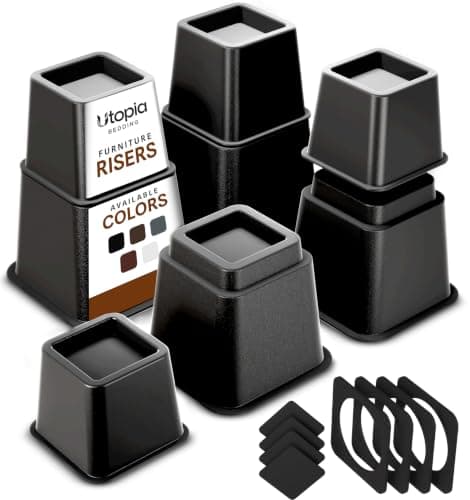
Our top pick — Utopia Bedding Adjustable Bed Risers, 3 & 5 in



Nothing here is medical advice. Prices are pulled live and stamped with the date they were checked; scores are our published spec rubric, not a test result. How we pick · How we make money · Corrections