Single review
YrHeiper bed assist rail review
The floor leg is the feature. Read on what the listing publishes — and on the beds it rules out.
By Stephen V.Published Updated How we pick
We earn a commission if you buy through the links on this page, at no extra cost to you. It does not change what we recommend, and we have not tested these products — here is what we do instead.
We rank this one as the most stable underfoot in our main bed rails comparison and the best floor-supported option in the rails-for-adjustable-beds guide, and the reason is a single piece of design: it has a floor-standing support leg. That is the feature that answers the most common complaint people have about bed rails — the wobble.
1 · A rail that does not wobble
YrHeiper Bed Assist Rail with Support Leg
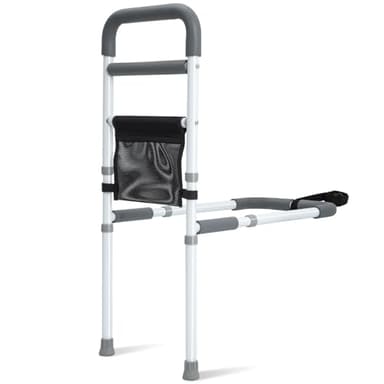
A floor-standing support leg takes the load off the mattress edge, which is the failure people describe when a rail feels wobbly.
- Support
- Floor leg
- Our spec score
- 8.2/10
- Best for
- A rail that does not wobble
As of September 22, 2026. #ad How we’re funded
What works
- A support leg that reaches the floor, so your weight goes into the carpet rather than into the mattress edge
- It names ASTM F3186-17 — the standard 16 CFR part 1270 made mandatory — and publishes a 350 lb load rating
- Storage pouch, which is where the remote and the glasses end up whether you plan it or not
What doesn’t
- The listing contradicts itself on height adjustment: one bullet says to adjust the height, another says no adjustment is needed. Ask before you buy if the grip height matters to you
- Not compatible with adjustable or recessed bed frames — the listing rules both out
- A floor leg is one more thing to catch a foot on getting out; position it deliberately
Published specifications
| Support leg | Yes — floor-standing support leg |
|---|---|
| Adjustable | Listing is inconsistent — one bullet says the height adjusts, another says no adjustment is needed |
| Standard claimed | ASTM F3186-17, named on the listing |
| Load rating | 350 lb |
| Storage pouch | Yes |
| Fits | King, queen, full and twin; mattresses 7.9–13 in; not adjustable or recessed frames |
| Light | Not published |
Read from the product listing on 2026-08-26. Blanks are specifications the manufacturer does not publish, not figures we could not be bothered to find.
How the score was reached
| Standard complianceNames ASTM F3186-17 specifically — the standard 16 CFR part 1270 made mandatory — not a generic ASTM claim. | 10 |
|---|---|
| Grip and reachFloor-standing support leg published; the listing contradicts itself on height adjustment. | 8 |
| Load rating350 lb published. | 9 |
| FitFour bed sizes and a 7.9–13 in mattress window published; adjustable and recessed frames excluded. | 9 |
| Night useNo light published — neutral score. | 5 |
| Mean, rounded to one decimal | 8.2 |
The case for it
The support leg is the whole argument, and it is a good one. A conventional portable rail anchors by sliding a plate under the mattress and relying on your body weight to hold it down, so all of the load ends up going into the soft edge of the mattress — which is exactly why a rail can feel like it flexes when you pull on it hardest, at the moment you are half-standing and most need it not to. A leg that reaches the floor sends your weight into the carpet instead, and that changes how solid the rail feels under a real pull. That is the mechanical argument, and it holds. What does not follow from it is a recommendation for an adjustable base: the listing rules out adjustable and recessed bed frames outright, so whatever the floor leg does for stability, this is not the rail the manufacturer will stand behind on a bed that bends.
Two more published features back it up. The height is adjustable, so the grip can be set where your hand actually falls rather than where a box designer guessed, and the listing publishes its fit across four bed sizes — king, queen, full and twin — which is more than several rivals manage. There is a storage pouch too, easy to dismiss until you notice it is where the glasses, the phone and the water end up anyway; hung on the rail you are already holding, it keeps the night trip to one task instead of three.
The case against it
The reservation is a compatibility one rather than a documentation one. The listing rules out adjustable and recessed bed frames. On a site about adjustable beds that is the sentence that matters, and the seller states it plainly, so it is not a gap for you to fill — it is an answer, and the answer is no. The second reservation is smaller but odd: the listing contradicts itself on height adjustment, telling you in one bullet to adjust the height and in another that no adjustment is needed. If the grip height is the thing you are buying for, settle that with the seller first. And the leg itself carries a small cost of its own: it is one more thing on the floor beside the bed to catch a foot on getting out, so it has to be positioned deliberately, not just wherever it lands.
The support leg, in practical terms
It is worth being precise about what the leg does and does not do, because it is the reason to buy this over a plain plate-anchored rail. What it does: it gives the rail a second load path, into the floor, so the grip feels solid under the sideways-and-down pull of someone pushing up to stand — the moment a plate-only rail feels least reassuring. What it does not do: it does not turn the rail into a full-length guard, it does not remove the entrapment checks, and it does not override the listing's own exclusion of adjustable and recessed frames. It also adds a fixed obstacle in the exact strip of floor you step into when you get out of bed, so the sensible setup is to place the leg where your feet do not go — slightly forward of where you stand, not directly under it. Position it once, deliberately, and confirm you can get out of bed without stepping over it in the dark.
How it scores
On our rubric this is one of the better-documented rails we track. Standard compliance scores at the top of the band, because the listing names ASTM F3186-17 rather than gesturing at a generic badge, and load rating scores high on the published 350 lb. Fit scores well on four published bed sizes and a 7.9 to 13 inch mattress window — with the exclusions counted honestly, because a stated incompatibility is information, not a blank. Grip and reach loses a point to the listing's own contradiction about height adjustment, and night use sits at the neutral middle for the plain reason that no light is published. The block above shows every score with its one-line reason, and the full rubric is here.
What we could not verify
- Whether the height actually adjusts. The listing says both that it does and that no adjustment is needed, and we cannot resolve that from the page.
- Whether the ASTM F3186-17 claim was independently tested or self-declared. The standard is named; the testing body is not.
- How much of the load the floor leg actually carries. The leg is published; its share of the 350 lb is not.
- Any light for night use. None published.
- Long-term stability of the adjustable leg under repeated daily use — no manufacturer in this category publishes a cycle rating, and we will not estimate one.
How it compares in the category
Against the other rails we track, the YrHeiper's profile is the mirror image of the Stander EZ Adjust: the Stander states a generic ASTM claim but publishes no load rating, while this one names the exact standard and publishes 350 lb. If your priority is a rail that does not flex when you lean on it on a conventional flat frame, this is the one. If your bed is an adjustable base, it is not — this listing excludes them, and the Click-N-Go is the only rail we track that names adjustable frames at all. Because it is really a bedside support rather than a full-length guard, it is also worth reading against rail versus assist handle — a floor-supported grip has more in common with a handle than with a barrier, and that is a point in its favor if standing up, not rolling out, is your actual problem. The full roundup sets them side by side with live prices.
Fitting it
As with any bedside support, position beats hardware. Sit on the edge of the bed the way you actually do, feet flat, and set the height so the grip is where your hand falls as you begin to push up — usually further forward and lower than people first place it. Then plant the floor leg where your feet will not meet it on the way out. The 350 lb rating is published, but load-test it anyway before you rely on it: lean your weight on it, standing beside the bed, and confirm nothing shifts. And measure the gaps between the rail and the mattress with the mattress compressed — the leg changes how the rail sits, so do not assume the gaps match a plate-only rail. The full fitting sequence is here.
Who should buy it
Someone on a conventional flat frame whose main complaint about bed rails is that they wobble, who wants the reassurance of a support that reaches the floor, and who will position that leg so it is not a trip hazard on the way out. It is not the pick if your bed is an adjustable base or a recessed frame — the listing excludes both, and the Click-N-Go is the only rail we track that names adjustable frames. And it is the wrong tool entirely for someone who might climb over a rail, which who should not use one covers in full.
Questions people actually ask
Does the YrHeiper bed rail wobble?
It is built specifically to address that. A floor-standing support leg sends your weight into the floor rather than into the soft mattress edge, which is the flex people describe when a plate-anchored rail feels wobbly under a hard pull. We have not tested it, but the design targets the right failure.
Is the YrHeiper bed rail ASTM approved?
The listing names ASTM F3186-17 specifically — the standard the CPSC made mandatory for adult portable bed rails on 21 August 2023 under 16 CFR part 1270. Naming the exact standard is stronger than a generic "ASTM approved" badge, because it tells you which test the claim refers to.
How much weight does the YrHeiper hold?
The listing publishes 350 lb for the heavy-duty frame and stabilizing leg. That is the second-highest published figure of the rails we track, behind the Lesamediio's 400 lb.
What bed sizes does the YrHeiper fit?
The listing publishes fit across king, queen, full and twin, and the height is adjustable. Confirm the floor leg reaches your floor cleanly on the frame and mattress height you actually have.
Is the floor support leg a trip hazard?
It can be if you place it carelessly. A leg on the floor beside the bed is one more thing to catch a foot on getting out, so position it slightly forward of where you stand rather than directly in your path, and check you can get out of bed without stepping over it in the dark.
Sources
Every factual claim on this page traces to one of these, or to a product listing cited in the specification table beside it.
Read next
Comparison
Best Bed Rails
Scored on whether the listing states compliance with the standard that became federal law in 2023 — and four other things.
Our top pick — Lesamediio HC035 Bed Assist Rail
$69.99 · Check priceAs of September 22, 2026. #ad How we’re funded
Guide
Bed Rail Safety
The federal rule, the seven entrapment zones, and the measurements to take on your own bed. The page to read before you buy anything.
Guide
Fitting a Bed Rail
Fitting takes twenty minutes. The measuring afterwards is the part that decides whether it is safe.
Head to head
Rail vs Assist Handle
Two products, one search term, completely different jobs. Most people searching for the first one need the second.



Nothing here is medical advice. Prices are pulled live and stamped with the date they were checked; scores are our published spec rubric, not a test result. How we pick · How we make money · Corrections