Guide
Fitting a bed rail safely
Fitting takes twenty minutes. The measuring afterwards is the part that decides whether it is safe.
By Stephen V.Published Updated How we pick
Fitting a bed rail is not difficult. Fitting one and then confirming it is actually safe on your bed, with your mattress, takes a tape measure and about ten more minutes — and it is the part that matters. Here is the sequence.
Before you start
- Have the instructions, a tape measure, and a second person if the rail is heavy.
- Strip the bed to the fitted sheet. You need to see where the mattress actually meets the frame.
- Check the mattress fills the frame with no gap at the sides. If there is already a gap there, adding a rail does not fix it — it puts a barrier over it.
- Read the safety page if you have not. The measurements below make far more sense once you know what they are for.
Fitting
- Position the rail where it is useful, not where it is easy. Sit on the edge of the bed as you actually do. The rail should be where your hand falls, and — if it is a full-length rail — should cover the length of your torso, not the whole mattress.
- Anchor exactly as instructed. If a plate goes under the mattress, it goes under the mattress, not under the fitted sheet. If straps are supplied, use them; they are not optional packaging.
- Tighten fully, then load it. Put real weight on the rail — lean on it hard, standing beside the bed. Anything that shifts now will shift at 3am.
- Set any height adjustment before measuring, not after. Changing the height changes every gap you are about to measure.
Measuring, which is the actual job
Compare each measurement against the FDA's dimensional guidance. Take every one with the mattress compressed — press down firmly beside the rail with your free hand, the way a sleeping body would — because an empty mattress measures a gap that does not exist in use.
| Measure | Where | Should be |
|---|---|---|
| Inside the rail | Between the rail's own bars | Under 4¾ in (120 mm) |
| Under the rail | Between the rail's supports | Under 4¾ in (120 mm) |
| Rail to mattress | The vertical gap, mattress compressed | Under 4¾ in (120 mm) |
| Under the rail ends | At each end of the rail | Under 2⅜ in (60 mm) |
The extra checks for an adjustable base
Every gap you just measured is a measurement of the bed lying flat. An adjustable base does not spend the evening lying flat.
- Raise the head to its steepest angle and re-measure all four gaps.
- Raise the foot section and re-measure.
- Return to flat and check the rail has not shifted or bound.
- Confirm the rail does not obstruct the deck reaching flat. If the bed cannot lie flat with the rail fitted, the rail is wrong for that bed.
Rails for adjustable beds explains why the anchoring method is the root of most of these problems and which designs avoid it.
Re-check it later
Put a note somewhere. Re-measure after any mattress change, after any new mattress topper — a 3-inch topper changes the rail-to-mattress relationship completely, and can push the stack past the depth window the rail publishes — and every few months regardless. Mattresses soften, and a gap that was fine when the rail went on can grow without anyone deciding anything.
And re-check the height while you are there. The bed being at a workable height is what makes a rail a handhold rather than a lifeline. The measuring guide is here.
Questions people actually ask
How do you install a bed rail?
Follow the manufacturer's instructions exactly, then measure the gaps between rail, mattress and frame with the mattress compressed. Fitting is the easy part; the measuring afterwards is what decides whether the installation is safe.
What gap is safe between a bed rail and the mattress?
FDA guidance for the zone between rail and mattress is under 120 mm, about 4¾ inches, measured with the mattress compressed as it would be under a person. Under the rail at its ends the figure is tighter: under 60 mm, about 2⅜ inches.
How often should you re-check a bed rail?
After any change to the mattress, the bedding or the frame, and periodically anyway. Mattresses soften. A gap that measured correctly when the mattress was new can open up over a couple of years without anyone noticing.
Do I need tools to fit a bed rail?
Most portable rails are tool-free by design. If a rail needs the frame drilled or modified, that is a different class of product and a different level of commitment — check the warranty on your bed first.
Sources
Every factual claim on this page traces to one of these, or to a product listing cited in the specification table beside it.
Read next
Guide
Bed Rail Safety
The federal rule, the seven entrapment zones, and the measurements to take on your own bed. The page to read before you buy anything.
Comparison
Best Bed Rails
Scored on whether the listing states compliance with the standard that became federal law in 2023 — and four other things.
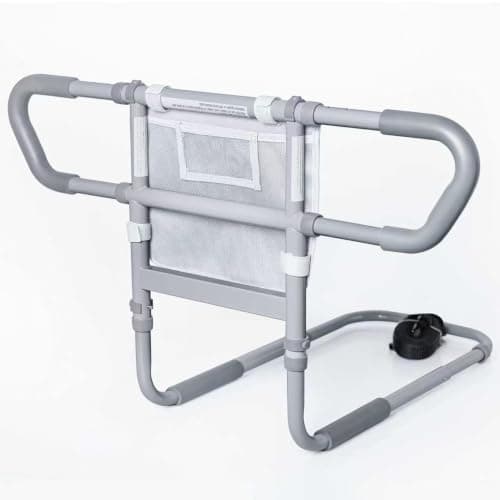
Our top pick — Lesamediio HC035 Bed Assist Rail
$69.99 · Check priceAs of October 20, 2026. #ad How we’re funded
Comparison
Rails for Adjustable Beds
The compatibility question everyone asks and almost no listing answers. Here is what to check before you order.
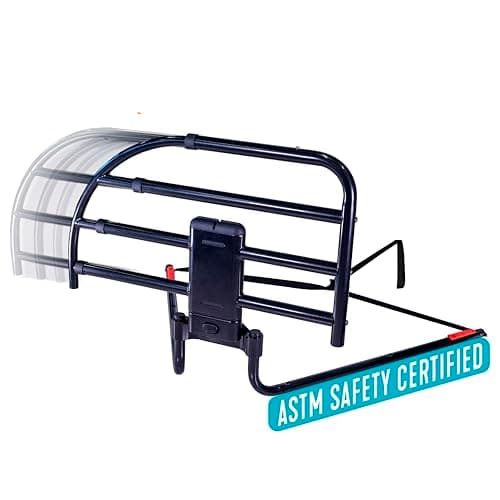
Our top pick — Able Life Click-N-Go Extendable Bed Rail
$159.99 · Check priceAs of October 20, 2026. #ad How we’re funded
Guide
Firmness and Edge Support
Firmness labels are marketing. Edge support is the specification that decides whether you can get up, and nobody publishes it.


Nothing here is medical advice. Prices are pulled live and stamped with the date they were checked; scores are our published spec rubric, not a test result. How we pick · How we make money · Corrections