Guide
Who should not use a bed rail
Four situations where a rail makes things worse, and the alternatives that work better in each.
By Stephen V.Published Updated How we pick
Most pages about bed rails are written to sell one. This one exists because there are situations where the right answer is no rail, and a reader in one of those situations is not served by a product grid.
1. Someone who might climb over it
This is the most important item on the page. If a person gets up at night while confused, disoriented, or simply determined, a rail does not stop them — it changes the route. Instead of sitting up and swinging their legs out at mattress height, they go over the top of a barrier and land from higher up, often awkwardly, often headfirst.
This applies to dementia, to delirium after an illness or an operation, to some medication effects, and to anyone who is simply not fully awake when they decide to get up. The rail has to be understood to be useful.
Instead: lower the bed rather than fence it. A lower sleep surface makes both the getting-up and the falling shorter. Floor beds and fall risk covers the trade-off honestly, because a very low bed is harder to stand up from and that is a real cost.
2. Someone who cannot reposition themselves
The entrapment risk the FDA documents is largely a risk of being unable to get out of a gap you have slid into. Someone with the strength and mobility to push themselves away from a rail is at much lower risk than someone who cannot.
If a person cannot reliably reposition without help, a rail is not the tool. That is a situation to raise with a clinician, and it is often the situation in which a hospital bed — where the rails, mattress and frame are engineered together as a system — is the right answer rather than a consumer rail on an ordinary bed.
3. Any bed where the gaps do not measure up
This is not about the person at all. If the mattress is soft, undersized for the frame, or older and compressed at the edges, the gap between mattress and rail can exceed the FDA's guidance the moment weight goes on it. The rail may be perfectly compliant; the combination is not.
Instead: fix the mattress, or do not fit the rail. A firm-edged mattress that fills the frame is the precondition, not an upgrade. Firmness for seniors explains why edge support matters here beyond comfort.
4. Someone who does not want one
Worth saying plainly. A rail on the bed of an adult who has not agreed to it is a decision made about them rather than with them, and it tends to be resisted in ways that make everything less safe — climbing over it, sleeping in a chair instead, not mentioning a fall. If the rail is contentious, the conversation is the intervention, and an occupational therapist is usually better at it than a family member.
What to use instead
Depending on what the actual problem is:
- Difficulty standing up — an assist handle, positioned where the hand falls from sitting. Smaller, cheaper, no entrapment length.
- The bed is the wrong height — work out the target and fix it. This is the single most under-used fix in the whole subject.
- Getting up in the dark — a light within reach of the bed, or a rail-mounted motion light. The CDC's falls guidance is about the environment as much as the person.
- A carer needs to know — a bed exit alarm, with the caveat below.
About bed exit alarms
An alarm is not a safety device for the person in the bed. It is a notification for somebody else. If there is nobody in the house to notify, it does nothing but make a noise at the person who just got up — which can startle them mid-transfer, which is the opposite of what anyone wanted.
1 · A caregiver in the same room · we would skip this one
Smart Caregiver Bed Alarm for Elderly Adults (BB45-SYS)
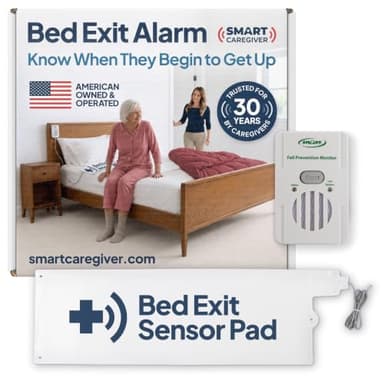
The in-room version, and the only bed alarm we track whose alarm sounds at the person getting up. CMS names an alarm audible to the person as something that can act as a physical restraint, and this listing sells the pager as a separate add-on kit.
- Alarm
- 80 dB in-room
- Our spec score
- 5.8/10
- Best for
- A caregiver in the same room
As of October 20, 2026. #ad How we’re funded
What works
- The simplest form of the product — a pad, a cord and a monitor, with nothing to pair, configure or keep on a network
- Low-battery and sensor status lights, so you can tell at a glance that it is still working, and a reset button that silences it without unplugging anything
- A published one-year warranty and a sealed, wipe-clean pad, from a company that has made only this category for decades
What doesn’t
- The alarm sounds in the room at 80 dB. CMS guidance describes a position change alarm audible to the person as something that can have the effect of a physical restraint, and an alarm going off mid-transfer can startle someone into the fall you were trying to prevent
- The pager that fixes that is an add-on kit sold separately, so the version most people should own costs more than the sticker on this one
- No sensor pad life published, and the monitor is corded to the pad, so the cord runs across the floor beside a bed where someone is getting up in the dark
Published specifications
| Where the alert goes | In-room monitor, corded to the pad |
|---|---|
| Sensor pad | 10 x 30 in vinyl, foam interior, sealed for incontinence |
| Pad placement | Under the shoulder blades or hips |
| Published range | Not published |
| Alarm volume | 80 dB, two volume levels |
| Batteries | One 9 V, included; AC-02 adapter sold separately |
| Sensor pad life | Not published |
| Expandable with | Optional wireless pager add-on kit, sold separately |
| Warranty | 1 year manufacturer |
Read from the product listing on 2026-08-28. Blanks are specifications the manufacturer does not publish, not figures we could not be bothered to find.
How the score was reached
| Where the alert landsThe alarm sounds in the room at a published 80 dB; a pager is only an add-on kit sold separately. | 3 |
|---|---|
| How early it firesPad placement published, with the alarm sounding as pressure is removed. | 8 |
| Published rangeA corded monitor at the bedside — there is no wireless range to publish. | 5 |
| Running costs disclosedA one-year warranty and an included battery are published; no sensor pad life is. | 6 |
| ExpandabilityAn optional wireless pager kit is named; no supported sensor count is published. | 7 |
| Mean, rounded to one decimal | 5.8 |
If the point is to alert someone elsewhere in the house, buy the version with a wireless pager rather than the in-room version above. We have listed the simplest model because it is the one most people find first, and because the distinction between the two is exactly the sort of thing a product page will not spell out for you. We scored six bed alarms on exactly that distinction, including what CMS says about an alarm the person in the bed can hear. Where the reason a rail is ruled out is dementia, the alternative is not only an alarm but a system that will also cover the bedroom door, because wandering rather than the bedside is the real risk — what to buy for dementia care.
If the bed is in a care facility rather than a house, the decision is not only clinical — it is regulated, and the rule puts alternatives, an entrapment assessment and informed consent ahead of installation. Are bed rails allowed in nursing homes.
Questions people actually ask
Should someone with dementia use a bed rail?
Usually not. A person who does not understand why the rail is there may try to climb over it, and going over a rail turns a low roll-out into a fall from a greater height. This is a decision to make with a clinician who knows the person, not from a website.
Are bed rails considered a restraint?
They can be. If a rail is there to stop someone getting out of bed rather than to help them, that is functionally a restraint, and in care settings it is treated as one with all the assessment that implies. At home the label matters less than the question behind it: is this helping the person, or containing them?
What can I use instead of a bed rail?
Depending on the problem: an assist handle for standing up, a lower bed or a floor mattress for someone at risk of climbing over, a bed exit alarm to alert a carer, better lighting, and a bed set to the right height. Several of those cost nothing.
Is a bed alarm better than a rail?
It is different, not better. An alarm does nothing for the person in the bed — it tells someone else that they have got up. It is the right product only if there is someone to tell. We scored the alarms, and the evidence that they prevent falls is weaker than the marketing suggests.
Sources
Every factual claim on this page traces to one of these, or to a product listing cited in the specification table beside it.
Read next
Guide
Bed Rail Safety
The federal rule, the seven entrapment zones, and the measurements to take on your own bed. The page to read before you buy anything.
Comparison
Best Assist Handles
If the difficulty is standing up rather than staying in, this is the product you actually want.
Our top pick — Able Life Bedside Safety Handle
$49.99 · Check priceAs of October 20, 2026. #ad How we’re funded
Guide
Floor Beds and Fall Risk
Lowering a bed shortens the fall and makes standing up harder. Both halves of that are true, and the choice is real.
Head to head
Rail vs Assist Handle
Two products, one search term, completely different jobs. Most people searching for the first one need the second.



Nothing here is medical advice. Prices are pulled live and stamped with the date they were checked; scores are our published spec rubric, not a test result. How we pick · How we make money · Corrections