Guide
Bed elevation angles explained
Thirty degrees is not a wedge height and a wedge height is not an angle. Here is the arithmetic that connects them.
By Stephen V.Published Updated How we pick
This subject is full of numbers used loosely: 30 degrees, 7 inches, 10 inches, half a brick. They describe different things and cannot be compared without doing a little arithmetic, so here it is, once, in a place you can come back to.
Degrees and inches are not interchangeable
An angle only becomes a height when you know how long the thing being tilted is. Raise the end of a 30-inch section by 15 inches and you have a 30-degree incline. Raise the end of a 12-inch wedge by the same 15 inches and you have something you would fall off.
| Incline | Over a 12 in section | Over a 24 in section | Over a 30 in section |
|---|---|---|---|
| 7° | 1.5 in | 2.9 in | 3.7 in |
| 10° | 2.1 in | 4.2 in | 5.2 in |
| 15° | 3.1 in | 6.2 in | 7.8 in |
| 20° | 4.1 in | 8.2 in | 10.3 in |
| 30° | 6.0 in | 12.0 in | 15.0 in |
| 45° | 8.5 in | 17.0 in | 21.2 in |
The arithmetic is rise = length × sin(angle), rounded here to one decimal. You can check every cell with a calculator, which is rather the point of publishing the table instead of an assertion.
What this means for a wedge pillow
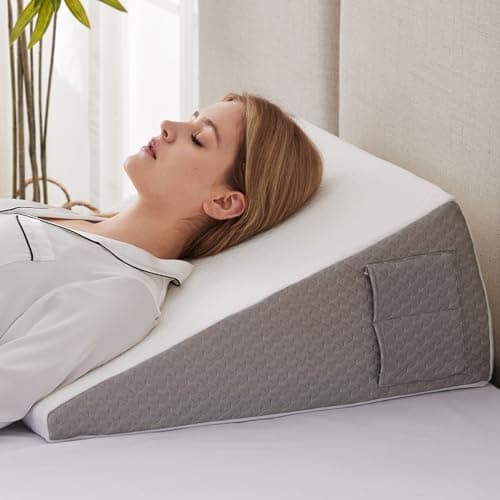
A wedge's advertised height is its rise at the tall end. Its angle depends on how long it is, and most listings do not publish the length. Two wedges both described as 10 inches can present completely different slopes.
Practically: a longer, shallower wedge supports the whole torso and is more comfortable to sleep on; a shorter, steeper one raises you more sharply and is easier to slide down. When a listing gives you only one number, that number is the rise. The wedges we track publish their heights, and we say so where the length is not published rather than calculating an angle from data we do not have.
What it means on an adjustable base
A base's head section is typically somewhere between two and two and a half feet long, so the numbers in the middle and right columns above are the relevant ones. A modest-looking 20-degree incline lifts the top of the head section by eight to ten inches — considerably more than a stack of pillows achieves, and applied along the whole torso rather than at the neck.
None of the bases in our comparison publish their maximum head angle in degrees. If you want to know what yours does, lay a phone with a level app on the deck at full incline. It takes ten seconds and it turns every number in every article into something concrete.
Where 30 degrees came from
It is a Medicare coverage threshold. Coverage determination L33820 includes, among the criteria for a hospital bed, a beneficiary who requires the head of the bed elevated more than 30 degrees most of the time due to congestive heart failure, chronic pulmonary disease, or problems with aspiration.
It has been repeated so often in consumer articles that it now reads as a clinical recommendation for anyone with heartburn. It is not. It is the line at which a particular funding body considers a particular piece of equipment justified for particular diagnoses. If you are pursuing coverage it matters a great deal, and our Medicare page sets out the criteria properly.
Getting to those angles on a bed with no motor is mostly a matter of risers under two legs or a wedge on the mattress. How to raise the head of a bed, safely has the inches-to-degrees arithmetic, the four riser sets we track, and the load figure none of their listings publishes.
One elevation claim in this category has no angle attached to it at all. The anti-snore preset is published by four of the fourteen bases we track, and not one of the four states the angle the button drives to. The snoring page.
Questions people actually ask
How many inches is a 30 degree bed elevation?
It depends entirely on the length of the section being raised, which is why the question has no single answer. Over a 30-inch torso section, a 30-degree incline lifts the top end by about 15 inches. Over a shorter wedge it is much less.
What angle is a 7 inch wedge pillow?
It depends on how long the wedge is. A 7.5-inch rise over a 24-inch base is roughly 18 degrees; the same rise over a 12-inch base is much steeper. A wedge's height alone does not tell you its angle, which is why we publish both when a listing gives them.
Where does the 30 degree figure come from?
Medicare's coverage criteria for hospital beds. Coverage determination L33820 references a beneficiary requiring the head of the bed elevated more than 30 degrees most of the time for certain conditions. It is a funding threshold, not a universal clinical target.
How do I measure the angle of my adjustable bed?
A phone's level or inclinometer app laid on the raised deck will tell you within a degree or two. It is worth doing once so that the numbers in articles mean something concrete on your own bed.
Sources
Every factual claim on this page traces to one of these, or to a product listing cited in the specification table beside it.
Read next
Comparison
Acid Reflux
Start with the cheap answer. If it works you will know within a week, and only then is a base worth considering.
Our top pick — Ruqmuis Bed Wedge Pillow, 10 in
Guide
Sleep Positions
Every position, what it changes, and how to test each one tonight with pillows before you spend anything.
Head to head
Wedge vs Adjustable Bed
One costs a fraction of the other. The cheap one wins more often than a site funded by product links is supposed to say.
Guide
Medicare Coverage
No. It can cover a hospital bed, and here are the actual criteria, quoted, with the codes and what you would pay.


Nothing here is medical advice. Prices are pulled live and stamped with the date they were checked; scores are our published spec rubric, not a test result. How we pick · How we make money · Corrections