Guide
Raising the head of a bed
Six inches at the head of an 80-inch bed is roughly a four-degree tilt. Here is how to get it with risers, a wedge or a motor, and the load figure no riser listing publishes.
By Stephen V.Published How we pick
The verdict first: if you want the head of the bed up by a specific number of inches, the thing to buy is the Home It riser set — it publishes three lift heights from one box, 3, 5 or 8 inches, and a 1,300 lb rating across its four pieces. Put the risers under the two legs at the head end and the whole bed tilts, which is what six inches of head elevation actually means. If you only want to find out whether the angle helps, try a wedge pillow first and spend a twentieth of the money.
This page is about raising the head END of a bed. If what you want is the whole bed higher, that is a different job, and if the bed is already on an adjustable base, the motor has probably made this page unnecessary.
The arithmetic, because it is small
A standard queen or king is 80 inches long. Lift one end by six inches and the surface sits at roughly four degrees to the floor — six over eighty. Eight inches gets you to about five and a half degrees. Those are small numbers and they are the right ones: the point of head elevation is to keep the stomach below the oesophagus overnight, and a four-degree tilt does that while a pile of pillows does not, because pillows bend the neck and leave the torso flat.
The practical consequence is that precision matters more here than it looks. Going from five inches to eight is a fifty per cent change in the angle, and that is the difference between a tilt you notice and one you do not. Published lift heights, rather than "a few inches of blocks", are the reason to buy risers rather than improvise with books.
Three ways to get the rise
| Method | What moves | Published range | The catch |
|---|---|---|---|
| Risers under the head legs | The whole bed tilts | 3, 5 or 8 in per set; two sets stack to 8 | No listing names head-end-only use |
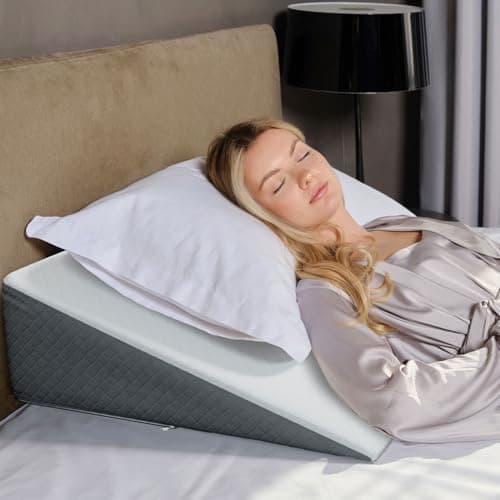
| Wedge pillow on the mattress | Your torso bends | 7.5 in and 10 in rises published | You can slide off it |
| Powered head section | The head section of the deck | Head lift published by 13 of 14 bases | Costs ten to thirty times as much |
| Extra pillows | Your neck only | Nothing published, ever | Bends the neck, leaves the torso flat |
What the four riser sets publish
| Riser | Lift | Published load (set of four) | Floor or leg detail published |
|---|---|---|---|
| Home It | 3, 5 or 8 in, stackable | 1,300 lb | None published |
| Utopia Bedding | 3 or 5 in, stackable to 8 | 1,300 lb | 0.7 in cup, for legs up to 2.8 in |
| MYMULIKE | 8 in, single piece | 6,000 lb | 5.5 x 5.5 in contact area |
| Apipi | 8 in, single piece | 3,000 lb | Polypropylene, internally reinforced |
What we would buy
Pick by what you are trying to settle. If the question is "what rise do I actually want", buy the set that gives you three answers. If the rise is settled and it is eight inches, buy the single piece that publishes the most load. If the question is "does elevation help me at all", buy the wedge and keep the receipt.
| # | Pick | Key spec | Score | Price |
|---|---|---|---|---|
| Rank1 |  Home It Adjustable Bed Risers, 3/5/8 in Best for dialling in the rise | Key spec3, 5 or 8 inLift | Score8.5/10 | |
| Rank2 |  MYMULIKE Bed Risers, 8 in Oversized Strongest published single piece | Key spec8 inLift | Score8.3/10 | |
| Rank3 |  Kolbs Bed Wedge Pillow, 7.5 in Cheapest way to test the angle | Key spec7.5 inRise | Score8.8/10 |
Prices checked October 16, 2026. Scores are our published spec rubric, not a test result — here is exactly how they are calculated.
1 · Best for dialling in the rise
Home It Adjustable Bed Risers, 3/5/8 in
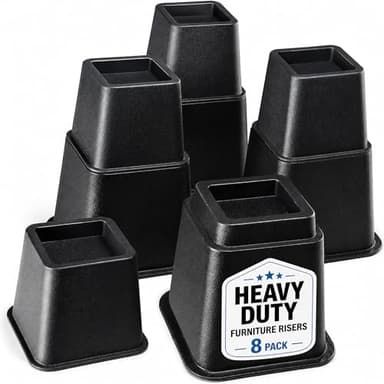
Three published lift heights from one set and a published 1,300 lb rating — the most flexible way to test a height before committing to it.
- Lift
- 3, 5 or 8 in
- Our spec score
- 8.5/10
- Best for
- Trying a height first
What works
- Three heights out of one box, so you can try 3 inches, decide it is not enough, and go to 5 without buying twice
- A published 1,300 lb rating for the set, and a published material — polypropylene, not an unnamed plastic
- Cheap enough that testing a height costs less than being wrong about one
What doesn’t
- Stacked risers are less stable than a single-piece riser of the same height — stack at your own judgment
- No published socket depth, and socket depth is what decides whether your bed leg actually sits in it
- Raising a bed raises the fall distance. Height helps you stand; it does not help you land
Published specifications
| Lift heights | 3, 5 or 8 inches (stackable) |
|---|---|
| Load rating | 1,300 lb |
| Pack | 4 |
| Material | Polypropylene |
| Socket depth | Not published |
Read from the product listing on 2026-08-26. Blanks are specifications the manufacturer does not publish, not figures we could not be bothered to find.
How the score was reached
| Lift rangeThree published heights from 3 to 8 inches. | 10 |
|---|---|
| Load rating1,300 lb published for the set. | 9 |
| StabilityPolypropylene with a broad base published; stackable by design, and no socket depth. | 7 |
| Set sizeFour-pack — one per bed leg. | 8 |
| Mean, rounded to one decimal | 8.5 |
2 · Strongest published single piece
MYMULIKE Bed Risers, 8 in Oversized
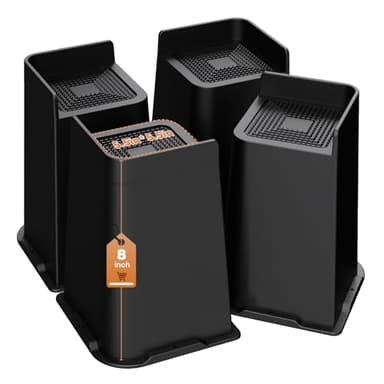
The highest published load rating in this set by a wide margin, in a single-piece 8-inch riser — no stacking.
- Lift
- 8 in
- Our spec score
- 8.3/10
- Best for
- A big lift, unstacked
What works
- One piece at 8 inches — no stack to work loose
- A published 6,000 lb rating, which is far beyond anything a bed will ask of it
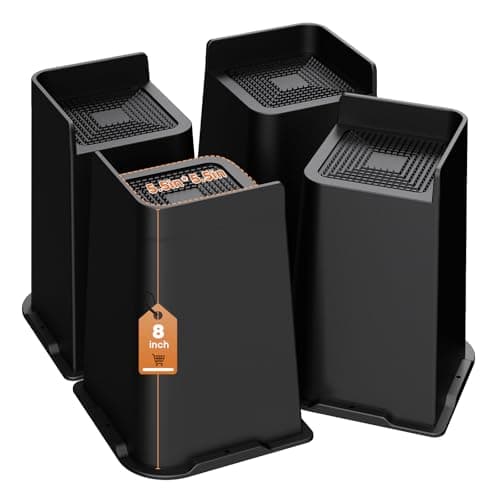
- A published 5.5 by 5.5 inch top surface — the figure that decides whether it tips, and one almost no riser listing prints
What doesn’t
- 8 inches only. If that is too much you are buying a different set
- Eight inches is a large change. Measure before you buy — most people need far less than they think
- No published socket depth
Published specifications
| Lift heights | 8 inches (single piece) |
|---|---|
| Load rating | 6,000 lb |
| Pack | 4 |
| Top surface | 5.5 × 5.5 in contact area |
| Socket depth | Not published |
Read from the product listing on 2026-08-26. Blanks are specifications the manufacturer does not publish, not figures we could not be bothered to find.
How the score was reached
| Lift rangeOne published height only, 8 inches. | 6 |
|---|---|
| Load rating6,000 lb published — the top band. | 10 |
| StabilitySingle-piece construction with a published 5.5 × 5.5 in top surface. | 9 |
| Set sizeFour-pack — one per bed leg. | 8 |
| Mean, rounded to one decimal | 8.3 |
3 · Cheapest way to test the angle
Kolbs Bed Wedge Pillow, 7.5 in
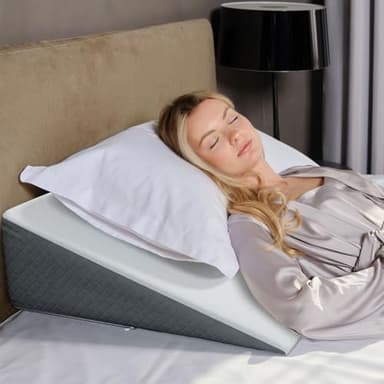
A published 7.5-inch rise and a published FSA eligibility, at roughly one twentieth of what a base costs.
- Rise
- 7.5 in
- Our spec score
- 8.8/10
- Best for
- Trying elevation cheaply
What works
- If the problem is reflux, this is the thing to try before a base — and CMS itself points people at elevation before equipment
- FSA eligibility is published, which turns a $36 pillow into a pre-tax $36 pillow
- It publishes what is inside it: a 1.5-inch memory foam top layer over a high-density foam core, on a removable machine-washable cover
What doesn’t
- A wedge raises your chest, not the whole bed. It does nothing at all for getting out of bed
- 7.5 inches is a modest rise; some people need more angle than this gives
- The foam densities themselves are not published, so how much the core will sag over a year is still a guess
Published specifications
| Height | 7.5 inches |
|---|---|
| Width | Standard |
| FSA eligible | Yes (stated on the listing) |
| Cover | Jacquard, removable and machine washable |
| Fill | 1.5 in memory foam over a high-density foam core |
Read from the product listing on 2026-08-26. Blanks are specifications the manufacturer does not publish, not figures we could not be bothered to find.
How the score was reached
| Rise published7.5-inch height published. | 9 |
|---|---|
| CoverageStandard width stated; no length or torso-coverage figure. | 6 |
| Cover and careA removable, machine-washable jacquard cover and a published two-layer fill. | 10 |
| Cost of tryingFSA-eligible and an order of magnitude below a base. | 10 |
| Mean, rounded to one decimal | 8.8 |
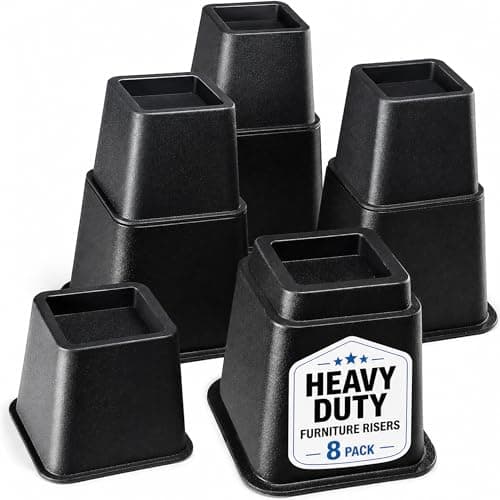
Home It — for working out the number. Three published lifts from one purchase, 3, 5 or 8 inches, stackable, with a published 1,300 lb rating across four risers. That makes it the cheapest way to test two or three angles over a fortnight before settling. It publishes nothing about socket depth or the surface that meets the floor, which is the category's standard blank.
MYMULIKE 8-inch — for a settled eight inches. A single-piece 8-inch riser with the highest published load rating of anything we track at 6,000 lb per set, and a published 5.5 by 5.5-inch contact area — the only riser here that tells you how much of it meets the floor. Single-piece matters at this height: there is no joint between two stacked halves to work loose. No socket depth published.
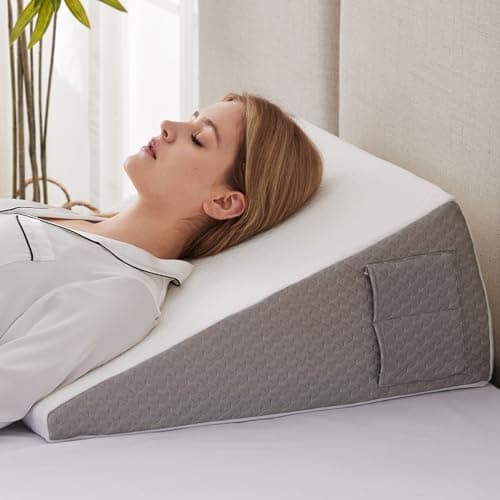
Kolbs 7.5-inch wedge — for finding out whether the angle helps at all. A published 7.5 inches of rise, memory foam over a high-density core, a washable jacquard cover, and a stated FSA eligibility, at roughly a twentieth of what a powered base costs. It raises your torso rather than tilting the bed, so it is also the option that does not affect anyone else in the bed. Both wedges we track.
Four checks after you raise it
- Push the bed, hard, from the side. A bed on risers at one end is a bed with a new centre of gravity. If it rocks or walks, come down an increment.
- Re-measure the sitting edge. Risers raise the edge you stand up from as well as the head of the bed. Feet flat, knees level or just below the hips is still the target.
- Re-check any bed rail. A tilted mattress changes the gaps a rail was fitted against, and gaps are the entrapment mechanism the FDA guidance below is about. The fitting checks, and whether risers and rails can be used together.
- Watch the mattress for a week. A tilted deck gives a mattress a reason to travel that a flat one does not. How to stop a mattress sliding.
If elevation turns out to be something you want every night, and you want to be able to change it from inside the bed rather than from the floor, that is the argument for a powered base rather than for more risers. Thirteen of the fourteen bases we track publish a head lift, and seven of those publish the angle it reaches. What to look for when buying one.
The riser and wedge figures above were read from live Amazon listings on the dates stamped in their own specification tables, and the blanks are reported as blanks. The six-inches-is-four-degrees arithmetic is geometry, flagged as reasoning rather than a measurement. Nothing here is medical advice: if reflux or breathing is the reason you are raising the bed, the elevation figure to use is the one your clinician gives you. How we pick.
Questions people actually ask
How do you raise the head of a bed?
Three ways, in rising order of cost. Put risers under the two legs at the head end, which tilts the whole bed and keeps the mattress flat. Put a wedge on top of the mattress, which raises your torso and leaves the bed alone. Or use a base with a motor, which raises the head section only and is the one option you can change from lying down. Which is right depends on whether you want the bed tilted or your body bent.
How many inches should I raise the head of my bed?
The figure usually quoted for reflux is six to eight inches at the head end, and both of those are achievable with the risers we track — 3, 5 and 8-inch lifts are published across the four sets. What matters is that the elevation is a tilt of the whole surface rather than a stack of pillows, because pillows bend the neck and leave the torso flat. What the angles actually work out to.
What is six inches of rise in degrees?
About four degrees on a standard 80-inch bed — six inches of rise over 80 inches of length. That sounds like almost nothing and it is not: a four-degree tilt is enough to keep the stomach below the oesophagus, which is the whole mechanism. It is also why an inch or two makes a noticeable difference at this end of the scale, and why guessing is worse than measuring.
Can I put bed risers under just two legs?
People do it constantly, and no riser listing we have read names the practice either way. That is the honest answer: all four riser sets we track publish a load rating for a set of four, none publishes a per-riser figure, and none addresses using two. If you do it, use the lowest rise that works, check the bed cannot walk off the risers, and never stack two risers to reach a height a single piece could have given you. Bed riser weight limits, in detail.
Is a wedge pillow as good as raising the bed?
It is different, not worse. A wedge raises your torso from where it bends rather than tilting the whole surface, so it is the better answer if someone shares the bed and does not want the tilt, and the worse answer if you move around at night — you can slide off a wedge, and you cannot slide off a bed on risers. The cheapest way to find out which you prefer is to try the wedge first. Wedge pillow versus adjustable bed.
Does raising the head of the bed make it harder to get out of?
Raising the head end with risers raises the whole bed, including the edge you sit on to stand up, which can be a bonus or a problem depending on your height. Measure the sitting edge afterwards: feet flat on the floor and knees level with or just below the hips is the target either way. How to measure bed height from the floor.
Sources
Every factual claim on this page traces to one of these, or to a product listing cited in the specification table beside it.
Read next
Guide
Elevation Angles
Thirty degrees is not a wedge height and a wedge height is not an angle. Here is the arithmetic that connects them.
Comparison
Acid Reflux
Start with the cheap answer. If it works you will know within a week, and only then is a base worth considering.
Our top pick — Ruqmuis Bed Wedge Pillow, 10 in
$38.99 · Check priceAs of October 16, 2026. #ad How we’re funded
Comparison
Best Bed Risers
The cheapest fix in this subject, scored on the two specs that matter: how much lift, and how much load.
Our top pick — Home It Adjustable Bed Risers, 3/5/8 in
Guide
Riser Weight Limits
The published ratings run from 1,300 lb to 6,000 lb for a set of four, which is several times anything a bed asks for. The real limits are stacking, socket depth and tipping.
Our top pick — MYMULIKE Bed Risers, 8 in Oversized
Comparison
Best Wedge Pillows
The cheapest way to sleep on an incline — scored on published rise, coverage and cover, with the one thing a fixed ramp can never do.
Our top pick — Kolbs Bed Wedge Pillow, 7.5 in
Guide
Raising an Adjustable Bed
Four ways to fix a base that sits too low, in order of how safe they are on a motorized frame.
Guide
Measuring Your Bed
Two minutes, one tape measure, and the mistake nearly everyone makes with a soft mattress.

Nothing here is medical advice. Prices are pulled live and stamped with the date they were checked; scores are our published spec rubric, not a test result. How we pick · How we make money · Corrections