Guide
Mattress thickness for adjustable beds
Thickness quietly decides three things at once: whether the mattress bends on the base, how high the bed ends up, and how deep a sheet you need.
By Stephen V.Published Updated How we pick
How thick a mattress should be for an adjustable base has two answers that people usually collapse into one. There is the thickness that bends well on the base — a mechanical question — and there is the thickness that puts your sleep surface at the right height and needs the right sheets — a planning question. This page keeps them apart, because the mattress that flexes beautifully can still be two inches too tall to get out of, and the one at the perfect height can still be too stiff to bend.
None of this is about comfort, which is personal and which we do not rank. It is about the two things thickness quietly decides for you: whether the mattress works on the base at all, and how high and how deep the finished bed ends up.
The sweet spot: roughly 8 to 12 inches
For an adjustable base, roughly 8 to 12 inches of flexible foam, or a flexible hybrid, is the range that bends cleanly without fighting the motors. That is not a hard rule — it is where the mattresses that flex well tend to sit — but the reasoning holds at both ends. Go much thicker, past about 14 inches, and the mattress starts to resist the bend: the extra material stiffens the whole slab, the head section rises at a shallower and less useful angle, and on a very thick mattress the base can end up working against the mattress rather than with it. Go much thinner, under about 8 inches, and a different problem appears — a thin mattress can telegraph the gaps and hinges of the base through to your body, so you feel the deck under you. Every mattress we track is 12 inches, which sits at the top of that comfortable band.
Why thickness is a height decision
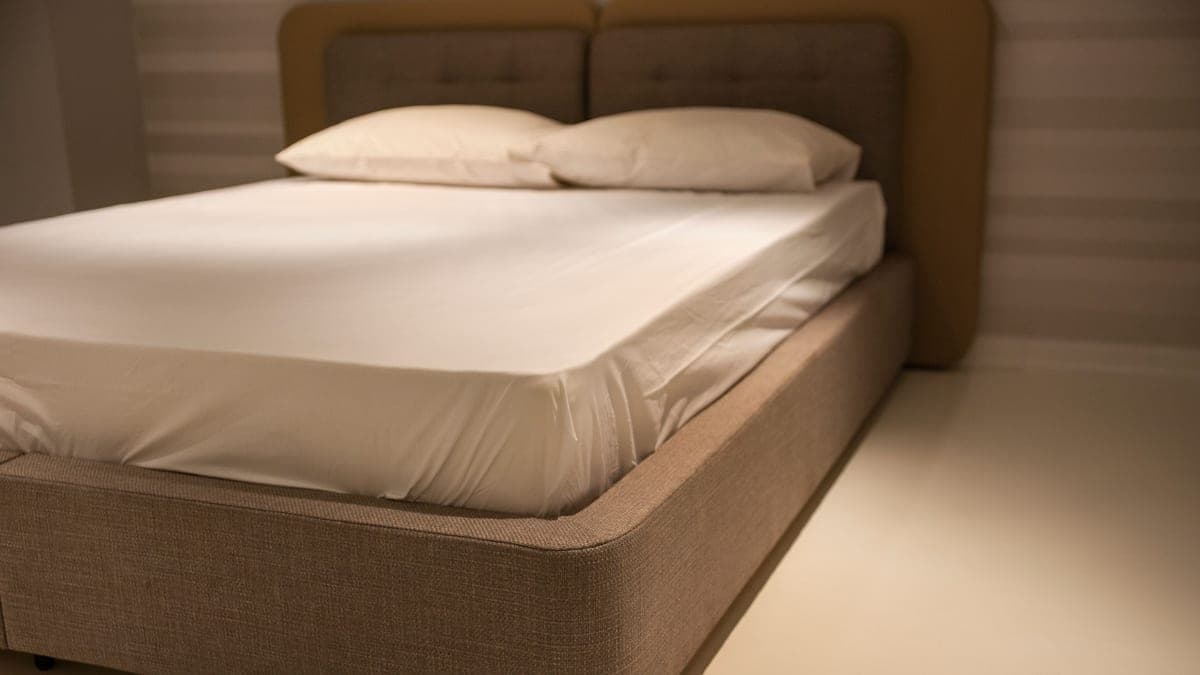
On this site, mattress thickness is more than half of what decides your sleep-surface height, and sleep-surface height is what decides whether you can plant your feet and stand up. The arithmetic is simple: your base or frame height plus the mattress thickness equals the top of the bed. Swap a 10-inch mattress for a 12-inch one and you have just raised the bed two inches without touching the frame — often enough to turn a bed you could leave comfortably into one you cannot, or the reverse. That is why we treat thickness as a height spec first: a thicker mattress is not automatically better, it is simply higher, and higher is only better if you needed the height. Measure your frame, decide your target from the height arithmetic, and let that pick the thickness rather than defaulting to 12 inches because everything is 12 inches. It works in the other direction too: if the mattress is staying and the bed is simply too tall, the low bed frames we track publish decks from 4 to 7 inches, and the right one is your target minus this number.
Why thickness is also a sheet decision
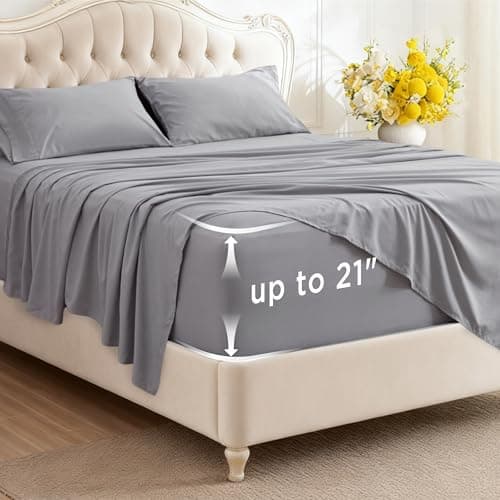
The same number decides your sheets. A fitted sheet has to reach around the full depth of the mattress and tuck under, and on an adjustable base it also has to survive the mattress bending, which stretches it across a longer curve and pulls at the corners. The rule is your mattress thickness plus any topper thickness plus about two inches for the tuck — so a 12-inch mattress wants at least a 14-inch pocket, and a 12-inch mattress under a 3-inch topper wants at least 17. Buy for your real stack, not the deepest number available; a pocket far too deep bunches under the corners just as reliably as one too shallow. The full sheet-sizing table and the anchoring that actually matters go further.
| Mattress thickness | Effect on bed height | Pocket to look for |
|---|---|---|
| 8 in | A lower surface; easier to sit down onto for a taller person | At least 10 in |
| 10 in | A middle-of-the-road height | At least 12 in |
| 12 in | Common today; taller than a generation ago | At least 14 in |
| 12 in + 3 in topper | Three inches higher again | At least 17 in |
| 14 in | Tall; check it still bends usefully | At least 16 in |
Why some mattresses bend and some do not
Thickness sets whether the bend is effective; construction sets whether there is a bend at all. An all-foam mattress has no internal frame to resist folding, so it flexes on any base whether it is 8 or 12 inches. A modern hybrid with pocketed coils usually bends too, because the coils move independently. A traditional innerspring with a rigid perimeter wire often will not, and anything with a wood or steel insert cannot bend and will be damaged by the attempt. This is why every mattress we track is all-foam: foam removes the compatibility question, and thickness then becomes purely a height-and-sheet decision rather than a will-it-even-work one. If you are weighing the constructions against each other, foam versus hybrid is the fuller comparison.
| Construction | At 8 to 12 in | Thicker than about 14 in |
|---|---|---|
| All-foam | Flexes readily | Flexes, but the bend gets shallow |
| Flexible pocket-coil hybrid | Usually flexes | May resist; check first |
| Rigid innerspring / border rod | Often will not bend | Will not bend |
| Wood or steel insert | Does not bend | Does not bend |
Thin mattresses and the gaps underneath
There is a floor as well as a ceiling. A very thin mattress — under about 8 inches — flexes easily, but it can transmit the hard edges of the base through to you: the hinge where the head section meets the middle, the gap between segments, the frame under the foam. On a flat frame that never matters; on a base that folds and unfolds every night, a too-thin mattress can let you feel the deck. The fix is not always a thicker mattress — sometimes it is a thin comfort layer or a topper over a serviceable thin mattress — but it is worth knowing before you decide that thinner is simply lower and therefore safer. Thinner is lower, which is often the goal on this site; but too thin brings its own comfort cost.
How to choose your thickness
- Start from the height you need, not the thickness. Measure your frame or base, decide your target sleep-surface height from the arithmetic, and subtract to find the thickness that lands you there.
- Stay in the 8-to-12-inch band if you can. It flexes well and covers most height targets. Go thicker only if you specifically need the height and have confirmed the mattress still bends usefully.
- Confirm the construction bends. Thickness is moot if the mattress is a rigid innerspring — run the two-minute test or ask the seller in writing.
- Buy the sheets for the finished stack. Mattress plus topper plus two inches, and check the pocket depth before the base arrives, not after the first corner lets go.
- Re-measure after any change. A new mattress, a topper or a different frame all move the surface height, and the height is what decides whether standing up is easy. Edge support decides the rest — why the edge matters.
Questions people actually ask
How thick should a mattress be for an adjustable bed?
Roughly 8 to 12 inches of flexible foam or hybrid flexes cleanly on a base. Thicker than about 14 inches starts to resist the bend; thinner than about 8 can let you feel the base's hinges and gaps. Within that band, let your target bed height pick the exact number.
Is a 12-inch mattress too thick for an adjustable base?
No. Twelve inches sits at the top of the comfortable range and flexes fine if the construction is all-foam or a flexible hybrid. The thing to check with 12 inches is height — it may put your sleep surface higher than you can comfortably get out of. The height arithmetic.
Does mattress thickness change what sheets I need?
Yes. Deeper mattresses need deeper pockets: mattress thickness plus any topper plus about two inches for the tuck. A 12-inch mattress wants at least a 14-inch pocket. The sizing table.
Will a thicker mattress bend on an adjustable base?
Thickness affects how well it bends, not whether it can. A very thick mattress bends at a shallower, less useful angle; a rigid innerspring will not bend at any thickness. Construction decides whether it bends at all — the compatibility test.
Read next
Guide
Base Compatibility
No, and the two-minute test to find out about the one you own — before the base is in the room.
Comparison
Best Mattresses for Seniors
Scored on published height, flex and certification — not on how they feel, because we have not slept on them.
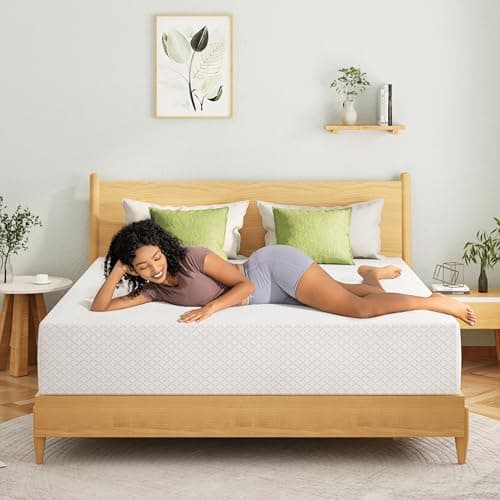
Our top pick — EGOHOME 12 Inch Queen Memory Foam Mattress
$249.99 · Check priceAs of September 22, 2026. #ad How we’re funded
Guide
Firmness and Edge Support
Firmness labels are marketing. Edge support is the specification that decides whether you can get up, and nobody publishes it.
Comparison
Best Sheets
Scored on published pocket depth and anchoring design, because thread count has nothing to do with why your sheet keeps coming off.
Our top pick — Bedsure Deep Pocket Queen Sheet Set
Comparison
Best Low Bed Frames
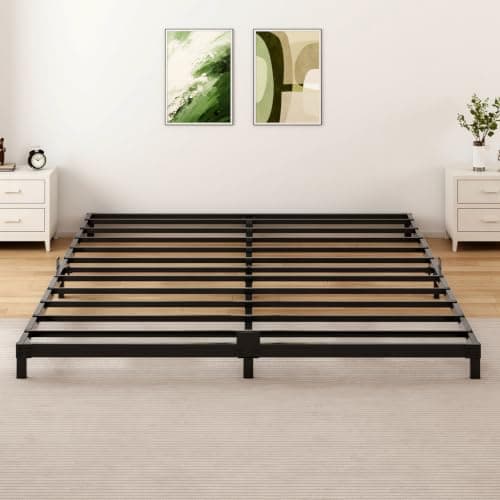
Deck height plus mattress thickness is the whole decision. Six frames from 4 to 7 inches, scored on what each one actually publishes.
Our top pick — Samhapyrom 6 Inch Low Profile Bed Frame, Queen
$85.99 · Check priceAs of September 22, 2026. #ad How we’re funded
Nothing here is medical advice. Prices are pulled live and stamped with the date they were checked; scores are our published spec rubric, not a test result. How we pick · How we make money · Corrections