Guide
Firmness and edge support
Firmness labels are marketing. Edge support is the specification that decides whether you can get up, and nobody publishes it.
By Stephen V.Published Updated How we pick
We do not rank mattresses by firmness, and this page explains why — and what we would look at instead.
Firmness labels are not a measurement
Medium, medium-firm and firm are marketing terms. There is no industry scale behind them and no requirement to be consistent, so one manufacturer's medium firm can be another's firm. A number of retailers publish a one-to-ten scale, but each publishes their own, calibrated by nobody.
That is why our rubric caps firmness disclosure at seven out of ten even for mattresses that state a firmness clearly: they have told you something, and what they told you is not comparable with what anybody else told you. Our full rubric.
Edge support is the spec that matters here
Nearly everything on this site is about getting into and out of bed. That movement happens entirely at the edge of the mattress — you sit on the perimeter, you take your full weight there, and you push up from there. What the middle of the mattress does at that moment is irrelevant.
A mattress with a soft edge does three unhelpful things:
- It lowers your effective bed height by however far you sink — often an inch or two, which is enough to undo a carefully measured setup. Which is why you measure compressed.
- It rolls away under you, so you slide forward as you sit rather than settling, and your feet arrive on the floor before you meant them to.
- It makes a bed rail's gaps worse. A soft edge compresses under and beside a rail, opening the rail-to-mattress gap that the FDA's guidance is about — and a deep mattress may be outside the depth window the rail publishes before softness even enters it.
How to test it yourself
- Sit on the very edge of the mattress, exactly where you get in and out, feet on the floor.
- Notice how far you sink. More than an inch or two and the edge is soft.
- Notice whether you feel pulled forward. If the edge is rolling away under you, that is the failure mode that matters.
- Stand up. If you have to shuffle back onto firmer mattress before you can push up, the edge is not doing its job.
Do this on your current mattress before buying anything. It is a common cause of the complaint people describe as the bed being too low, and if it is the cause, risers will not fix it.
What to do about a soft edge
| Option | Notes |
|---|---|
| A grab handle beside the bed | Lets your arms do what the edge will not. Cheapest real fix |
| Sit further back, then edge forward | Free, and a genuinely useful habit whatever the mattress |
| Turn or rotate the mattress | Free, and buys time if one edge is more worn |
| A topper | Makes it worse, not better. Listed here so you do not try it |
| A new mattress with reinforced perimeter coils | The actual fix, and the most expensive one |
The middle matters too, but differently
Firmness matters most in one sleeping position, and it is the commonest one: on your side, your whole weight lands on the shoulder and the hip with the waist suspended between them. What that does to the choice, and the figure none of these listings publishes.
A dip in the middle of a mattress means you sleep in a hollow and have to climb up out of it to get to the edge. That is a support failure and it is not fixable from above — a topper will follow the dip rather than fill it. The straight-edge test on that page takes thirty seconds and tells you which problem you have.
Questions people actually ask
What mattress firmness is best for seniors?
There is no defensible single answer, because firmness labels are not standardized between manufacturers and there is no published scale behind medium or medium-firm. What does matter measurably is edge support, and no listing publishes that either — but you can test it in a shop in ten seconds.
What is edge support?
How well the perimeter of the mattress holds your weight when you sit on it. Poor edge support means you sink and the edge rolls away under you, which makes standing up harder and sitting down less controlled.
How do I test edge support?
Sit on the very edge as you would when getting out of bed, and see how far you sink and whether you feel like you are sliding forward. If you sink more than an inch or two, the edge is soft.
Is a soft mattress bad for older adults?
Not inherently. What causes problems is a soft or collapsed edge, and a middle that has developed a dip you have to climb out of. Softness in the sleeping surface is a preference; softness at the edge is a functional problem.
Read next
Comparison
Best Mattresses for Seniors
Scored on published height, flex and certification — not on how they feel, because we have not slept on them.
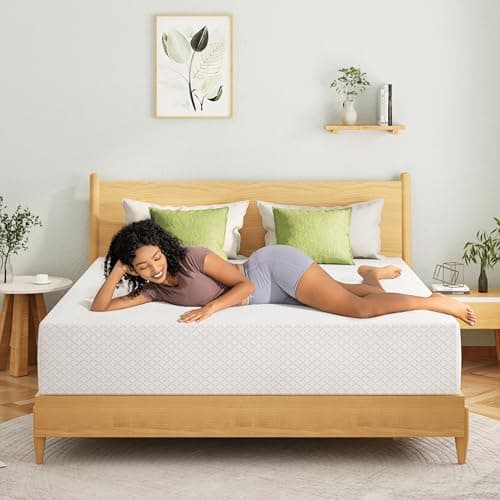
Our top pick — EGOHOME 12 Inch Queen Memory Foam Mattress
$249.99 · Check priceAs of October 21, 2026. #ad How we’re funded
Head to head
Mattress vs Topper
One changes the surface, one changes the support. Three tests tell you which problem you actually have.
Guide
Measuring Your Bed
Two minutes, one tape measure, and the mistake nearly everyone makes with a soft mattress.
Guide
Fitting a Bed Rail
Fitting takes twenty minutes. The measuring afterwards is the part that decides whether it is safe.

Nothing here is medical advice. Prices are pulled live and stamped with the date they were checked; scores are our published spec rubric, not a test result. How we pick · How we make money · Corrections