Guide
Common adjustable bed problems
Almost nothing that fails is the frame. It is the electronics, and every one of them is a part rather than the whole bed. Here is what goes wrong and what to do.
By Stephen V.Published Updated How we pick
Adjustable beds fail in a small number of predictable ways, and almost none of them are the frame. The frame is welded steel and it will outlive you. What fails is the electronics — the remote, the control box, the motors, and the cables between them — and the good news buried in that sentence is that every one of those is a part, not the whole bed. This page runs through what actually goes wrong, in rough order of how often, what you can fix yourself, and when to stop and call the seller.
Start here: is it the bed or the power?
Before you diagnose anything, rule out the boring causes, because most dead-bed calls are one of these and every one of them is free to check.
- Check the wall outlet. Plug a lamp into it. Beds get unplugged by vacuum cleaners and switched-off power strips more often than motors actually die.
- Check the cables at the bed. The lead from the wall to the control box, and the low-voltage leads from the control box to each motor, work loose — especially just after delivery, when a connector was never fully seated. Push each one home.
- Check the battery backup, if it has one. A flat backup battery can confuse some control boards. If there is a battery pack, that is the first consumable to suspect.
- Reset it. Unplug the bed at the wall, wait a full minute, plug it back in. This clears a surprising number of faults, exactly like it does with a router.
The remote
The remote is the part you touch every day, so it is the part that wears out first. Wired remotes fail at the cord, usually where it flexes near the plug; wireless remotes fail at the batteries or lose their pairing with the control box. The symptoms are a bed that responds intermittently, only from certain angles, or not at all while other functions still work.
- Change the batteries first on a wireless remote. It is the cheapest test there is.
- Re-pair it if the maker documents a pairing sequence — many wireless handsets have one, usually a button held during power-up.
- Check the cord on a wired remote by wiggling it at both ends while pressing a button. Intermittent response as you flex the cord means the cord, not the bed.
- Replace the remote. A remote is a stocked spare part on most bases, and a new handset is far cheaper than anything else on this page.
The control box
The control box is the sealed unit under the frame that takes mains power, listens to the remote and drives the motors. When it fails, the classic sign is that nothing works at all — no motor, no lights, no response from a remote with fresh batteries — even though the outlet is live. It is the brain, and it is the part most worth asking about before you ever buy, because a bed whose control box is not sold as a spare is a bed with a hidden expiry date.
A control box is usually a bolt-in, unplug-the-old, plug-in-the-new job that one person can do in about fifteen minutes with the bed on its side. The hard part is not the labor, it is getting the right part. This is where the relationship with the seller matters — see how adjustable beds work for the exact questions to ask about spares before you buy.
The motors
Each moving section of the bed is driven by a linear actuator — a motor turning a screw inside a tube. Actuators are robust and they usually announce trouble before they quit: a grinding or buzzing noise, a section that moves slower than its partner, or a bed that lifts on one side and lags on the other. A motor that hums but does not move has usually reached the end of its travel or is being asked to lift more than it is rated for; a motor that is silent has lost power or failed outright.
- Do not overload it. A motor straining against too much weight is a motor whose life you are shortening. Weight capacity explains what the frame and its motors are actually asked to carry.
- Listen for which one. On a dual-motor bed, working out whether it is the head or the foot actuator narrows the part you need down to one.
- Actuators are replaceable on most bases and, like the control box, they unbolt and unplug. Whether they are stocked as spares is, again, the question to ask the seller in writing before you buy.
Things that look like faults but are not
Some of the most-searched adjustable-bed problems are not failures at all, and it is worth naming them so you do not send back a working bed.
- Fitted sheets popping off. A bending mattress defeats an ordinary fitted sheet. That is physics — you need deep-pocket sheets with real anchoring.
- A gap opening at the head. As the head rises, the mattress slides down slightly and a gap can open at the top. Many bases have a retainer bar or bracket to stop this; check yours is fitted.
- The bed feeling too low or too high. That is a height decision, not a defect — work out the target and adjust.
- A slight rock or lean. A base on carpet or an uneven floor can rock. Level the legs before assuming the frame is bent.
Cables, and the first week after delivery
Almost every fault that appears in the first week traces back to assembly rather than to a defect, and knowing that before you conclude the bed is broken saves a needless return. Connectors that were pushed most of the way home during setup work loose as the bed is used; a lead pinched under a leg chafes; a plug that was never fully seated backs out. Before the first-week panic, put the bed flat, get underneath it with a torch, and firmly reseat every connector you can reach. If you had white-glove delivery and the crew assembled it, this is still worth doing — a connector that tested fine on day one can back out by day three.
Noise: what is normal and what is not
Adjustable beds are not silent, and knowing what is normal saves a service call you do not need. A steady, moderate hum while a section moves, stopping the instant the section stops, is the actuator doing its job. A single clunk as a hinge takes up its slack at the start of a movement is usually normal too. What is not normal is a grinding, a screech, or a hum that continues after the bed has stopped moving — those point at an actuator reaching the end of its life or a motor straining against too much load. If one side is clearly noisier than the other, that is the side to describe to the seller. Almost no manufacturer in this category publishes a decibel figure, so quiet is usually a claim rather than a measurement; judge it in person if you can.
When to stop and call the seller
Do the free checks above first — outlet, connectors, batteries, a one-minute reset. If the bed is still dead after that, stop poking at it and contact the seller, and do it in a way that protects you.
- While it is in warranty, let the seller send the part or the replacement. Opening a sealed control box yourself can void the cover, and the part is theirs to supply.
- Describe the symptom precisely — which motor, what noise, what the remote does with fresh batteries — because it decides which part they send.
- Ask whether the part is available and what it costs, even in warranty, because the answer tells you what the bed will cost to keep running in year six. A bed whose parts are not sold is a bed you cannot repair.
- Keep the order details. Warranty on the motor and the control board is often a different length from the warranty on the frame, and you will need the date.
None of this should put you off. An adjustable bed has fewer things to go wrong than a dishwasher, and the things that do go wrong are bolt-in parts rather than write-offs — as long as you buy from a seller who stocks them. If you have not bought yet, our comparison and the assembly guide are the two pages that save the most grief later.
Questions people actually ask
Why has my adjustable bed stopped working?
Most often a loose cable or a power problem, not a broken motor. Check the wall outlet with a lamp, push every connector at the control box firmly home, change the remote batteries, and unplug the bed for a full minute before plugging it back in. Those free checks fix a large share of dead beds.
What breaks first on an adjustable bed?
The remote, then the control box, then a motor — in that rough order. All three are replaceable parts on most bases, which is why the question to ask before buying is whether the seller stocks them. A bed whose parts are not sold separately becomes scrap when one small component fails.
Can I fix an adjustable bed myself?
The free checks, yes — outlet, connectors, batteries, a reset. Swapping a remote is easy. A control box or actuator is usually a bolt-in, unplug-and-replace job one person can do, but do not open sealed parts while the bed is in warranty, because that can void the cover. Let the seller supply the part.
Is my fitted sheet coming off a fault?
No. A bending mattress defeats an ordinary fitted sheet — that is physics, not a defect. You need deep-pocket sheets with a real anchoring design, not a repair.
My bed lifts unevenly on one side — what is wrong?
On a dual-motor bed that usually means one actuator is lagging, failing, or being asked to lift more than it is rated for. Work out whether it is the head or the foot motor, avoid overloading it, and quote that symptom to the seller — it decides which part they send.
Read next
Guide
How They Work
What is inside the frame, what the buttons do, and which parts fail first. No sales pitch, just the mechanism.
Guide
Delivery and Assembly
The hardest part of owning a base often happens before you press a button. Here is how to get it into the room and put together without hurting yourself.
Guide
Weight Capacity
The rating has to cover the mattress, the bedding and you sitting hard on one corner. Most listings do not publish a rating at all.
Comparison
Best Adjustable Beds for Seniors
Ranked on leg height, controls and published capacity — not on how the marketing photo looks.
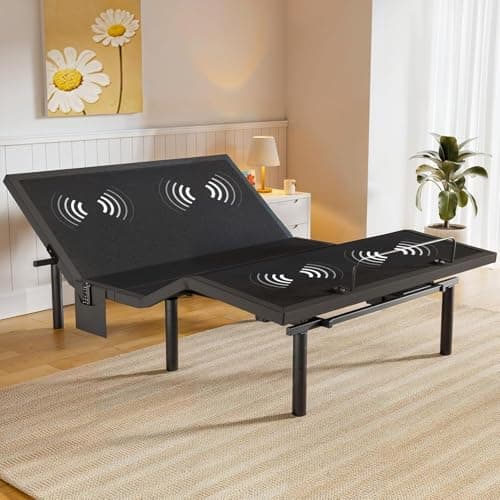
Our top pick — Amada 01B-Q1 Queen Adjustable Bed Frame
Guide
Remote Not Working
Most dead-remote faults are free to fix. Here are the checks in order, and how to tell when the problem is the control box or a motor instead.


Nothing here is medical advice. Prices are pulled live and stamped with the date they were checked; scores are our published spec rubric, not a test result. How we pick · How we make money · Corrections