Guide
Using bed risers and a bed rail together
Raising a bed does not raise the rail relative to the mattress. What it does change is the distance to the floor, and whether a floor-standing support leg still reaches.
By Stephen V.Published How we pick
Yes, you can use bed risers and a bed rail together, and the reason is simple geometry: a rail that clamps to the frame rises with the frame, so its height above the mattress - the dimension the entrapment gaps depend on - does not change. If you have already fitted a rail correctly, adding risers does not un-fit it. Two things do change, and they are the whole content of this page: the distance to the floor grows by exactly the riser height, and any rail with a floor-standing support leg now has a longer gap to bridge.
What risers move, and what they do not
A riser lifts the frame's legs. Everything bolted to the frame goes up with it: the slats, the mattress, the headboard and a clamped bed rail. Everything referenced to the floor does not: the fall distance, a support leg, and the height of your own feet above the carpet when you sit on the edge.
| Dimension | Before | After 8-inch risers | Why it matters |
|---|---|---|---|
| Rail height above mattress | Unchanged | Unchanged | The entrapment gaps you measured stay as measured |
| Sleep surface height off floor | e.g. 22 in | 30 in | This is the number you were trying to change |
| Fall distance from the mattress top | 22 in | 30 in | A fall now starts 8 inches higher |
| Reach from a floor-standing support leg | Touches the floor | 8 in short | The leg must adjust or the rail loses its support |
| Feet-to-floor when sitting on the edge | Flat | Possibly dangling | Dangling feet make standing up harder, not easier |
What to check before you combine them, in order
- Your target height, measured. Sit on the edge. Feet flat, knees level with or just below the hips. The distance from the floor to the top of the mattress at that position is the target, and the riser you want is the one that closes the gap - often 3 or 5 inches rather than 8. The full arithmetic.
- The socket against your frame's foot. A riser is a cup, and your frame's foot has to sit in it. One of the four risers we track publishes the cup dimensions - a 0.7-inch recessed cup for legs up to 2.8 inches. For the others, measure the foot and ask the seller.
- Whether your rail clamps to the frame or stands on the floor. Frame-clamped rails come up with the bed and keep their fit. A rail with a floor-standing support leg does not, and that leg has to cover the riser height or the rail loses the support that was its selling point.
- The rail's published mattress thickness range. Risers do not change your mattress thickness, so a rail that fitted still fits. But if you are changing the mattress at the same time - which people often are - the range is the specification to check: the rails we track publish windows of 10 to 14 inches, 10 to 12, 7.9 to 13 and 6 to 14.
- The gaps, re-measured after everything is in place. The FDA's entrapment guidance is dimensional, which means a tape measure answers it on your own bed. Re-check once, after the risers and the rail are both fitted. How to fit a rail.
- Whether the whole assembly is still stable. Four risers raise a bed's centre of gravity and add four joints to it. Push the bed firmly at the headboard and at one corner before anybody sleeps in it, and re-check the frame bolts a fortnight later.
The products that make this combination work
Two risers and one rail, chosen for the specifications this particular pairing depends on rather than for being the best in their categories overall.
1 · The only riser publishing socket depth
Utopia Bedding Adjustable Bed Risers, 3 & 5 in
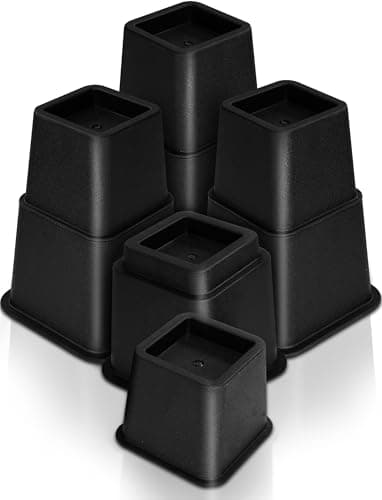
Two heights, the same published 1,300 lb rating, and the only riser here that publishes how deep the socket is.
- Lift
- 3 or 5 in
- Our spec score
- 8.3/10
- Best for
- A small, sure lift
What works
- 1,300 lb published rating in a two-height set
- It publishes a 0.7-inch recessed cup depth and a 2.8-inch leg size — the two figures that decide whether your bed leg actually seats, and the only riser here that prints either
- Most people who need a lift need 3 to 5 inches, not 8 — this covers the common case
What doesn’t
- No single-piece 8-inch option; getting to 8 means stacking, and a stack is always less steady than one piece
- No published material — 'premium materials' is not a specification
- Same caveat as any riser: it raises the bed and the fall
Published specifications
| Lift heights | 3 or 5 inches (stackable to 8) |
|---|---|
| Load rating | 1,300 lb |
| Pack | 4 |
| Material | Not published |
| Socket depth | 0.7 in recessed cup, for legs up to 2.8 in |
Read from the product listing on 2026-08-26. Blanks are specifications the manufacturer does not publish, not figures we could not be bothered to find.
How the score was reached
| Lift rangeTwo published heights, 3 and 5 inches, stackable to 8. | 8 |
|---|---|
| Load rating1,300 lb published for the set. | 9 |
| StabilityA published 0.7 in socket depth and 2.8 in leg fit; material still unnamed. | 8 |
| Set sizeFour-pack — one per bed leg. | 8 |
| Mean, rounded to one decimal | 8.3 |
2 · Three heights to fine-tune with
Home It Adjustable Bed Risers, 3/5/8 in
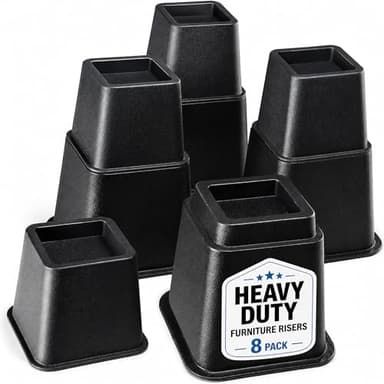
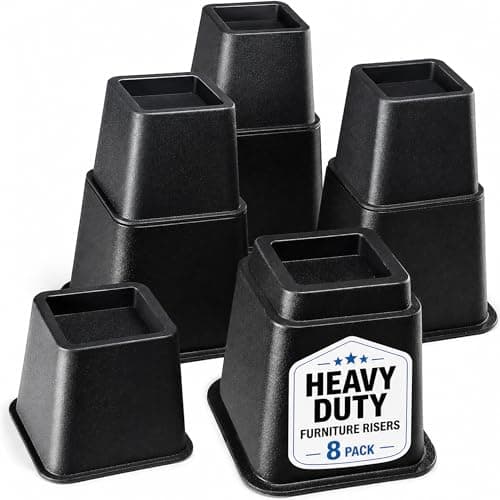
Three published lift heights from one set and a published 1,300 lb rating — the most flexible way to test a height before committing to it.
- Lift
- 3, 5 or 8 in
- Our spec score
- 8.5/10
- Best for
- Trying a height first
What works
- Three heights out of one box, so you can try 3 inches, decide it is not enough, and go to 5 without buying twice
- A published 1,300 lb rating for the set, and a published material — polypropylene, not an unnamed plastic
- Cheap enough that testing a height costs less than being wrong about one
What doesn’t
- Stacked risers are less stable than a single-piece riser of the same height — stack at your own judgment
- No published socket depth, and socket depth is what decides whether your bed leg actually sits in it
- Raising a bed raises the fall distance. Height helps you stand; it does not help you land
Published specifications
| Lift heights | 3, 5 or 8 inches (stackable) |
|---|---|
| Load rating | 1,300 lb |
| Pack | 4 |
| Material | Polypropylene |
| Socket depth | Not published |
Read from the product listing on 2026-08-26. Blanks are specifications the manufacturer does not publish, not figures we could not be bothered to find.
How the score was reached
| Lift rangeThree published heights from 3 to 8 inches. | 10 |
|---|---|
| Load rating1,300 lb published for the set. | 9 |
| StabilityPolypropylene with a broad base published; stackable by design, and no socket depth. | 7 |
| Set sizeFour-pack — one per bed leg. | 8 |
| Mean, rounded to one decimal | 8.5 |
3 · The rail with the most adjustment
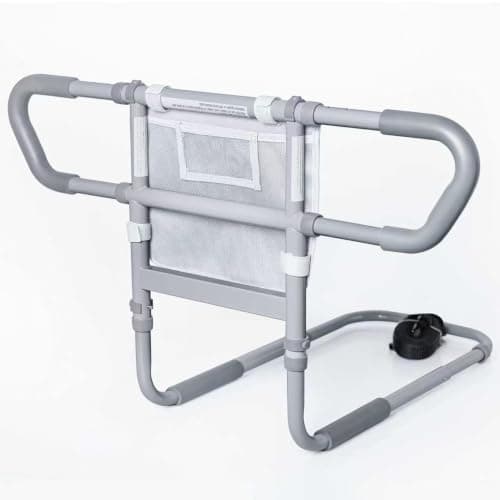
Lesamediio HC035 Bed Assist Rail
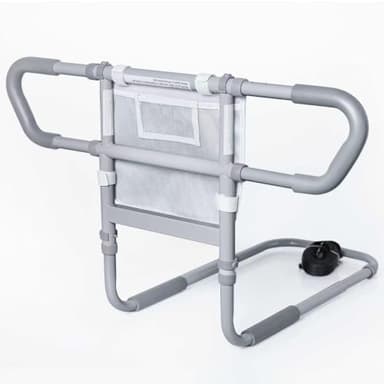
The highest published load rating here at 400 lb, on a rail that names the exact ASTM standard rather than gesturing at one.
- Load rating
- 400 lb
- Our spec score
- 9.2/10
- Best for
- The highest published load rating
As of October 4, 2026. #ad How we’re funded
What works
- It publishes a 400 lb load rating — the one number you actually lean on, and the highest figure any rail here prints
- It names the standard instead of gesturing at it: ASTM F3186-17, the standard 16 CFR part 1270 made mandatory in August 2023
- Published width and height adjustment, so the grip can be set where your hand falls from sitting, plus a motion sensor light and a safety strap to the opposite side of the frame
What doesn’t
- The listing states it is not compatible with adjustable beds. If the deck bends, this is the wrong rail
- One handrail, not a U-bar — there is no second grip height for anyone who pushes up in two stages
- The light's brightness, run-time and power source are not published, and a sensor light is the first component to fail on an inexpensive rail
Published specifications
| Standard claimed | ASTM F3186-17, named on the listing |
|---|---|
| Load rating | 400 lb |
| Light | Motion sensor night light |
| Grip form | Single padded non-slip handrail |
| Adjustable | Width 23–30.5 in, height 20.5–23.5 in |
| Stabilizer bar | Extends to 28 in under the mattress |
| Storage pocket | Yes — detachable |
| Fits | Twin, full, queen and king; not adjustable beds |
Read from the product listing on 2026-08-26. Blanks are specifications the manufacturer does not publish, not figures we could not be bothered to find.
How the score was reached
| Standard complianceNames ASTM F3186-17 specifically — the standard 16 CFR part 1270 made mandatory — not a generic ASTM claim. | 10 |
|---|---|
| Grip and reachPadded non-slip handrail with published width and height adjustment; one grip height, not two. | 9 |
| Load rating400 lb published — the highest figure any rail here states. | 10 |
| FitTwin, full, queen and king published; explicitly not for adjustable beds. | 8 |
| Night useMotion sensor light published; no brightness or run-time figure. | 9 |
| Mean, rounded to one decimal | 9.2 |
The Utopia Bedding set is here for one reason: it is the only riser we track that publishes how deep its socket is - a 0.7-inch recessed cup for legs up to 2.8 inches - which is the figure that decides whether it will sit under your frame's foot at all. It publishes 3 and 5 inch heights, stackable to 8, and a 1,300 lb rating. The Home It set publishes three heights from one box, 3, 5 or 8 inches, and the same 1,300 lb, which makes it the set to buy if you want to try a height, live with it for a week and then change it by two inches.
The Lesamediio rail earns its place because it adjusts in both dimensions - 23 to 30.5 inches of width and 20.5 to 23.5 inches of height - so it can be re-set after a height change rather than replaced. It also publishes the highest load rating of any rail we track at 400 lb, names ASTM F3186-17 exactly, and carries a motion-sensor night light. Its listing states it is not for adjustable beds, so this pairing is for a conventional frame.
The combination we would avoid
A rail whose support comes from a floor-standing leg, on a bed that has just gone up by 5 or 8 inches. The point of a floor leg is to take the load off the mattress edge, which is precisely the failure people describe when a rail feels wobbly - and a leg that no longer reaches the floor delivers none of that while still looking like it does.
The rail we track with that design publishes an inconsistent position on its own adjustment: one bullet says the height adjusts, another says no adjustment is needed. We record the inconsistency rather than resolve it, and for this pairing it is disqualifying on its own - you cannot plan around a range nobody has stated. If you already own one and you are raising the bed, get the leg's travel in inches from the seller before the risers go under.
The honest trade, stated plainly
Raising a bed to a height somebody can stand up from reduces the number of difficult exits. Raising a bed also increases how far there is to fall if an exit goes wrong, and the CDC's own figures on how common falls are in this age group mean that is not a theoretical cost. Both of those are true at the same time, and no product resolves the tension.
What we would do is pick the height on the measurement rather than on the maximum, keep the rail properly fitted and re-measured, and put something soft on the floor on the exit side if the height has gone up meaningfully. Fall mats are covered in the alternatives to bed rails, which is also the page to read if the rail itself is starting to look like the wrong tool.

Nothing here is medical advice. The product figures above were read from live listings on the dates stamped on each specification table, the entrapment point is cited to the FDA's own guidance rather than paraphrased, and the arithmetic in the table is arithmetic you can redo with your own numbers. Where a listing publishes nothing - socket depth on three of the four risers, a support leg's travel on the rail that has one - this page says so. How we pick.
Questions people actually ask
Can you use bed risers with a bed rail?
Usually yes, with two caveats. A rail that clamps to the bed frame goes up with the frame, so its height above the mattress does not change and the gaps you measured stay the same - that is the good news. The caveats are that the fall distance to the floor grows by exactly the riser height, and that a rail with a floor-standing support leg will no longer reach the floor unless that leg adjusts far enough.
Do bed risers make a bed rail less safe?
They do not change the rail's fit, because the rail and the mattress move up together. They do change the consequence of going over or around it: a fall from a bed on 8-inch risers starts 8 inches higher. That is a real trade to weigh rather than a reason to avoid risers - if raising the bed is what makes somebody able to stand up unaided, fewer exits are attempted from a seated-to-standing position that was failing.
Will a bed rail with a support leg still work on risers?
Only if the leg adjusts by at least the riser height, and the listing has to tell you its range. The rail we track with a floor-standing support leg publishes an inconsistent position on whether its height adjusts at all - one bullet says it does and another says no adjustment is needed - which is exactly the uncertainty you do not want when the leg has to cover another 5 inches. Ask the seller for the leg's range in inches before you add risers.
How high can you safely raise a bed with risers?
Raise it to a measured target, not as far as the risers go. The target is the height at which the person sits on the edge with their feet flat on the floor and their knees level with or just below their hips. Run the arithmetic first - it takes five minutes with a tape measure - and then buy the riser that gets you there, which is often 3 or 5 inches rather than 8.
Do bed risers fit a metal bed frame?
It depends on the socket, and only one of the four risers we track publishes the figure that decides it. The Utopia Bedding set publishes a 0.7-inch recessed cup for legs up to 2.8 inches; the other three publish no socket depth at all. A metal frame with a wide flat foot, a caster, or a glide plate is the common failure case, and a tape measure across your own frame foot answers it before the risers arrive.
Is it better to raise the bed or fit a rail?
They answer different questions, and the order matters. Height changes whether the movement is possible at all; a rail gives you something to pull against while you make it. If somebody is heaving themselves up from a bed that is too low, fix the height first and then see whether the rail is still needed. Rail or alarm, and when neither covers the other half of that decision.
Sources
Every factual claim on this page traces to one of these, or to a product listing cited in the specification table beside it.
Read next
Comparison
Best Bed Risers
The cheapest fix in this subject, scored on the two specs that matter: how much lift, and how much load.
Our top pick — Home It Adjustable Bed Risers, 3/5/8 in
Guide
Fitting a Bed Rail
Fitting takes twenty minutes. The measuring afterwards is the part that decides whether it is safe.
Guide
Best Bed Height for Seniors
A calculator that shows its working, because the right answer depends on your legs and not on an average.
Comparison
Best Bed Rails
Scored on whether the listing states compliance with the standard that became federal law in 2023 — and four other things.
Our top pick — Lesamediio HC035 Bed Assist Rail
$69.99 · Check priceAs of October 4, 2026. #ad How we’re funded
Head to head
Risers vs Leg Extensions
One sits under the leg, one becomes the leg. The difference matters more on an adjustable base than on a normal frame.
Head to head
Alarm vs Rail
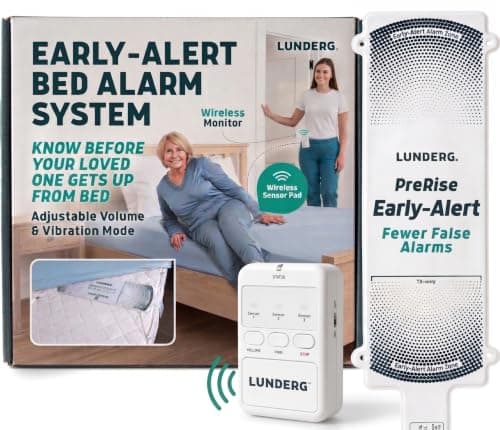
One tries to keep somebody in the bed. The other tells you they have left it. Which you need depends on a single question about the person, not about the product.
Our top pick — Lunderg Wireless Early Alert Bed Alarm System
$119.95 · Check priceAs of October 4, 2026. #ad How we’re funded
Nothing here is medical advice. Prices are pulled live and stamped with the date they were checked; scores are our published spec rubric, not a test result. How we pick · How we make money · Corrections