Head to head
Alternatives to bed rails for the elderly
Five ways to make getting in and out of bed safer, and the honest test for which problem you actually have before you buy a rail.
By Stephen V.Published How we pick
Search for a bed rail and the whole internet assumes you have already decided you need one. Often you have not — or should not. A rail is the only fall-prevention product on this site that can leave a person less safe than they were before it arrived, because of the gaps it creates between rail, mattress and frame. This page sets the rail beside the four things people most often need instead, and gives you an honest test for which problem you actually have. It used to be a section inside who should not use a bed rail; it is important enough to stand on its own.
When a rail is the wrong tool
The reason to start with the alternatives is not squeamishness about hardware. The FDA, working with the Hospital Bed Safety Workgroup, documents seven potential entrapment zones in a bed system — spaces inside the rail, under it, and between the rail and the mattress — where a person who slides or rolls can become caught and be unable to free themselves. The Consumer Product Safety Commission judged the hazard serious enough to make a mandatory federal standard for adult portable bed rails in 2023. A rail is a reasonable tool for the right person on the right bed. For the wrong person — someone who might climb over it, or who cannot deliberately move away from it — it converts a low roll-out into a fall from a greater height, and the options below are safer by design.
The five options, side by side
These get sold as if they were interchangeable. They are not. Each solves a different problem and each carries a different amount of added risk.
| Option | The problem it solves | Added risk it carries | When it is the right call |
|---|---|---|---|
| Full-length bed rail | Stops a roll-out; gives something to pull against | Entrapment along its length, and a climb-over risk | A person who can move away from it deliberately, on a firm mattress that fills the frame |
| Assist handle | Something to grip while sitting up and standing | Low — far less length to be trapped along | The difficulty is standing up, not staying in bed |
| Floor bed or lower bed | Shortens both the climb-out and the fall for someone who gets up while confused | Harder to stand up from once you are down there | Someone who might climb over a rail, or who gets up at night disoriented |
| Bed-height change (risers or leg adjustment) | Sets the surface where feet plant flat and you rise in one movement | Very low — the fix most people skip entirely | Standing is a lurch because the bed is too low, or you slide off because it is too high |
| Fall mat beside the bed | Softens the landing when a fall is accepted as possible | A trip edge of its own; it prevents no falls | A carer has judged a fall likely and wants to reduce injury, usually alongside a low bed |
Assist handle: the swap most people actually need
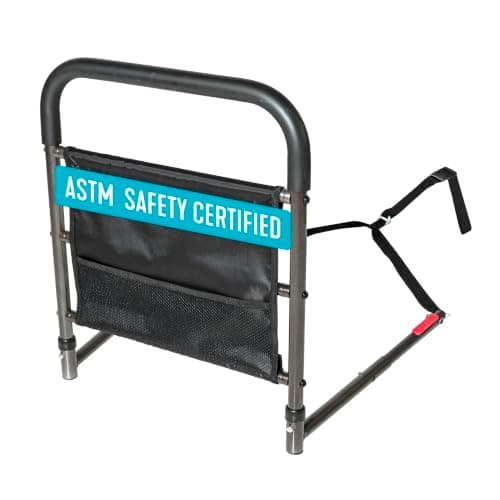
Far more people arrive searching for a rail than actually need one. The tell is in what happened: if the frightening moment was standing up, or hauling yourself off the edge on the furniture, the problem is a transfer, not a roll-out — and a handle is the tool. It is a short grab bar at the side of the bed, positioned where your hand falls when you sit on the edge. It is smaller, cheaper, and easier to fit than a full-length rail, and because it presents almost no length there is little for a limb or head to become trapped along. It will not stop anyone rolling out of bed, so it is not a swap if that is the genuine risk. The handles we track are here, and we compared the two products head to head because the confusion between them is the single most common mistake in this subject. Worth knowing: a handle is regulated under the same federal rule as a rail — the definition covers grab bars and assistive bars — so a product called a handle is not an unregulated one.
Floor beds and lower beds
For the person a rail is most dangerous for — someone who gets up at night confused and would climb over a barrier — the honest answer is usually to lower the bed rather than fence it. A lower sleep surface makes both the getting-up and any fall shorter, and it removes the height a climb-over adds. It is not free of trade-offs: a very low bed is harder to stand up from, which is a real cost for someone with weak legs or stiff hips. Floor beds and fall risk works through that balance without pretending it is one-sided, because a bed that is safe to fall out of but impossible to rise from has only moved the problem.
Changing the bed height
The most under-used fix in the whole subject is not a safety product at all — it is putting the bed at the height where your feet plant flat on the floor and standing is a single step rather than a lurch or a slide. A great deal of what looks like a need for a rail is really a bed that is too low to rise from or too high to sit down onto safely. Work out your target height first; if the bed is badly wrong, bed risers or, on an adjustable base, its own leg settings can fix it, and the rail may become optional. Risers versus leg extensions covers which route suits which frame.
Fall mats
A fall mat belongs in a different category from everything above, and it is important not to file it as a fall preventer. It is a cushioned pad on the floor beside the bed that softens a landing. It stops no falls, and it introduces a soft, raised edge that is itself a trip hazard for anyone still walking to the bathroom. Its honest use is narrow: a carer has decided that a fall is a real possibility despite everything else, usually for someone on a low or floor bed, and wants to reduce the injury when it happens. Used that way, deliberately, it is sensible. Used as reassurance so that no other change gets made, it is worse than nothing.
Which one for you
Start from what actually happened, or what you are genuinely afraid will happen, and the answer usually sorts itself.
- “I struggle to get up.” An assist handle, and first the arithmetic on bed height — the two together solve more than either alone.
- “I woke up on the floor.” That is the one case where a rail may genuinely fit — for a person who can reposition themselves, on a firm mattress — and it is also a conversation with a doctor, because rolling out while asleep can have causes worth investigating.
- “They get up confused at night.” Not a rail. A lower bed, better lighting, and a clear path beat a barrier that gets climbed. Floor beds and fall risk.
- “A fall is probably going to happen anyway.” A low bed plus a fall mat to soften the landing, decided with a clinician who knows the person — injury reduction, not fall prevention.
What each option costs, roughly
We do not print prices in prose, and live figures for everything we track sit on the roundup pages — but the rough order is worth knowing before you shop. An assist handle is usually the least expensive of these; a fall mat and a set of bed risers sit in similar budget territory; a full-length rail is a step above; and a proper low or adjustable bed frame is in a different bracket entirely. The point is not that cheaper is better. It is that the two changes that help most people — a height correction and an assist handle — are also among the least expensive, which is the opposite of what the shopping results imply. Live prices for the handles are here, and the rails are here.
You can combine them
None of these is exclusive, and the better setups usually stack. A height correction plus an assist handle solves most transfer problems together, because one puts the surface where you can rise from it and the other gives you something fixed to rise against. A low bed plus a fall mat plus good lighting is a coherent plan for someone who may still get up unaided. What does not combine is a rail with the situations it is wrong for — no amount of lighting or matting turns a barrier into the right answer for someone who will climb over it. Match each change to the problem it solves, layer the ones that address your actual risks, and leave out the one that carries a risk you do not need.
Questions people actually ask
What can I use instead of a bed rail for the elderly?
Depending on the actual problem: an assist handle if the difficulty is standing up, a lower or floor bed if someone might climb over a rail, a bed-height correction if standing is a lurch, and a fall mat if a carer has accepted a fall may happen and wants to soften the landing. Several of those are cheaper and none carries the entrapment risk a rail does.
Why would a bed rail be the wrong choice?
Because a rail creates gaps between itself, the mattress and the frame that a person can slide into and be unable to escape — the entrapment risk the FDA documents. For someone who is confused, cannot reposition themselves, or might climb over the rail, it can make a fall worse rather than prevent it. Who should not use one covers this in full.
Is an assist handle better than a bed rail?
For most people who search for a rail, yes — because the real problem is usually standing up, not rolling out. A handle is smaller, cheaper, and presents far less length along which a limb or head can be trapped. It will not stop a roll-out, so it is not a straight swap if that is the genuine risk.
Do fall mats prevent falls?
No. A fall mat softens a landing; it does nothing to stop the fall. It is an injury-reduction tool, usually paired with a low or floor bed for someone whom a carer has judged likely to get up unaided. Treated as a fall preventer it gives false confidence and adds its own trip edge.
Does Medicare pay for bed rails or the alternatives?
A consumer portable bed rail bought on Amazon is not covered. Some equipment prescribed as durable medical equipment can be, under specific rules. Our Medicare coverage page walks through what qualifies and what does not.
Sources
Every factual claim on this page traces to one of these, or to a product listing cited in the specification table beside it.
Read next
Guide
Who Should Not Use One
Four situations where a rail makes things worse, and the alternatives that work better in each.
Comparison
Best Assist Handles
If the difficulty is standing up rather than staying in, this is the product you actually want.
Our top pick — Able Life Bedside Safety Handle
$49.99 · Check priceAs of September 21, 2026. #ad How we’re funded
Guide
Floor Beds and Fall Risk
Lowering a bed shortens the fall and makes standing up harder. Both halves of that are true, and the choice is real.
Head to head
Rail vs Assist Handle
Two products, one search term, completely different jobs. Most people searching for the first one need the second.


Nothing here is medical advice. Prices are pulled live and stamped with the date they were checked; scores are our published spec rubric, not a test result. How we pick · How we make money · Corrections