Head to head
Bed alarm or bed rail?
One tries to keep somebody in the bed. The other tells you they have left it. Which you need depends on a single question about the person, not about the product.
By Stephen V.Published How we pick
These two products get bought for the same worry and they do opposite things. A bed rail is a barrier and a handhold: it is for somebody who wants help getting out of bed, or who rolls in their sleep. A bed alarm is a notification: it is for somebody who is going to get up whether or not they should, and it exists so a caregiver knows. If you are buying for someone with dementia or night-time confusion, buy the alarm — our pick is the Lunderg wireless early alert, because the sound happens at the caregiver and not at the person in the bed. If the person knows their own limits and simply needs something to pull against, buy the rail.
| # | Pick | Key spec | Score | Price |
|---|---|---|---|---|
| Rank1 | 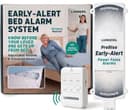 Lunderg Wireless Early Alert Bed Alarm System Best alarm: the alert leaves the room | Key spec400 ftPager range | Score8.8/10 | |
| Rank2 | 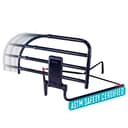 Able Life Click-N-Go Extendable Bed Rail Best rail for an adjustable frame | Key specAdjustable framesFits | Score8.0/10 | |
| Rank3 | 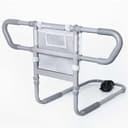 Lesamediio HC035 Bed Assist Rail Highest published load rating | Key spec400 lbLoad rating | Score9.2/10 | |
| Rank4 | 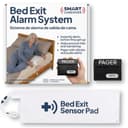 Smart Caregiver Bed Exit Alarm with Wireless Pager (RP-WPBR1-SYS) Best alarm to build on | Key spec6 sensorsPager supports | Score8.8/10 |
Prices checked October 4, 2026. Scores are our published spec rubric, not a test result — here is exactly how they are calculated.
The one question that decides it
Does the person understand that they should not get out of bed unaided, and will they act on that?
If yes, a rail is a tool they will use as intended. It gives them something fixed to pull against, it marks the edge of the bed in the dark, and it is cheap. If no — because of dementia, post-operative delirium, a urinary urgency that overrides judgement, or simple habit after sixty years of getting up unassisted — then a rail stops being a handhold and becomes an obstacle between a determined person and the floor. People climb over rails, and a fall over a rail starts higher than a fall from a mattress.
What each one actually does
| Bed rail | Bed alarm | |
|---|---|---|
| What it is | A fixed barrier and handhold on the side of the bed | A sensor that signals when weight leaves the bed |
| Who it is for | Somebody who wants help getting up safely | Somebody who will get up regardless |
| What it needs from the person | That they use it as intended | Nothing |
| What it needs from you | Correct fitting, and a mattress inside its published thickness range | Somebody near enough to respond, every night |
| Federal position | Mandatory CPSC standard since 21 July 2023 | CMS names an alarm audible to the person as a possible restraint |
| Ongoing cost | None | Sensor pads are consumable; one brand publishes 15 months |
| What it cannot do | Stop a determined person — and raises the fall height if they climb | Prevent the fall; it reports the exit |
What to look for, if the answer is a rail
- A named standard, not a gesture at one. Adult portable bed rails have been under a mandatory federal standard since July 2023. Three of the rails we track name ASTM F3186-17 exactly; others say ASTM safety approved, which is weaker language for the same claim.
- A published mattress thickness range that includes your mattress. This is the fit specification that decides whether the gaps are safe, and every rail we track publishes one. The ranges differ — 10 to 14 inches, 10 to 12, 7.9 to 13, 6 to 14 — and a mattress outside the range is an installation to abandon, not to force.
- Whether it is listed for an adjustable bed frame. Almost none are. Of the rails and handles we track, exactly one publishes compatibility with adjustable frames, and four publish the opposite in plain words. Rails for adjustable beds.
- A published load rating. The figures we have read run from 300 to 400 lb. It matters because the load case is a person pulling sideways on it to stand, not a person lying still.
- The gaps, measured after fitting. The FDA's entrapment guidance is about dimensions, and dimensions are something you can check with a tape measure on your own bed. How to fit a rail.
What to look for, if the answer is an alarm
- Where the alert lands. This is the whole specification. Five of the six alarms we track send it to a pager the caregiver carries or to a phone app; one sounds an 80 dB alarm in the room, at the person getting up, which is the arrangement CMS guidance treats as potentially restraining.
- Published range, and whether the house is bigger than it. The pagers we track publish 300 ft and up to 400 ft; one listing contradicts itself between its bullets and its specification table, which we record rather than resolve.
- Pad or floor sensor. A pad under the hips or shoulders fires as weight shifts, which is early. A floor motion sensor fires once feet are already down, which is later and cheaper. Neither is wrong; they buy you different amounts of time.
- Sensor pad life, and what a replacement costs. Only one brand publishes a figure — 15 months. A pad is a consumable and an alarm is therefore a subscription with extra steps.
- What happens in a power cut. Most of the alarms we track run on AA or 9V cells and keep working; the in-room model's mains adapter is sold separately. What a power cut does to the bedroom.
The honest limit on alarms
The strongest study we have found on this question did not find what the category implies. Shorr and colleagues ran a cluster randomized trial across hospital units in 2012, increased bed alarm use substantially, and reported no significant reduction in falls, fall-related injuries or deaths. It is a hospital trial rather than a home one, and a home has a different response time and a different person responding — but it is the best evidence available, and it points one way.
So we would put it like this. An alarm does not prevent a fall. It converts an unwitnessed fall into a witnessed one, and it converts a silent 3am exit into a 3am exit somebody knows about. Both of those are genuinely valuable, and neither is prevention. If you buy an alarm expecting the fall rate to drop on its own, the evidence says you will be disappointed; if you buy it so that nobody lies on a bathroom floor for two hours, it does exactly that.
Among 16 hospital units, an intervention that increased bed alarm use did not change the rate of inpatient falls, fall-related injuries, or the use of physical restraints.
The four products in full
Two alarms and two rails, so the comparison is concrete. Full write-ups, published specifications, and the dates each listing was read.
1 · Best alarm: the alert leaves the room
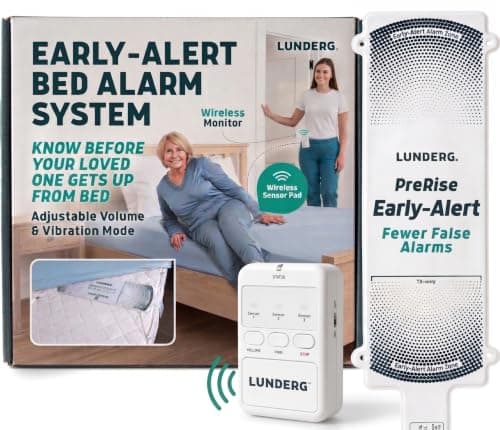
Lunderg Wireless Early Alert Bed Alarm System
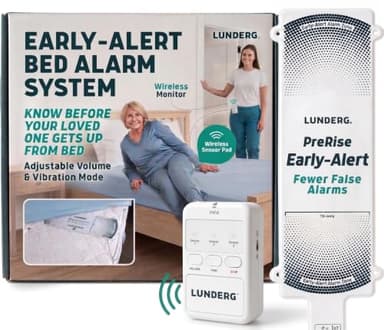
The only brand here that says how long its sensor pad lasts, on a system built around the idea that nothing should make a noise at the person in the bed.
- Pager range
- 400 ft
- Our spec score
- 8.8/10
- Best for
- Alerting a caregiver in another room
As of October 4, 2026. #ad How we’re funded
What works
- Nothing in this system is stated to sound at the bedside — every alert goes to a pager the caregiver carries, which is the distinction the whole category turns on
- The pad sits at hip level and the listing says it alerts before the person is out of bed, rather than once their weight has already gone
- Lunderg is the only brand here that publishes how long its sensor pad lasts — 15 months — on the one part of the system that is a consumable
What doesn’t
- The specification table gives an audible-noise figure of 120 dB and never says which device it describes; the same brand's bed-and-chair set publishes 48 dB for what looks like the same pager, and neither listing resolves the contradiction
- The 15-month pad life is a claim in the bullet points, not a warranty term — no warranty length is published anywhere on the listing
- The pad is a consumable and the listing says nothing about what a replacement costs, so the running cost is knowable in months but not in dollars
Published specifications
| Where the alert goes | Wireless pager carried by the caregiver |
|---|---|
| Sensor pad | 10 x 33 in, foam interior, incontinence-resistant |
| Pad placement | Hip level |
| Published range | Up to 400 ft |
| Sensor pad life | 15 months (seller stated) |
| Pager alert modes | High volume, low volume or vibrate only |
| Batteries | 2 AA, included |
| Wi-Fi or app required | No |
| Expandable with | Lunderg chair alarm and call button |
| Warranty | Not published |
Read from the product listing on 2026-08-28. Blanks are specifications the manufacturer does not publish, not figures we could not be bothered to find.
How the score was reached
| Where the alert landsThe listing states every alert goes to a pager the caregiver holds and that nothing sounds at the bedside. | 10 |
|---|---|
| How early it firesHip placement published, with a stated alert before the person is out of bed. | 10 |
| Published range400 ft published — the longest figure on this page. | 9 |
| Running costs disclosedA 15-month pad life and included batteries are published; no warranty term is. | 8 |
| ExpandabilityA chair alarm and a call button are named as compatible; no supported sensor count is published. | 7 |
| Mean, rounded to one decimal | 8.8 |
2 · Best rail for an adjustable frame
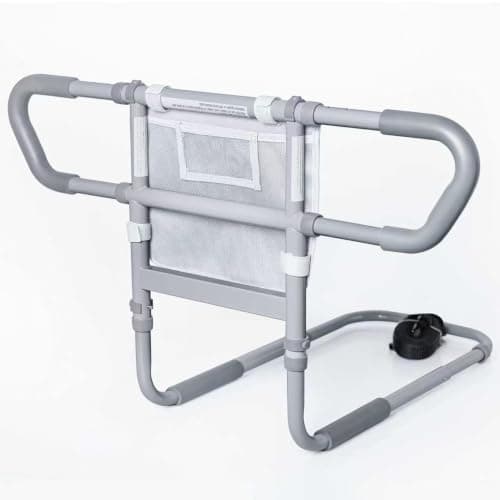
Able Life Click-N-Go Extendable Bed Rail
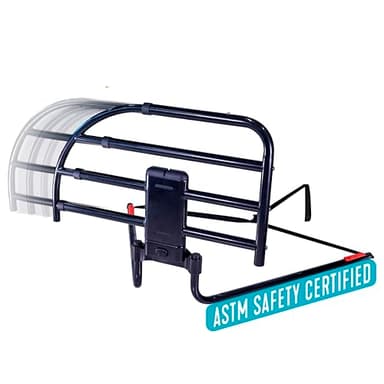
The only rail in this set whose listing names adjustable bed frames specifically — which is the compatibility question everyone asks and almost nobody answers.
- Fits
- Adjustable frames
- Our spec score
- 8.0/10
- Best for
- Adjustable bed frames
As of October 4, 2026. #ad How we’re funded
What works
- Explicitly listed for wood adjustable bed frames, so the mounting question has a published answer
- Removable without tools, which matters when a carer needs the side of the bed clear
- States ASTM compliance and publishes both bed-size fit and a 300 lb load rating
What doesn’t
- Wood frames specifically — an all-steel adjustable base is a different mounting problem, so check before ordering
- The published mattress window is narrow — 10 to 12 inches — and a lot of modern mattresses are thicker than that
- The most expensive rail in this comparison by some distance
Published specifications
| Adjustable-bed compatible | Yes — listed for wood adjustable bed frames |
|---|---|
| Standard claimed | ASTM safety approved |
| Removable | Yes |
| Extendable | Yes |
| Load rating | 300 lb |
| Fits | King, queen, full and twin beds; mattresses 10–12 in thick |
| Light | Not published |
Read from the product listing on 2026-08-26. Blanks are specifications the manufacturer does not publish, not figures we could not be bothered to find.
How the score was reached
| Standard complianceASTM compliance stated on the listing. | 9 |
|---|---|
| Grip and reachExtendable and removable; no padding or height detail published. | 8 |
| Load rating300 lb published. | 8 |
| FitBed sizes, a mattress window AND adjustable-frame compatibility all published. | 10 |
| Night useNo light published — neutral score. | 5 |
| Mean, rounded to one decimal | 8.0 |
3 · Highest published load rating
Lesamediio HC035 Bed Assist Rail
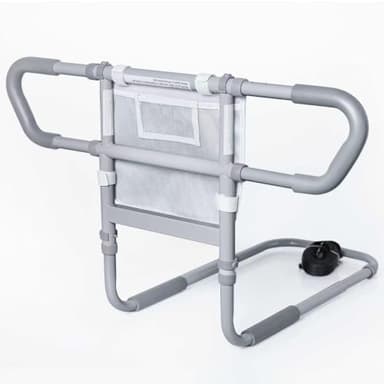
The highest published load rating here at 400 lb, on a rail that names the exact ASTM standard rather than gesturing at one.
- Load rating
- 400 lb
- Our spec score
- 9.2/10
- Best for
- The highest published load rating
As of October 4, 2026. #ad How we’re funded
What works
- It publishes a 400 lb load rating — the one number you actually lean on, and the highest figure any rail here prints
- It names the standard instead of gesturing at it: ASTM F3186-17, the standard 16 CFR part 1270 made mandatory in August 2023
- Published width and height adjustment, so the grip can be set where your hand falls from sitting, plus a motion sensor light and a safety strap to the opposite side of the frame
What doesn’t
- The listing states it is not compatible with adjustable beds. If the deck bends, this is the wrong rail
- One handrail, not a U-bar — there is no second grip height for anyone who pushes up in two stages
- The light's brightness, run-time and power source are not published, and a sensor light is the first component to fail on an inexpensive rail
Published specifications
| Standard claimed | ASTM F3186-17, named on the listing |
|---|---|
| Load rating | 400 lb |
| Light | Motion sensor night light |
| Grip form | Single padded non-slip handrail |
| Adjustable | Width 23–30.5 in, height 20.5–23.5 in |
| Stabilizer bar | Extends to 28 in under the mattress |
| Storage pocket | Yes — detachable |
| Fits | Twin, full, queen and king; not adjustable beds |
Read from the product listing on 2026-08-26. Blanks are specifications the manufacturer does not publish, not figures we could not be bothered to find.
How the score was reached
| Standard complianceNames ASTM F3186-17 specifically — the standard 16 CFR part 1270 made mandatory — not a generic ASTM claim. | 10 |
|---|---|
| Grip and reachPadded non-slip handrail with published width and height adjustment; one grip height, not two. | 9 |
| Load rating400 lb published — the highest figure any rail here states. | 10 |
| FitTwin, full, queen and king published; explicitly not for adjustable beds. | 8 |
| Night useMotion sensor light published; no brightness or run-time figure. | 9 |
| Mean, rounded to one decimal | 9.2 |
4 · Best alarm to build on
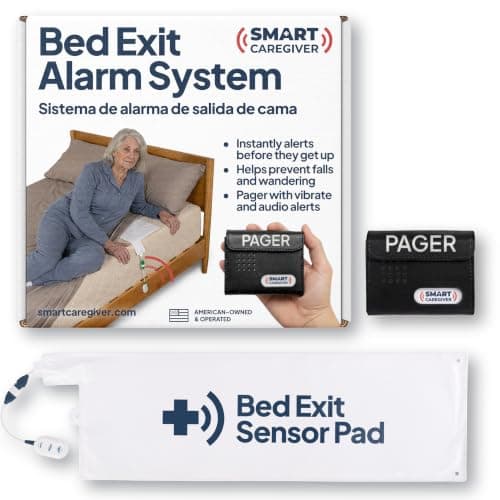
Smart Caregiver Bed Exit Alarm with Wireless Pager (RP-WPBR1-SYS)
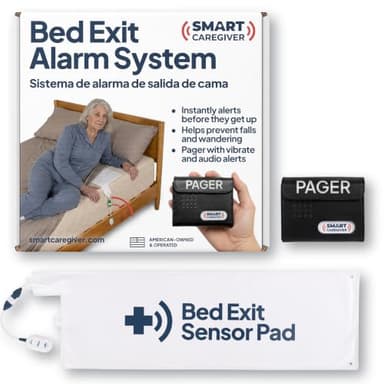
The listing that answers the most questions before you have to ask them, and the one to buy if the bed alarm is going to become a chair pad and a door sensor as well.
- Pager supports
- 6 sensors
- Our spec score
- 8.8/10
- Best for
- A system that will grow
As of October 4, 2026. #ad How we’re funded
What works
- The most complete specification table of any alarm here: range, pager volume, pad dimensions, battery type and warranty length are all published rather than left for you to guess
- One pager takes up to six sensors and the listing names the types, so the system grows with the problem instead of being replaced by a second one
- A published one-year manufacturer warranty, which four of the six systems here do not state at all
What doesn’t
- The pad goes under the shoulders, and the competing brand on this page argues in its own listing that shoulder placement is exactly what produces false alarms. Neither seller offers evidence, so you are choosing between two marketing claims
- Nothing is published about how long the sensor pad lasts, and the pad is the part that wears out
- The pager is published at 70 dB, well below the loudest figure here. If it has to wake you from sleep, test it in the house before you rely on it
Published specifications
| Where the alert goes | Wireless pager carried by the caregiver |
|---|---|
| Sensor pad | 10 x 30 in, 0.5 in thick, weight sensing |
| Pad placement | Under the shoulders |
| Published range | 300 ft |
| Pager alert modes | Sound or vibrate |
| Pager volume | 70 dB |
| Batteries | 2 AA, included |
| Sensor pad life | Not published |
| Expandable with | Up to 6 sensors — chair pad, door exit, floor mat, motion, call button |
| Warranty | 1 year manufacturer |
Read from the product listing on 2026-08-28. Blanks are specifications the manufacturer does not publish, not figures we could not be bothered to find.
How the score was reached
| Where the alert landsPager with sound or vibrate published; the listing does not state whether the base unit is silent. | 9 |
|---|---|
| How early it firesShoulder placement published, with a stated alert as the person starts to get up. | 9 |
| Published range300 ft published. | 8 |
| Running costs disclosedA one-year warranty and included batteries are published; no sensor pad life is. | 8 |
| ExpandabilityUp to six sensors published, and the listing names five sensor types plus call buttons. | 10 |
| Mean, rounded to one decimal | 8.8 |
On the alarm side, the Lunderg early alert is our pick because the alert goes to a pager the caregiver carries, with high volume, low volume or vibrate-only modes, up to 400 ft of published range, a hip-level incontinence-resistant pad and the only published pad life in the category. The Smart Caregiver pager system is the one to buy if this is going to grow — its pager supports up to six sensors, so a chair pad, a door exit sensor or a call button can be added to the same receiver later.
On the rail side, the Able Life Click-N-Go is the only product we track whose listing names adjustable bed frames specifically, which is the compatibility question people ask most and sellers answer least. The Lesamediio publishes the highest load rating of any rail we track at 400 lb, names ASTM F3186-17 exactly, adjusts in both width and height, and carries a motion-sensor night light — but like most of the category its listing states it is not for adjustable beds.
When the answer is neither
A surprising share of this problem is a height problem wearing a safety costume. If somebody is unsteady standing up because the bed is too high for their legs, no rail and no alarm fixes the cause — the bed does. A set of risers or a thinner mattress changes the mechanics of the movement itself, and it costs less than either product on this page. Work out the target height before you shop, and the alternatives to a rail covers floor beds, fall mats and height changes together.
There is also a third product people mean when they say rail. An assist handle is a short padded grip for standing up, not a full-length barrier for staying in — and for somebody whose problem is getting vertical rather than rolling out, it is the better tool. Rail versus assist handle is the page for that distinction, and the scored handle roundup is the shortlist.

The dementia case, specifically
If the person has dementia, our answer is an alarm with the alert outside the room, and not a rail. The Alzheimer's Association's guidance on wandering is written around the same principle: the goal is to know and to make the environment safer, not to contain somebody who no longer understands the containment. A rail in that situation is a barrier to climb and a fall that starts from higher up. We have written the full dementia page because the purchase genuinely changes, and because so much of the category is sold without that distinction.
Nothing on this page is medical advice and none of these products is a substitute for an assessment by somebody who can see the bed and the person. Every specification above was read from a live product listing on the date stamped on its table, and the two claims about federal position are cited to the Federal Register and to CMS rather than paraphrased. How we pick.
Questions people actually ask
Should I buy a bed alarm or a bed rail?
Ask one question: does the person know they should not get up on their own? If the answer is yes, they want a handhold, and a rail or assist handle is the right purchase. If the answer is no — because of dementia, delirium or confusion at night — a rail becomes something to climb over and an alarm that tells a caregiver is the better tool. Our pick in the second case is the Lunderg wireless early alert, because the noise happens at the caregiver rather than at the person in the bed.
Do bed alarms actually prevent falls?
The best evidence we have says not on its own. A cluster randomized trial published in the Annals of Internal Medicine in 2012 increased bed alarm use substantially across hospital units and found no significant reduction in falls, fall-related injuries or deaths. That does not make an alarm useless — it makes it a notification device rather than a prevention device. It buys a caregiver time to arrive, and what happens with that time is what determines the outcome.
Are bed rails dangerous?
They carry a specific, documented risk: entrapment in the gaps between the rail, the mattress and the frame. The FDA's Hospital Bed Safety Workgroup publishes the dimensional guidance on those zones, and adult portable bed rails have been under a mandatory federal safety standard since 21 July 2023. A correctly fitted rail on a mattress within its published thickness range is a different object from a rail wedged onto the wrong bed. Bed rail safety covers the gaps to measure.
Can you use a bed alarm and a bed rail together?
Yes, and for someone who wants a handhold but is also unsteady at night it is a sensible combination — the rail helps the intended exit, the alarm tells somebody it happened. What we would not do is use a rail as a barrier on someone who does not understand it and add an alarm to catch them climbing over it. In that situation the rail is the part to remove.
Does a bed alarm count as a restraint?
CMS guidance to nursing-home surveyors names an alarm that is audible to the resident as something that can function as a physical restraint, because the person modifies their behaviour to avoid setting it off. That is written for facilities rather than for private homes, and it is the reason we rank alarms by where the alert lands. Five of the six alarms we track send the alert to a pager or a phone; one sounds in the room at 80 dB.
Which is cheaper, a bed alarm or a bed rail?
Both sit in the same modest bracket next to a bed or a base, and prices move, so the live figures on this page are the ones to compare rather than any claim we could write. The cost difference that matters is not the purchase: a sensor pad is a consumable. One brand we track publishes a 15-month pad life, which makes the alarm an ongoing cost in a way a rail is not.
Sources
Every factual claim on this page traces to one of these, or to a product listing cited in the specification table beside it.
- Shorr et al. — Effects of an Intervention to Increase Bed Alarm Use to Prevent Falls in Hospitalized Patients: A Cluster Randomized Trial, Annals of Internal Medicine 157(10), 2012
- CMS — State Operations Manual Appendix PP, guidance to surveyors (F604 physical restraints; F689 accidents and supervision)
- FDA — Hospital Bed Safety Workgroup FAQ on entrapment issues
- Federal Register — Safety Standard for Adult Portable Bed Rails, final rule, 21 July 2023
- CDC — Facts About Falls
Read next
Comparison
Best Bed Alarms
The first question is not which alarm. It is whether the noise happens next to the person getting up, or on a pager in your pocket.
Our top pick — Lunderg Wireless Early Alert Bed Alarm System
$119.95 · Check priceAs of October 4, 2026. #ad How we’re funded
Comparison
Best Bed Rails
Scored on whether the listing states compliance with the standard that became federal law in 2023 — and four other things.
Our top pick — Lesamediio HC035 Bed Assist Rail
$69.99 · Check priceAs of October 4, 2026. #ad How we’re funded
Guide
Who Should Not Use One
Four situations where a rail makes things worse, and the alternatives that work better in each.
Comparison
Best for Dementia
Six in ten people living with dementia wander. That one fact changes which alarm to buy, and rules out the product most families reach for first.
Our top pick — Smart Caregiver Bed Exit Alarm with Wireless Pager (RP-WPBR1-SYS)
$105.95 · Check priceAs of October 4, 2026. #ad How we’re funded
Head to head
Rail vs Assist Handle
Two products, one search term, completely different jobs. Most people searching for the first one need the second.
Head to head
Alternatives to Rails
Five ways to make getting in and out of bed safer, and the honest test for which problem you actually have before you buy a rail.


Nothing here is medical advice. Prices are pulled live and stamped with the date they were checked; scores are our published spec rubric, not a test result. How we pick · How we make money · Corrections