Comparison
The best adjustable bed for sleep apnea
CPAP is the treatment; an adjustable bed is only positioning. Here is which base does that best, and the honest limits.
By Stephen V.Published Updated How we pick
We earn a commission if you buy through the links on this page, at no extra cost to you. It does not change what we recommend, and we have not tested these products — here is what we do instead.
People with sleep apnea are told, correctly, that a machine is the answer, and then they see an adjustable bed advertised with an 'anti-snore' button and wonder whether the bed could do the job instead. It cannot, and this page says so before it recommends anything. What a bed can do is narrower than the marketing implies, and worth understanding on its own terms.
The distinction that matters here is between snoring and apnea, and between apnea that changes with position and apnea that does not. Snoring is the sound of soft tissue vibrating in a partly narrowed airway. Apnea is the airway actually closing, repeatedly, so that breathing stops for seconds at a time. Some people's events are worse lying flat on their back and better on their side or with the head raised — that is what 'positional' means — and some people's events are much the same in every position. You cannot tell which you are from how you feel, and neither can anyone selling you a bed.
Mechanically, raising the upper body from the hips uses gravity to keep the tongue and the soft tissue of the throat from falling back quite as far when you lie on your back. For some people that reduces the vibration that is snoring, and for some with mild, positional events it helps a little. Neither of those is the same as treating obstructive sleep apnea, and that is the line this whole page is built around.
What an adjustable bed can and cannot do for apnea
- Can hold the head raised all night without pillows sliding away, which is the one thing a stack of pillows reliably fails at.
- Can make CPAP more livable for some people — a raised head and a tidy hose can make the mask easier to tolerate, which we cover on CPAP and adjustable beds.
- Can reduce ordinary, non-apnea snoring for some sleepers, which is why bases carry an anti-snore preset.
- Cannot treat, cure or prevent obstructive sleep apnea. It is not a medical device and does not claim to be.
- Cannot tell you whether your breathing problem is positional. Only a sleep study can, and that is a clinician's call.
The catch with 'anti-snore' as a selling point
An anti-snore preset sells beds because the word does a lot of quiet work. It suggests the bed is addressing the same thing a CPAP addresses, and it is not. The preset is a small head raise — often around seven degrees — saved so you can reach it with one button in the dark. For someone whose snoring is simple and positional, that mild tilt genuinely helps on some nights. For someone with obstructive sleep apnea, the same tilt does nothing to keep the airway open, and treating the button as a solution is exactly how people talk themselves out of the machine that actually works. We score the preset as a convenience, because that is honestly all it is.
How much elevation, and how to find yours
Two of these bases publish how far the head travels — 65 degrees on the DOMIA T600 and the Amada queen — and none publishes the angle the anti-snore or zero-gravity button settles at, which is the number that would actually tell you something. What you can do is measure it yourself: lay a phone with a level or inclinometer app on the raised deck and read the number at the position you intend to sleep at. It takes ten seconds and it turns the marketing into something concrete. As a rule the useful instruction is not a number anyway — raise the whole upper body from the hips rather than folding the neck, go as high as is comfortable to sleep at, and if you slide down the bed in the night you have gone too steep. The arithmetic that connects angles and inches is on its own page.
How we scored them
- Head-incline range. The single most relevant thing here. A base that raises the whole upper body from the hips, high enough to feel, is doing the only mechanical thing on offer. Two of these publish a maximum head angle in degrees; for the rest we read it from the position description and say where the number is missing.
- Positioning presets. A saved anti-snore or zero-gravity position is a convenience, not a therapy. It matters because a preset you can reach in the dark with one button is easier to actually use every night than an angle you rebuild by hand.
- Ease of nightly use. A lit remote, an under-bed light, a wireless handset rather than a corded one. If you get up in the night with a CPAP on, fewer cords and more light is safer.
- Quiet operation. A motor that wakes a partner every time you adjust defeats the point. Where a listing states a quiet motor we credit it; where it says nothing we do not guess.
- CPAP practicalities. USB ports for charging and a design that does not fight a hose. A CPAP unit itself plugs into the wall, not a USB port, so we do not overstate this — but a tidy bedside matters when there is already a machine and a hose on it.
| # | Pick | Key spec | Score | Price |
|---|---|---|---|---|
| Rank1 | 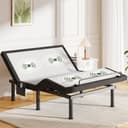 DOMIA T600 Queen Adjustable Bed Frame Only queen with both presets | Key specZero-G, anti-snorePresets | Score8.2/10 | |
| Rank2 | 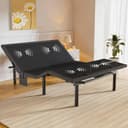 Amada 01B-Q1 Queen Adjustable Bed Frame Best for easy nightly use | Key spec8-13 inLeg heights | Score9.0/10 | |
| Rank3 | 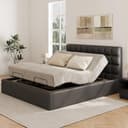 FlexiSpot S3K-Lite King Adjustable Bed Base Best drop-in for your current frame | Key specZero-clearanceClearance | Score8.4/10 | |
| Rank4 |  Marsail NS0 Split King Adjustable Bed Base Best when only one partner needs it | Key specDual, splitMotors | Score8.8/10 | |
| Rank5 | 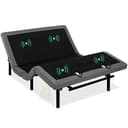 Best Choice Products Ergonomic Queen Adjustable Bed Frame Best plain wireless queen | Key specNot publishedLeg heights | Score8.2/10 |
Prices checked November 7, 2026. Scores are our published spec rubric, not a test result — here is exactly how they are calculated.
The picks, and where each one stops
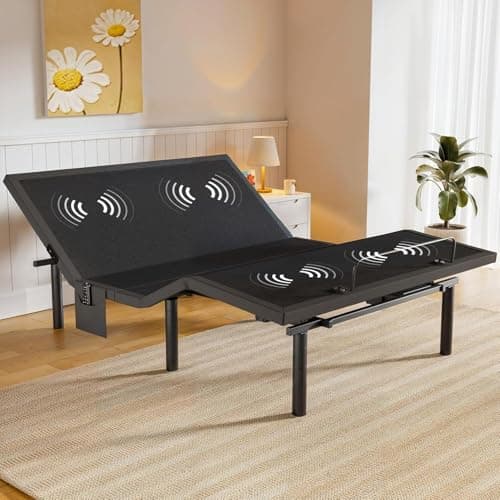
The DOMIA T600 queen is the only queen here that publishes both a zero-gravity and an anti-snore preset, which is exactly the pair you want if positioning is the whole point. Both are one-button positions you can reach in the dark, and this listing backs them with a 750 lb capacity, an under-bed nightlight and a motor published at 45 dB or less. The honest limits: it never says whether the remote is wireless or wired, it publishes no deck height above its three leg heights — and, worth repeating, the anti-snore button is a small head raise, not a medical function.
The Amada queen names a zero-gravity setting but no anti-snore preset, so the small head raise for snoring is one you set by hand — which, given that no listing publishes the angle its anti-snore button stops at, is not the loss it sounds. What it does have is the most livable bedside here for someone getting up in the dark: a wireless remote, an LED night light under the frame, head travel published at 65 degrees, and a USB-A and a USB-C on each side for the phone and the chargers that collect on a bedside table. It publishes 750 lb and four leg heights in inches. Against it: it is queen only, and it never publishes the depth of the deck above those legs.
The FlexiSpot S3K-Lite is a zero-clearance king base that drops inside a bed frame you already own, so the finished height stays whatever already works for you, and it publishes a zero-gravity preset. Against it: the listing publishes almost nothing else — no capacity, no remote type — and if your existing frame is already too low, a drop-in base does not fix that; risers or a different frame do.
The Marsail NS0 split king is the one to look at if you share the bed and only one of you needs the head raised. Two independent halves mean one person can sit up while the other stays flat, and it publishes both zero-gravity and anti-snore presets plus four USB ports. The cost is real: a split king needs two twin XL mattresses and a gap filler, and two motors are twice the things that can fail out of warranty.
The Best Choice Products queen is the plain option that turns out to save the most positions: head and foot incline worked by a wireless remote with its own flashlight, an under-frame nightlight, two USB ports, a published 750 lb, and TV, head-tilt and zero-gravity presets plus one you can store yourself. That wireless remote matters more than it sounds on a falls-focused site — there is no cord to trip on beside the bed. Against it: none of those presets is an anti-snore position, no angle is published for any of them, and the listing states nothing at all about leg height. Pick it if a cordless base at a plain price is the point and a saved anti-snore position is not.
What none of these listings publish
Read the picks above and you will notice how often the phrase 'not published' turns up, and that is the honest state of this category. These are affordable bases, and affordable bases publish thin spec sheets. For apnea positioning specifically, three blanks are worth knowing about before you spend anything.
- The maximum head angle on three of the five. The DOMIA and the Amada publish 65 degrees; the FlexiSpot, the Marsail NS0 and the Best Choice Products queen state nothing in degrees, so for those three 'how high does it actually go' is a question you answer with a phone level after it arrives, not before.
- Weight capacity. Only some bases in our wider comparison publish a figure at all; among these picks most do not, and it is the number you most want before leaning on the edge of a frame.
- Noise. A couple of listings claim a quiet motor; the rest say nothing, and 'quiet' is not a measured figure anyone can be held to.
We would rather point at the blanks than fill them with numbers we cannot stand behind. If any of the three matters to your decision, a short message to the seller before ordering is worth the five minutes.
The bases in full
1 · Only queen with both presets
DOMIA T600 Queen Adjustable Bed Frame
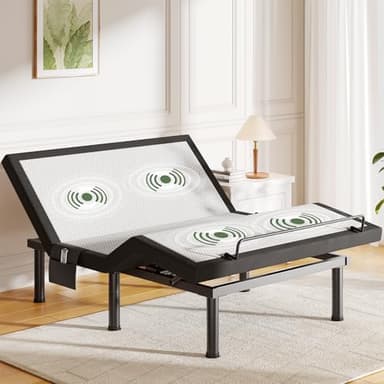
The only queen here that publishes both a zero-gravity and an anti-snore preset, on the only queen base in the set that also publishes a warranty term and a motor-noise figure.
- Presets
- Zero-G, anti-snore
- Our spec score
- 8.2/10
- Best for
- Both presets, published
As of November 7, 2026. #ad How we’re funded
What works
- Zero-gravity and anti-snore are both published as presets — no other queen in this set states both — alongside a 750 lb capacity this category usually leaves blank
- Motor noise given as a number, under 45 dB, rather than as the word quiet. Only two other bases in this set — both Tami Tami split kings — do that
- A five-year warranty on the frame and motor, and 30,000 tested lift cycles, both published. No other queen base here publishes a warranty term at all
What doesn’t
- The listing never says whether the remote is wireless or wired, and on a bed you operate from the mattress that is the control detail that matters most
- Three leg heights are published but not the depth of the deck sitting on them, so the finished sleep-surface height is still an estimate until it arrives
- The listing rules out a zero-clearance setup — the legs are required — so this cannot drop inside a frame you already own
Published specifications
| Positions | Head to 65 degrees and foot to 45 degrees, separately or together, plus zero-gravity and anti-snore presets |
|---|---|
| Motors | Dual, 8,000 N of thrust published, tested to 30,000 lift cycles |
| Leg height options | 3 heights up to 12 inches, from 4 in and 8 in leg sections |
| Frame height off floor | Not published |
| Remote | Not published |
| Weight capacity | 750 lb |
| Massage | Head and foot, multiple modes and intensity levels |
| USB ports | USB-A and USB-C |
| Motor noise | Under 45 dB |
| Under-bed light | Under-bed nightlight |
| Warranty | 5 years on frame and motor |
| Sizes listed | Queen |
Read from the product listing on 2026-09-10. Blanks are specifications the manufacturer does not publish, not figures we could not be bothered to find.
How the score was reached
| Entry-height controlThree leg-height options published with their measurements; four or more is the top band, and the frame height itself is not published. | 8 |
|---|---|
| ControlsThe listing never states whether the remote is wireless — the neutral score on /methodology. | 5 |
| Weight capacity750 lb published — the top band on /methodology. | 10 |
| Position rangeHead and foot, separately or together, plus published zero-gravity and anti-snore presets. | 9 |
| Setup and daily useAll three: USB-A and USB-C ports, an under-bed nightlight and a published tool-free five-minute assembly. | 9 |
| Mean, rounded to one decimal | 8.2 |
2 · Best for easy nightly use
Amada 01B-Q1 Queen Adjustable Bed Frame
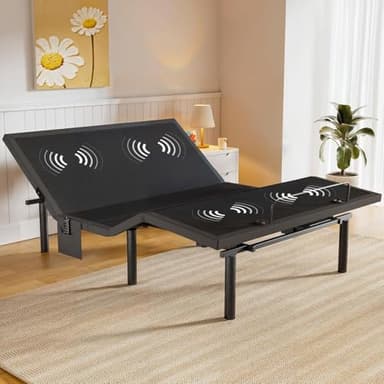
The queen that publishes its leg heights as actual inches — four of them — with an under-frame light alongside, which is the combination that matters if getting out is the problem.
- Leg heights
- 8-13 in
- Our spec score
- 9.0/10
- Best for
- Getting the height right
What works
- Four leg heights published as measurements, not a count, so the sleep surface can be planned to your legs before delivery
- An LED night light under the frame, which is the difference between a lit path to the bathroom and feeling for the wall
- A published 750 lb capacity, and a USB-A and a USB-C on each side so the phone, the hearing aid charger and the lamp do not fight over one outlet
What doesn’t
- The listing publishes the leg heights but never the depth of the deck on top of them, so the finished sleep surface is still an estimate until it arrives
- The zero-gravity preset is named but the angles it drives to are not, so what the button actually does is unknown until you press it
- Queen only in this listing, so a split configuration is not an option here
Published specifications
| Leg height options | 4 — 8, 10, 11 and 13 in, built from 2, 3 and 8 in leg sections |
|---|---|
| Frame height off floor | Not published |
| Remote | Wireless |
| Weight capacity | 750 lb |
| Positions | Head to 65°, foot to 45°, with a zero-gravity preset |
| Massage | Head and foot, 3 intensities and 4 modes |
| USB ports | USB-A and USB-C on each side |
| Under-bed light | LED night light |
| Sizes listed | Queen |
Read from the product listing on 2026-09-23. Blanks are specifications the manufacturer does not publish, not figures we could not be bothered to find.
How the score was reached
| Entry-height controlFour published leg heights, as inches; the deck depth above them is not published. | 9 |
|---|---|
| ControlsWireless remote plus a lit under-frame light for night use. | 9 |
| Weight capacity750 lb published — the top band on /methodology. | 10 |
| Position rangeHead and foot to published angles, plus one named preset — zero gravity. No anti-snore. | 8 |
| Setup and daily useUSB-A and USB-C per side, an LED night light and a published 3-step tool-free build. | 9 |
| Mean, rounded to one decimal | 9.0 |
3 · Best drop-in for your current frame
FlexiSpot S3K-Lite King Adjustable Bed Base
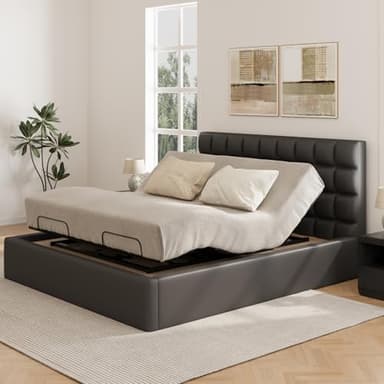
Zero clearance means it drops into an existing bed frame, which is the cheapest way to keep a bed you already like at a height you already know works.
- Clearance
- Zero-clearance
- Our spec score
- 8.4/10
- Best for
- Dropping into your existing frame
As of November 7, 2026. #ad How we’re funded
What works
- Zero-clearance: it sits inside the bed frame you already own, so the finished height stays whatever it is now
- Zero-gravity, anti-snore and a one-button memory position, all published — the fullest preset list of any base here
- A published 750 lb capacity, a five-year quality guarantee and a remote with a built-in flashlight, so finding the flat button at 3am does not mean finding a lamp first
What doesn’t
- One leg height, 12 inches, and no published frame height — so if you use it outside a frame the finished height is fixed
- If your existing frame is already too low, a zero-clearance base does not fix that; risers or a different frame do
- King only, and no USB ports or under-bed lighting published
Published specifications
| Fits inside an existing frame | Yes — zero-clearance design |
|---|---|
| Leg height options | 12 in legs (one published height) |
| Frame height off floor | Not published |
| Remote | Wireless, with a built-in flashlight |
| Weight capacity | 750 lb |
| Positions | Head and foot incline, zero-gravity, anti-snore and a memory preset |
| Massage | Not published |
| USB ports | Not published |
| Under-bed light | Not published |
| Warranty | 5 years — a five-year quality guarantee, stated on the listing |
| Sizes listed | King |
Read from the product listing on 2026-10-21. Blanks are specifications the manufacturer does not publish, not figures we could not be bothered to find.
How the score was reached
| Entry-height controlZero-clearance preserves your existing frame height; one published leg height, 12 in, and no frame height. | 7 |
|---|---|
| ControlsWireless remote with a published built-in flashlight for night use. | 9 |
| Weight capacity750 lb published — the top band on /methodology. | 10 |
| Position rangeZero-gravity, anti-snore and a memory preset all published — the top band. | 10 |
| Setup and daily useNo USB, lighting or assembly detail published. | 6 |
| Mean, rounded to one decimal | 8.4 |
4 · Best when only one partner needs it
Marsail NS0 Split King Adjustable Bed Base

Two independent halves, so one person can sit up to read at midnight without tipping the other one out of a book.
- Motors
- Dual, split
- Our spec score
- 8.8/10
- Best for
- Two people, one bed
As of November 7, 2026. #ad How we’re funded
What works
- Each half moves independently, which is the entire argument for a split king
- Published zero-gravity and anti-snore presets — an anti-snore preset is a small head raise, not a medical device
- Published three-minute setup, four USB ports and a 750 lb rating per twin XL half
What doesn’t
- A split king needs two twin XL mattresses and a gap filler, which is money and effort the listing price does not include
- The legs are described as adjustable but neither the number of settings nor the heights are published, so the entry height is still a guess until it arrives
- A one-year warranty, where two of the split kings we track publish five
Published specifications
| Configuration | Split king — two independent twin XL halves |
|---|---|
| Motors | Dual motor, validated for 50,000 cycles |
| Leg height options | Adjustable legs; neither the count nor the heights are published |
| Frame height off floor | Not published |
| Remote | Wireless |
| Weight capacity | 750 lb per twin XL half |
| Positions | Head and foot incline, zero-gravity and anti-snore presets |
| USB ports | 4 |
| Under-bed light | Yes |
| Motor noise | Not published |
| Warranty | 1 year |
| Sizes listed | Split king |
Read from the product listing on 2026-08-28. Blanks are specifications the manufacturer does not publish, not figures we could not be bothered to find.
How the score was reached
| Entry-height controlAdjustable legs published, but no count and no measurements — the middle band on /methodology. | 7 |
|---|---|
| ControlsWireless remote plus a published under-bed light. | 9 |
| Weight capacity750 lb per half published — the top band on /methodology. | 10 |
| Position rangeIndependent halves plus published zero-gravity and anti-snore presets. | 9 |
| Setup and daily useFour USB ports, under-bed lighting, three-minute setup claimed. | 9 |
| Mean, rounded to one decimal | 8.8 |
5 · Best plain wireless queen
Best Choice Products Ergonomic Queen Adjustable Bed Frame
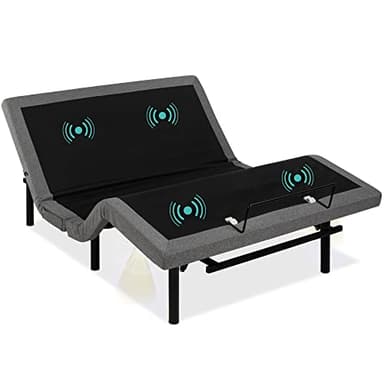
A long-listed, conventional queen base that names three presets and a lit remote; nothing published about height, which is the thing this site cares about most.
- Leg heights
- Not published
- Our spec score
- 8.2/10
- Best for
- A plain queen base
As of November 7, 2026. #ad How we’re funded
What works
- Three named presets plus a saved custom position — more named positions than any other queen we track
- A wireless remote with its own flashlight, a nightlight under the frame, two USB ports and a published 750 lb capacity
- It has been listed long enough to have a real service history behind it, which newer entries do not
What doesn’t
- Nothing at all published about leg height or frame height — on the one site metric that matters most, this listing is silent
- The presets are named but no angle is published for any of them, and there is no anti-snore position among them
- 137 lb of frame, which is a two-person carry and a real consideration up a staircase
Published specifications
| Leg height options | Not published |
|---|---|
| Frame height off floor | Not published |
| Remote | Wireless, with a built-in flashlight |
| Weight capacity | 750 lb |
| Positions | Head and foot incline, with TV, head-tilt and zero-gravity presets and a saved custom position |
| Massage | Wave, pulse and constant modes |
| USB ports | 2 |
| Under-bed light | Nightlight |
| Sizes listed | Queen |
Read from the product listing on 2026-09-23. Blanks are specifications the manufacturer does not publish, not figures we could not be bothered to find.
How the score was reached
| Entry-height controlNo leg-height information published — neutral score. | 5 |
|---|---|
| ControlsWireless remote with a flashlight, plus a published nightlight. | 9 |
| Weight capacity750 lb published — the top band on /methodology. | 10 |
| Position rangeHead and foot incline plus three named presets — TV, head-tilt and zero gravity. | 9 |
| Setup and daily useTwo USB ports and a nightlight published. | 8 |
| Mean, rounded to one decimal | 8.2 |
If you already have a CPAP
An adjustable bed and a CPAP are not competitors; they solve different problems, and used together the bed can make the machine easier to live with. A raised head can reduce the swallowed air — aerophagia — that some CPAP users find uncomfortable, and a tidy incline gives the hose somewhere to sit rather than dragging across your face. We wrote the whole comparison on CPAP versus an adjustable bed, including an honest table of what each one does and does not do.
None of that is the bed treating your apnea. It is the bed removing small frictions that make people give up on a mask in the first weeks — which is exactly the period when most people who abandon CPAP do so. If a more tolerable setup keeps you using the machine, the bed has helped in the only way it honestly can: by supporting the treatment, not standing in for it.
The cheapest thing to try first
If there is no apnea diagnosis and the complaint is simply snoring — usually somebody else's complaint — the shortlist shifts, because what you are buying is a published anti-snore position rather than a tolerable place to wear a CPAP mask. The snoring page, and the angle none of these bases publishes.
Before any base, you can find out whether head elevation does anything for your snoring for the price of a wedge pillow. Prop your upper body up from the shoulders — not by folding your neck on stacked pillows — for a week and see whether it changes anything. If it does, a base makes that angle repeatable and stops it sliding away at two in the morning; if it does not, you have saved the cost of a base. The wedge-versus-base comparison lays out that test, and our reflux page lists the wedges we track.
Questions people actually ask
Can an adjustable bed cure sleep apnea?
No. Obstructive sleep apnea is a medical diagnosis, and its first-line treatment is CPAP. A bed position is not a treatment and does not claim to be. Raising the head may reduce ordinary snoring and, for some people, mild positional breathing problems, but that is not the same as treating apnea. If apnea is suspected, that is a clinician conversation.
Does raising the head of the bed help sleep apnea?
For some people with mild, position-dependent events it helps a little, and it can reduce snoring that is not apnea. Only a sleep study can tell you whether your breathing problem is positional. A bed is comfort and positioning alongside medical care, never a substitute for it.
What is the anti-snore position?
A small head raise, typically in the region of seven degrees, saved as a one-button preset. It is a mild positional adjustment that reduces snoring for some sleepers. It is not a medical device and not a treatment for diagnosed sleep apnea.
Can I use a CPAP machine with an adjustable bed?
Yes, and for some people the two work well together: a raised head and a managed hose can make the mask easier to tolerate. The bed does not replace the machine. CPAP and adjustable beds covers what each one does and does not do.
What angle is best for sleep apnea?
There is no universal figure. Two of the bases here publish how far the head section travels — the DOMIA T600 and the Amada queen both state 65 degrees — but that is the limit of the motor, not a recommendation, and none of them publishes the angle its anti-snore or zero-gravity button actually stops at. What matters mechanically is that the whole upper body is raised from the hips rather than the neck being folded on pillows. Measure whatever you settle on with a phone level so it is repeatable.
Sources
Every factual claim on this page traces to one of these, or to a product listing cited in the specification table beside it.
Read next
Head to head
CPAP vs Adjustable Bed
One is a medical treatment, the other is furniture. The useful question is not which — it is what each one is for.
Comparison
Best Adjustable Beds for Seniors
Ranked on leg height, controls and published capacity — not on how the marketing photo looks.
Our top pick — Amada 01B-Q1 Queen Adjustable Bed Frame
Guide
Elevation Angles
Thirty degrees is not a wedge height and a wedge height is not an angle. Here is the arithmetic that connects them.
Comparison
Best Under $1,000
What a four-figure budget actually buys, and the three things you give up when you spend less.
Our top pick — Pipishell Twin XL Adjustable Bed Frame with Massage
$429.99 · Check priceAs of November 7, 2026. #ad How we’re funded
Guide
COPD and Breathing
Raising the head and chest helps some people breathe more easily. It is comfort positioning only, never a substitute for your prescribed care.

Nothing here is medical advice. Prices are pulled live and stamped with the date they were checked; scores are our published spec rubric, not a test result. How we pick · How we make money · Corrections