Head to head
Pursuing coverage vs buying outright
One costs weeks and might end in a denial. One costs a few hundred dollars and arrives Thursday. How to choose.
By Stephen V.Published Updated How we pick
This is a decision about time and certainty as much as money, and it is much easier once you separate the two products involved.
| Pursuing Medicare coverage | Buying outright | |
|---|---|---|
| What you get | A hospital bed | An adjustable base, or a cheaper targeted fix |
| Eligibility | Clinical criteria in L33820 must be met | None |
| Your cost if it works | 20% after the Part B deductible | The full price |
| Time | Weeks — appointment, documentation, supplier | Days |
| Risk | It may be denied | None, beyond the money |
| Whole-bed height adjustment | Yes | No |
| Fitted side rails | Yes | No — portable rails only |
| What it looks like in a bedroom | Like a hospital bed | Like a bed |
Pursue coverage if
- The clinical criteria plainly apply — positioning not feasible in an ordinary bed, head elevation over 30 degrees most of the time for one of the named conditions, or traction equipment.
- Someone helps with transfers, and the bed genuinely needs to raise and lower as a whole. No consumer product does this.
- Full-length fitted side rails are needed. A portable rail on an ordinary bed is not the same thing and the safety considerations are real.
- A clinician has already suggested it. That is the strongest signal there is.
Buy outright if
- The goal is angle — reflux, breathing, swelling, reading. A base costs far less than most people expect and arrives this week.
- The goal is getting out of bed more easily. That is height, and it is the cheapest fix in this whole subject. Run the arithmetic.
- The criteria clearly do not apply. Time spent pursuing a denial is time nobody gets back.
- The person will not accept a hospital bed in their bedroom. This is a real and legitimate reason, and it is not vanity.
The arithmetic worth doing
Price the covered route honestly. If a hospital bed is approved, you pay 20% of the approved amount after the deductible, usually as rental until the 13-month point. Then price the outright route: today's live prices for the base, plus a mattress if yours will not flex, plus sheets.
For someone who genuinely meets the criteria, the covered route is usually much cheaper and delivers a more capable piece of equipment. For someone who does not, it costs weeks and delivers nothing. The criteria are the whole decision, and they are quoted in full here.
The arithmetic is even more lopsided on the small safety items, because a rail or a bedside handle costs a fraction of a base and is not covered under any code. Bed rails and Medicare, with the coverage sentence quoted.
One thing to settle before you price either route: which plan you are actually on. A Medicare Advantage plan covers the same items as Original Medicare but can require prior authorization and an in-network supplier, and that changes the timeline rather than the price. How Advantage plans, private insurance and long-term care policies treat this purchase.
Questions people actually ask
Is it worth applying for Medicare coverage of a bed?
It is worth it if the clinical criteria genuinely apply, because a covered hospital bed can be substantially cheaper than buying equivalent equipment. It is not worth it if the criteria do not apply, because a consumer adjustable base is not a covered product at all.
How long does the Medicare route take?
It varies by supplier and contractor and we will not invent a figure. What is predictable is that it involves a clinical appointment, documentation, a supplier and possibly prior authorization — so it is measured in weeks rather than days.
What if I need something now?
Buy the cheap thing that solves the immediate problem — risers, a handle, a wedge — and pursue coverage in parallel if the criteria apply. Those purchases are small and they do not prejudice anything.
Will buying something myself affect a future claim?
Buying consumer furniture does not affect a Medicare claim for a hospital bed, because they are different products. If you are unsure, ask your supplier or a State Health Insurance Assistance Program counselor before spending on anything substantial.
Sources
Every factual claim on this page traces to one of these, or to a product listing cited in the specification table beside it.
Read next
Guide
Medicare Coverage
No. It can cover a hospital bed, and here are the actual criteria, quoted, with the codes and what you would pay.
Guide
Getting a Bed Approved
What the physician actually has to document, in what order, and the two mistakes that produce most denials.
Comparison
Best Under $1,000
What a four-figure budget actually buys, and the three things you give up when you spend less.
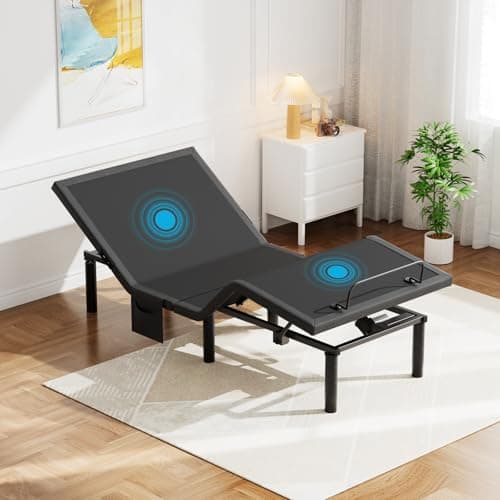
Our top pick — Pipishell Twin XL Adjustable Bed Frame with Massage
$429.99 · Check priceAs of October 20, 2026. #ad How we’re funded
Guide
What It Costs
Live prices across every category, plus the four accessory costs that never appear in anyone's total.
Our top pick — Pipishell Twin XL Adjustable Bed Frame with Massage
$429.99 · Check priceAs of October 20, 2026. #ad How we’re funded


Nothing here is medical advice. Prices are pulled live and stamped with the date they were checked; scores are our published spec rubric, not a test result. How we pick · How we make money · Corrections