Guide
Does insurance cover an adjustable bed?
Original Medicare is not the only plan people have. Here is how Advantage plans, private health insurance and long-term care policies actually treat this purchase.
By Stephen V.Published How we pick
Our Medicare page answers the version of this question most people ask, and the answer is no: Original Medicare covers hospital beds as durable medical equipment when a doctor certifies medical necessity, and an adjustable bed base sold as furniture is not that product. But Original Medicare is not the only plan people have. This page is about the other three - a Medicare Advantage plan, an ordinary private or employer health plan, and a long-term care policy - and what each can genuinely do.
The rule that every one of them is built on
Before the plans, the product. Medicare's published definition of durable medical equipment is the template most private plans borrow, and it is short enough to quote in full. Equipment qualifies if it is durable, meaning it can withstand repeated use; used for a medical reason; typically only useful to someone who is sick or injured; used in your home; and expected to last at least three years.
Read the third clause again, because it is the one an adjustable base fails. A motorized bed base is sold to people who are not sick or injured, in furniture stores and on Amazon, as a comfort product. That is not a technicality a better-worded letter gets around - it is what the product is. A hospital bed is a different item with its own codes and its own clinical criteria, and that is the thing a plan may pay for. Everything below follows from that one distinction.
Medicare Advantage: the same list, a different process
A Medicare Advantage plan - Part C - is a private plan that stands in for Original Medicare. Medicare.gov describes these plans plainly: Medicare health plans provide Part A hospital insurance and Part B medical insurance benefits to people with Medicare, and they are generally offered by private companies that contract with Medicare. The practical consequence is that the benefit does not shrink when you move to Part C, and it does not expand into consumer furniture either.
Medicare health plans provide Part A (Hospital Insurance) and Part B (Medical Insurance) benefits to people with Medicare. They are generally offered by private companies that contract with Medicare.
What does change is how you get the item. An Advantage plan can require prior authorization, can require that the supplier be in its network, and can prefer particular brands. Those are real differences and they are where Advantage claims fail in practice - not because the bed was ineligible, but because the paperwork went to a supplier outside the network or went in without the authorization. If you are pursuing a hospital bed on an Advantage plan, ask the plan two questions before anything else: which suppliers are in network for durable medical equipment, and is prior authorization needed for HCPCS codes E0260 or E0261.
Private and employer health insurance
For an employer plan or a marketplace plan the analysis is the same and the answer is usually the same: the DME benefit, if there is one, covers medically necessary equipment prescribed by a clinician, and a consumer adjustable base does not meet that description. Plans vary in how they define the benefit, what they require to authorize it, and how much they leave you to pay, so the only reliable source is your own plan document - the summary of benefits and coverage, under durable medical equipment.
Three things worth knowing before you call. A prescription from a doctor does not by itself create coverage; it is necessary and not sufficient, because the item still has to be a covered category. A letter of medical necessity is worth having anyway, because it is also what makes an HSA or FSA reimbursement defensible - which is a different route with different rules. And a plan that denies the base may still cover the hospital bed, so it is worth asking about the product that has a code rather than the product you saw in an advertisement.
Long-term care insurance
This is the one most families have not thought about and the one we can say least about with confidence. Long-term care policies are written to pay for care - help at home, assisted living, nursing facility costs - rather than to buy equipment, and any equipment or home-modification allowance is a feature of the individual contract rather than of the product category. Some policies include one. Many do not.
So the honest instruction is: read your own policy schedule, look for any home modification or equipment benefit, and ask the administrator in writing whether a bed or bed equipment falls inside it. We are not going to characterize what long-term care insurance generally covers, because there is no published rule to cite and the variation between policies is the whole story.
| Route | Consumer adjustable base | Hospital bed | Where the rule lives |
|---|---|---|---|
| Original Medicare | No | Possible, on criteria | Coverage determination L33820 |
| Medicare Advantage | No | Same items, plan process | Your plan's DME rules |
| Private or employer plan | Generally no | Possible, plan-defined | Your summary of benefits |
| Medicaid | Varies by state | Varies by state | Your state Medicaid program |
| VA health care | Not as furniture | Possible on referral | Prosthetic and Sensory Aids Service |
| Long-term care policy | Read the policy | Read the policy | Your own contract |
| HSA or FSA | Sometimes, with documentation | Yes, with documentation | IRS Publication 502 |
The Medicaid and VA rows have their own page, because both work nothing like Medicare and both are worth checking before you conclude nobody will help - Medicaid and VA routes. The HSA and FSA row has one too, and it is the route that most often produces an actual result for an actual reader: what makes a purchase eligible.
What to buy when the answer is no
For most people it will be no, and the useful thing then is to spend the money where it changes the most. Which is rarely the biggest product. Work out what the actual problem is first: if the bed is hard to get out of, that is height and it is fixed for very little; if the problem is needing to sleep at an angle, a wedge answers it for less than a tank of fuel; if you genuinely want the angle held every night by a motor, that is when a base is the right purchase and not before.
| # | Pick | Key spec | Score | Price |
|---|---|---|---|---|
| Rank1 | 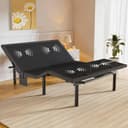 Amada 01B-Q1 Queen Adjustable Bed Frame Best base if you are paying yourself | Key spec4 adjustableLeg heights | Score8.8/10 | |
| Rank2 | 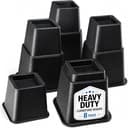 Home It Adjustable Bed Risers, 3/5/8 in Cheapest thing that actually helps | Key spec3, 5 or 8 inLift | Score8.5/10 | |
| Rank3 |  Kolbs Bed Wedge Pillow, 7.5 in The FSA-eligible option | Key spec7.5 inRise | Score8.8/10 |
Prices checked September 17, 2026. Scores are our published spec rubric, not a test result — here is exactly how they are calculated.
1 · Best base if you are paying yourself
Amada 01B-Q1 Queen Adjustable Bed Frame
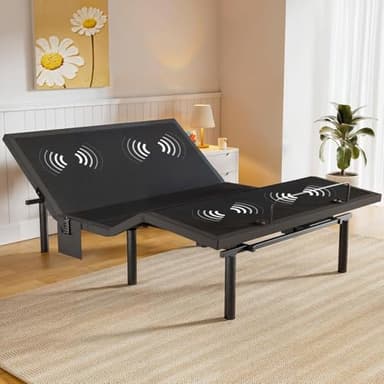
The base in this set that publishes the most leg heights — four — with an under-frame light alongside, which is the combination that matters if getting out is the problem.
- Leg heights
- 4 adjustable
- Our spec score
- 8.8/10
- Best for
- Getting the height right
What works
- Four leg heights, so the sleep surface can be set to your legs rather than the other way round
- An LED night light under the frame, which is the difference between a lit path to the bathroom and feeling for the wall
- A published 750 lb capacity, and four USB ports so the phone, the hearing aid charger and the lamp do not fight over one outlet
What doesn’t
- The listing publishes a capacity but not the frame height off the floor, so you still cannot work out the finished sleep surface before it arrives
- No zero-gravity or anti-snore preset — you set the angle by hand every time
- Queen only in this listing, so a split configuration is not an option here
Published specifications
| Leg height options | 4 height-adjustable legs |
|---|---|
| Frame height off floor | Not published |
| Remote | Wireless |
| Weight capacity | 750 lb |
| Positions | Head and foot incline |
| Massage | Yes |
| USB ports | 4 built-in |
| Under-bed light | LED night light |
| Sizes listed | Queen |
Read from the product listing on 2026-08-26. Blanks are specifications the manufacturer does not publish, not figures we could not be bothered to find.
How the score was reached
| Entry-height controlFour published leg-height options; the frame height itself is not published. | 9 |
|---|---|
| ControlsWireless remote plus a lit under-frame light for night use. | 9 |
| Weight capacity750 lb published — the top band on /methodology. | 10 |
| Position rangeHead and foot incline; no published presets. | 7 |
| Setup and daily useFour USB ports and an LED night light are both published. | 9 |
| Mean, rounded to one decimal | 8.8 |
2 · Cheapest thing that actually helps
Home It Adjustable Bed Risers, 3/5/8 in
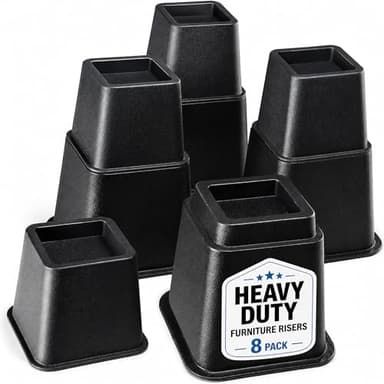
Three published lift heights from one set and a published 1,300 lb rating — the most flexible way to test a height before committing to it.
- Lift
- 3, 5 or 8 in
- Our spec score
- 8.5/10
- Best for
- Trying a height first
What works
- Three heights out of one box, so you can try 3 inches, decide it is not enough, and go to 5 without buying twice
- A published 1,300 lb rating for the set, and a published material — polypropylene, not an unnamed plastic
- Cheap enough that testing a height costs less than being wrong about one
What doesn’t
- Stacked risers are less stable than a single-piece riser of the same height — stack at your own judgment
- No published socket depth, and socket depth is what decides whether your bed leg actually sits in it
- Raising a bed raises the fall distance. Height helps you stand; it does not help you land
Published specifications
| Lift heights | 3, 5 or 8 inches (stackable) |
|---|---|
| Load rating | 1,300 lb |
| Pack | 4 |
| Material | Polypropylene |
| Socket depth | Not published |
Read from the product listing on 2026-08-26. Blanks are specifications the manufacturer does not publish, not figures we could not be bothered to find.
How the score was reached
| Lift rangeThree published heights from 3 to 8 inches. | 10 |
|---|---|
| Load rating1,300 lb published for the set. | 9 |
| StabilityPolypropylene with a broad base published; stackable by design, and no socket depth. | 7 |
| Set sizeFour-pack — one per bed leg. | 8 |
| Mean, rounded to one decimal | 8.5 |
3 · The FSA-eligible option
Kolbs Bed Wedge Pillow, 7.5 in
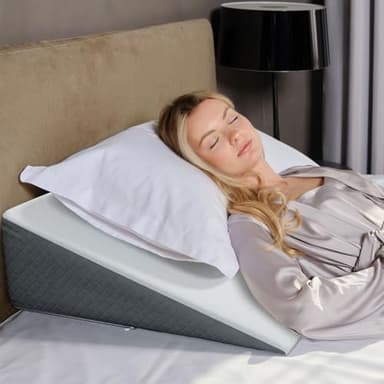
A published 7.5-inch rise and a published FSA eligibility, at roughly one twentieth of what a base costs.
- Rise
- 7.5 in
- Our spec score
- 8.8/10
- Best for
- Trying elevation cheaply
As of September 17, 2026. #ad How we’re funded
What works
- If the problem is reflux, this is the thing to try before a base — and CMS itself points people at elevation before equipment
- FSA eligibility is published, which turns a $36 pillow into a pre-tax $36 pillow
- It publishes what is inside it: a 1.5-inch memory foam top layer over a high-density foam core, on a removable machine-washable cover
What doesn’t
- A wedge raises your chest, not the whole bed. It does nothing at all for getting out of bed
- 7.5 inches is a modest rise; some people need more angle than this gives
- The foam densities themselves are not published, so how much the core will sag over a year is still a guess
Published specifications
| Height | 7.5 inches |
|---|---|
| Width | Standard |
| FSA eligible | Yes (stated on the listing) |
| Cover | Jacquard, removable and machine washable |
| Fill | 1.5 in memory foam over a high-density foam core |
Read from the product listing on 2026-08-26. Blanks are specifications the manufacturer does not publish, not figures we could not be bothered to find.
How the score was reached
| Rise published7.5-inch height published. | 9 |
|---|---|
| CoverageStandard width stated; no length or torso-coverage figure. | 6 |
| Cover and careA removable, machine-washable jacquard cover and a published two-layer fill. | 10 |
| Cost of tryingFSA-eligible and an order of magnitude below a base. | 10 |
| Mean, rounded to one decimal | 8.8 |
The Amada is the base we rank first across this site, because it publishes four adjustable leg heights and an under-frame light - the two specifications that bear on getting out of bed rather than on lying in it. The risers are there because they are the cheapest real improvement available to anybody in this position, publishing three lift heights and a 1,300 lb load rating. The Kolbs wedge is there because it states FSA eligibility on its own listing, which makes it the one product on this page with a genuine route to being paid for with pre-tax money. Prices on all three are pulled live and stamped with the date they were checked. What a base actually costs has the wider picture, and paying over time covers the arithmetic if the whole amount is not available at once.
The four questions to ask your plan
- Does my plan have a durable medical equipment benefit, and what does it pay? Get the percentage and the deductible, not just a yes.
- Is HCPCS code E0260 or E0261 covered, and under what conditions? Those describe a hospital bed. Asking about the code rather than about an adjustable bed gets you a real answer.
- Is prior authorization required, and which suppliers are in network? This is where Advantage and private plan claims most often fail.
- If it is denied, will you send the denial in writing with the reason? Say this before the decision, not after.
And if you want a second pair of eyes that is not selling you anything, every state has a State Health Insurance Assistance Program offering free, unbiased counseling on exactly these questions. It costs nothing and the counselors do this every day.
Questions people actually ask
Does health insurance cover an adjustable bed?
Generally not, for the same reason Medicare does not: an adjustable bed base sold as consumer furniture is not durable medical equipment. Medicare's own definition requires equipment that is durable, used for a medical reason, typically only useful to someone who is sick or injured, used in your home and expected to last at least three years. Most private plans are built on the same DME concept, so the product is the obstacle rather than the plan.
Does a Medicare Advantage plan cover adjustable beds?
It covers what Original Medicare covers, which is a hospital bed on medical necessity and not a consumer adjustable base. Medicare health plans provide Part A and Part B benefits to people with Medicare, so the item list does not change when you move to Part C. What can change is the process - the network you must use and whether prior authorization is required.
Does Humana, UnitedHealthcare or Aetna cover adjustable beds?
We are not going to answer for a named insurer, because we cannot read your plan and their rules differ by plan and by state. What we can tell you is what to ask and what to ask it about: the DME benefit, whether HCPCS code E0260 or E0261 is covered, and under what conditions. Those codes describe a hospital bed, which is the product your plan may pay for - the criteria are here.
Does long-term care insurance pay for an adjustable bed?
Long-term care policies pay for care and services rather than for equipment, as a rule, and any equipment allowance is written into the individual policy. There is no general answer, and anyone who gives you one has not read your contract. The document to read is your own policy schedule, and the person to ask is the policy administrator - in writing, so you have the answer on paper.
What if no insurance will pay?
That is the outcome for most people, and it is worth knowing early rather than after three months of phone calls. The good news is that the cheapest interventions are the ones that most often solve the actual problem - the height of the bed is fixed for a small fraction of a base, and a wedge pillow answers the elevation question for less again.
Sources
Every factual claim on this page traces to one of these, or to a product listing cited in the specification table beside it.
Read next
Guide
Medicare Coverage
No. It can cover a hospital bed, and here are the actual criteria, quoted, with the codes and what you would pay.
Guide
Medicaid and VA
Two routes that work nothing like Medicare, and are worth checking before you conclude nobody will help.
Guide
HSA and FSA
Usually not for a bed, sometimes for what goes on it. What actually decides eligibility, and what a letter of medical necessity does.
Head to head
Coverage vs Buying
One costs weeks and might end in a denial. One costs a few hundred dollars and arrives Thursday. How to choose.
Guide
Financing & Payments
A payment plan changes when you pay, not what a bed costs — and on the wrong terms it costs more. How to read the plan before you sign.

Nothing here is medical advice. Prices are pulled live and stamped with the date they were checked; scores are our published spec rubric, not a test result. How we pick · How we make money · Corrections