Single review
Kolbs bed wedge pillow
The cheapest honest way to test whether sleeping on an incline helps — read on what Kolbs publishes, and the things a fixed foam ramp can never do.
By Stephen V.Published Updated How we pick
We earn a commission if you buy through the links on this page, at no extra cost to you. It does not change what we recommend, and we have not tested these products — here is what we do instead.
The Kolbs wedge is the cheapest thing we cover that changes the angle you sleep at, and that is the entire point of it. It is a solid foam ramp that raises your head and chest on whatever mattress you already own, it publishes a 7.5-inch rise and — unusually for the category — a stated FSA eligibility, and it costs on the order of a twentieth of what an adjustable base costs. For a great many people that makes it the right place to start, because it answers one question cheaply: does sleeping propped up actually help me, before anyone spends on a base to do the same job by remote? We rank it first among the wedge pillows we track for exactly that reason.
1 · Trying elevation cheaply
Kolbs Bed Wedge Pillow, 7.5 in
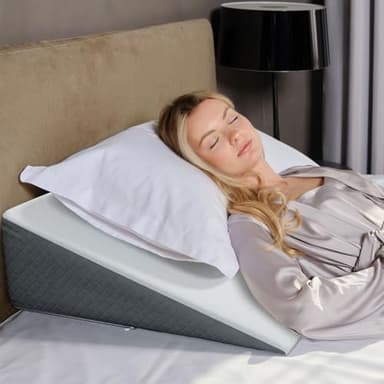
A published 7.5-inch rise and a published FSA eligibility, at roughly one twentieth of what a base costs.
- Rise
- 7.5 in
- Our spec score
- 8.8/10
- Best for
- Trying elevation cheaply
As of September 22, 2026. #ad How we’re funded
What works
- If the problem is reflux, this is the thing to try before a base — and CMS itself points people at elevation before equipment
- FSA eligibility is published, which turns a $36 pillow into a pre-tax $36 pillow
- It publishes what is inside it: a 1.5-inch memory foam top layer over a high-density foam core, on a removable machine-washable cover
What doesn’t
- A wedge raises your chest, not the whole bed. It does nothing at all for getting out of bed
- 7.5 inches is a modest rise; some people need more angle than this gives
- The foam densities themselves are not published, so how much the core will sag over a year is still a guess
Published specifications
| Height | 7.5 inches |
|---|---|
| Width | Standard |
| FSA eligible | Yes (stated on the listing) |
| Cover | Jacquard, removable and machine washable |
| Fill | 1.5 in memory foam over a high-density foam core |
Read from the product listing on 2026-08-26. Blanks are specifications the manufacturer does not publish, not figures we could not be bothered to find.
How the score was reached
| Rise published7.5-inch height published. | 9 |
|---|---|
| CoverageStandard width stated; no length or torso-coverage figure. | 6 |
| Cover and careA removable, machine-washable jacquard cover and a published two-layer fill. | 10 |
| Cost of tryingFSA-eligible and an order of magnitude below a base. | 10 |
| Mean, rounded to one decimal | 8.8 |
What you are actually buying: a cheap test
The real value of a wedge is not the foam; it is the information. Elevation eases night-time reflux for some people and lets some people breathe more comfortably propped up, and it does nothing for others — and there is no way to know which group you are in except to try it. An adjustable base can raise your head too, at many times the price, and a wedge lets you find out whether that expense is worth it for you before you commit to it. If a gentle incline turns out to help, you have your answer and you have spent very little; if it does not, you have spent very little to learn that too. That is the honest case for buying the cheapest option first, and the full wedge-versus-base comparison walks through where the line falls.
The FSA line, and why it matters
Most wedge listings say nothing about tax treatment; this one states FSA eligibility outright. If you have a flexible spending account, that means pre-tax dollars can cover it, which quietly lowers an already low cost. It is a small advantage and a real one, and it is the single spec that separates the Kolbs from the steeper wedge we also track, which makes no such statement. We are not going to quote a price — prices move, and we refuse to let a stale figure sit in the text — but the shape of the value is dependable: a cheap pillow made a little cheaper again, funded from money already set aside for health costs.
7.5 inches is a modest rise
Seven and a half inches is a sensible, moderate angle: enough to keep your head above your stomach for reflux, and gentle enough that most people do not slide down it in the night. It is deliberately not a dramatic incline, and that is the right choice for a first wedge and for most reflux use. But it is worth being clear that some people simply need more angle than this gives — the steeper 10-inch option we also cover exists for exactly that case, at the cost of more people sliding down it. If you already know from a hospital bed or a recliner that you want a pronounced recline, the modest rise here may underwhelm you; if you are testing the idea for the first time, starting gentle is the sensible move.
What a wedge cannot do
This is the part the listings never lead with, and on this site it is the most important part. A wedge raises your chest, not the bed. Everything else we cover is about the height of the sleeping surface and the effort of standing up from it, and a wedge changes neither — it does nothing whatever for the harder problem of getting into and out of bed safely. If your real difficulty is leaving the bed rather than lying in it, a wedge is money spent on the wrong layer, and bed height plus a grab handle is the page to read instead. And one firm limit that matters more than comfort: a wedge is not a treatment for sleep apnea. Positional elevation can make some people feel they breathe more easily, but obstructive sleep apnea is a diagnosed medical condition with medical treatments, and a foam ramp is not one of them — the sleep apnea page is clear about where a pillow stops and a doctor starts.
The case against it
Set the price aside and three honest reservations remain. The first is the one above — it raises the person, not the bed — and it is a limit of every wedge, not a fault of this one. The second is that 7.5 inches is modest, so a share of buyers will find it too little angle. The third is disclosure, though it is narrower than it was: the listing now names a 1.5-inch memory foam top over a high-density core, but publishes no density figure, and density is the spec that decides whether a wedge holds its shape under a real head and shoulders or slowly flattens and gives back less angle than the label promised. You learn that only after it arrives. None of these makes it a bad buy; they make it a cheap, limited one, which is exactly what a wedge is.
What we could not verify
- The fill. No foam type or density is published, so how well it holds its shape under weight is something you find out in person.
- Torso coverage. The listing states a standard width but no length or torso-coverage figure, so how much of your back it actually supports is not something the page tells you.
- How it performs for any condition. Whether elevation eases your reflux or breathing is personal and untestable from a listing — a wedge is a position to try, not a treatment. More on reflux and elevation.
- Long-term firmness. Cheaper foam can soften, and nothing here promises it will not; the washable cover outlasting the core is the usual pattern.
- Anything to do with getting out of bed. It does not address it, so there is nothing to verify — but it is the most common reason people are disappointed, so it belongs on the list.
How it compares to the other wedge we track
We cover two real wedges and, honestly, one base — because the base is where a wedge stops being the answer. The Kolbs is the gentler, cheaper, FSA-eligible one, the one to start with. The 10-inch alternative trades that modesty for a pronounced angle you feel across the whole back, with no FSA statement and more sliding down in the night. And an adjustable base does the one thing neither wedge can: it changes its angle after you have bought it, and raises your feet as well as your head. The wedge's whole flaw is that its angle is fixed in the factory and never changes; you own exactly one angle for the life of the foam.
| Option | Rise | The catch |
|---|---|---|
| Kolbs wedge | 7.5 in | Modest angle; fixed forever; foam named but not measured |
| Steeper wedge | 10 in | More angle, more sliding; no FSA line |
| Adjustable base | Any, by remote | Many times the price; also raises the feet |
Where it might not suit you
Three cases point elsewhere. If your problem is getting out of bed, this does nothing for it — read bed height instead. If you already know you want a steep recline, or you want to change the angle from night to night, a fixed 7.5-inch ramp will frustrate you and a base is the honest answer, expensive as it is — what a base actually costs is the page to weigh that against. And if your symptoms are new, worsening, or you have been told you may have sleep apnea, the right next step is a clinician, not a shopping page.
Who should buy it
Someone who wants to find out, cheaply, whether sleeping on an incline helps their night-time reflux or their breathing — before spending on a base to do the same job. The published 7.5-inch rise suits that gentle, first-try use; the stated FSA eligibility takes a little more off an already low cost; and the included washable cover is the part that will outlast everything else. Buy it understanding what it is: a cheap, fixed, limited test of one idea, and a genuinely good way to run that test. If it helps and you later want the angle adjustable and your feet raised too, that is where a base comes in — and if getting out of bed was ever the real problem, no pillow was going to be the fix.
Questions people actually ask
Does the Kolbs wedge help with acid reflux?
Raising the head and chest keeps your stomach below your throat, which many people find eases night-time reflux — and a wedge is the cheapest way to find out whether it helps you. It is a position, not a treatment, and new or worsening symptoms belong with a doctor. The reflux page.
How high is the Kolbs wedge?
A published 7.5 inches, which is a gentle, moderate incline. It is enough for reflux and light breathing comfort and gentle enough that most people do not slide down it, but some people need more angle than it gives.
Is the Kolbs wedge FSA eligible?
The listing states FSA eligibility, so if you have a flexible spending account, pre-tax dollars can cover it. That is unusual for the category, and it is the main spec that separates it from the steeper wedge we also track.
Will the Kolbs wedge help me get out of bed?
No. A wedge raises your upper body, not the bed, so it does nothing for the height of the sleep surface or the effort of standing up. If getting out of bed is the problem, the fix is bed height and a grab handle, not a pillow.
Can a wedge pillow treat sleep apnea?
No. Sleeping propped up may make some people feel they breathe more easily, but obstructive sleep apnea is a diagnosed medical condition with medical treatments, and a foam wedge is not one of them. If you think you may have apnea, see a clinician. The sleep apnea page.
Read next
Comparison
Best Wedge Pillows
The cheapest way to sleep on an incline — scored on published rise, coverage and cover, with the one thing a fixed ramp can never do.
Our top pick — Kolbs Bed Wedge Pillow, 7.5 in
$39.99 · Check priceAs of September 22, 2026. #ad How we’re funded
Comparison
Acid Reflux
Start with the cheap answer. If it works you will know within a week, and only then is a base worth considering.
Our top pick — Ruqmuis Bed Wedge Pillow, 10 in
$38.99 · Check priceAs of September 22, 2026. #ad How we’re funded
Head to head
Wedge vs Adjustable Bed
One costs a fraction of the other. The cheap one wins more often than a site funded by product links is supposed to say.
Comparison
Best Mattresses for Seniors
Scored on published height, flex and certification — not on how they feel, because we have not slept on them.
Our top pick — EGOHOME 12 Inch Queen Memory Foam Mattress
$249.99 · Check priceAs of September 22, 2026. #ad How we’re funded
Nothing here is medical advice. Prices are pulled live and stamped with the date they were checked; scores are our published spec rubric, not a test result. How we pick · How we make money · Corrections