Comparison
The best bed alarms for someone with dementia
Six in ten people living with dementia wander. That one fact changes which alarm to buy, and rules out the product most families reach for first.
By Stephen V.Published How we pick
We earn a commission if you buy through the links on this page, at no extra cost to you. It does not change what we recommend, and we have not tested these products — here is what we do instead.
If you are shopping for bed safety equipment because someone in your house has dementia, the decision is not the same one the rest of this section describes. Two things change it. The person may not reliably choose to stay put, and the person may not reliably understand a barrier. Together those rule out the product most families reach for first and promote a product most families think of last.
| # | Pick | Key spec | Score | Price |
|---|---|---|---|---|
| Rank1 | 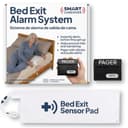 Smart Caregiver Bed Exit Alarm with Wireless Pager (RP-WPBR1-SYS) Best overall for wandering | Key spec6 sensorsPager supports | Score8.8/10 | |
| Rank2 | 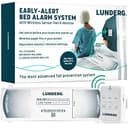 Lunderg Wireless Early Alert Bed Alarm System Earliest alert | Key spec400 ftPager range | Score8.8/10 | |
| Rank3 | 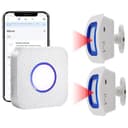 EverNary WiFi Smart Bed Sensor Alarm with App Best when you are out of the house | Key specPhone appAlert path | Score6.8/10 | |
| Rank4 | 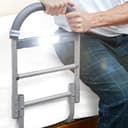 Lunderg Bed Assist Rail with Motion-Activated Light Best lit handhold | Key specMotion-activatedLight | Score8.0/10 | |
| Rank5 | 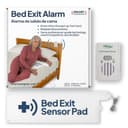 Smart Caregiver Bed Alarm for Elderly Adults (BB45-SYS) The one we would skip · we would skip this one | Key spec80 dB in-roomAlarm | Score5.8/10 |
Prices checked September 17, 2026. Scores are our published spec rubric, not a test result — here is exactly how they are calculated.
The fact that should shape the whole purchase
Six in 10 people living with dementia will wander at least once; many do so repeatedly.
Read that as a purchasing instruction. The risk you are buying against is not only a fall at the bedside; it is somebody leaving the bedroom, and then the house, without anyone knowing. That points at a system rather than a single gadget — something that alerts you when the bed is empty today, and that will also take a door sensor when you need one, without replacing everything you already own.
The Alzheimer's Association's own home-safety list names the product class directly. Among its recommendations are placing a pressure-sensitive mat in front of the door or at the person's bedside to alert you, installing warning bells above doors or a monitoring device that signals when a door is opened, and using night lights throughout the home. Those are three separate purchases in most catalogues. Two of the systems below carry all three on one pager.
Why a bed rail is usually the wrong answer here
A bed rail is a reasonable tool for somebody who can deliberately decide to move away from it. That single condition is what makes a rail a handhold rather than a trap, and it is the condition dementia most often removes. The FDA's hospital bed safety work documents entrapment in the gaps between rail, mattress and frame, and the people it describes as most at risk are those who are confused, restless or unable to reposition themselves — which is the population this page is about.
There is a second, simpler problem. A rail does not stop someone determined to get up; it changes how they get up. Climbing over a rail turns a roll onto the floor into a fall from higher, over an obstacle, often feet-first onto a hard edge. We have not tested that and nobody publishes numbers for it, but the mechanism is not controversial and it is why who should not use a bed rail exists as its own page.
How we ranked them for this particular reader
The scoring rubric is the same one on our methodology page and the same one behind the general bed alarm roundup. What changes here is the weighting, and we would rather say so plainly than pretend a different ranking fell out of nowhere.
- Where the alert lands. A pager or a phone, never a noise beside the bed. For somebody with dementia an unexplained alarm at two in the morning is frightening, and fear at two in the morning is how a bad night becomes a bad week.
- Whether the system extends to the door. This is the criterion that reshuffles the order against our general roundup. Wandering is the specific risk, and a hub that will take a door sensor later is worth more here than a slightly earlier bed alert.
- How early it fires. A pad at hip level under the sheet alerts as weight shifts off it; a floor sensor alerts once feet are already down. Earlier is better when the person may be out of the room in seconds.
- What the listing publishes about the consumable. The sensor pad wears out. Only one brand here publishes a life for it, and a system with an unknown recurring cost is a worse buy for a household that will be running it for years.
- Whether it needs the internet. One system here depends on 2.4 GHz Wi-Fi and a phone app. That is a real advantage when you are out and a real fragility when the router reboots at three in the morning.
The systems in full
1 · Best overall for wandering
Smart Caregiver Bed Exit Alarm with Wireless Pager (RP-WPBR1-SYS)
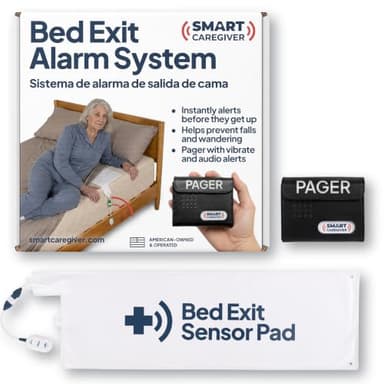
The listing that answers the most questions before you have to ask them, and the one to buy if the bed alarm is going to become a chair pad and a door sensor as well.
- Pager supports
- 6 sensors
- Our spec score
- 8.8/10
- Best for
- A system that will grow
As of September 17, 2026. #ad How we’re funded
What works
- The most complete specification table of any alarm here: range, pager volume, pad dimensions, battery type and warranty length are all published rather than left for you to guess
- One pager takes up to six sensors and the listing names the types, so the system grows with the problem instead of being replaced by a second one
- A published one-year manufacturer warranty, which four of the six systems here do not state at all
What doesn’t
- The pad goes under the shoulders, and the competing brand on this page argues in its own listing that shoulder placement is exactly what produces false alarms. Neither seller offers evidence, so you are choosing between two marketing claims
- Nothing is published about how long the sensor pad lasts, and the pad is the part that wears out
- The pager is published at 70 dB, well below the loudest figure here. If it has to wake you from sleep, test it in the house before you rely on it
Published specifications
| Where the alert goes | Wireless pager carried by the caregiver |
|---|---|
| Sensor pad | 10 x 30 in, 0.5 in thick, weight sensing |
| Pad placement | Under the shoulders |
| Published range | 300 ft |
| Pager alert modes | Sound or vibrate |
| Pager volume | 70 dB |
| Batteries | 2 AA, included |
| Sensor pad life | Not published |
| Expandable with | Up to 6 sensors — chair pad, door exit, floor mat, motion, call button |
| Warranty | 1 year manufacturer |
Read from the product listing on 2026-08-28. Blanks are specifications the manufacturer does not publish, not figures we could not be bothered to find.
How the score was reached
| Where the alert landsPager with sound or vibrate published; the listing does not state whether the base unit is silent. | 9 |
|---|---|
| How early it firesShoulder placement published, with a stated alert as the person starts to get up. | 9 |
| Published range300 ft published. | 8 |
| Running costs disclosedA one-year warranty and included batteries are published; no sensor pad life is. | 8 |
| ExpandabilityUp to six sensors published, and the listing names five sensor types plus call buttons. | 10 |
| Mean, rounded to one decimal | 8.8 |
2 · Earliest alert
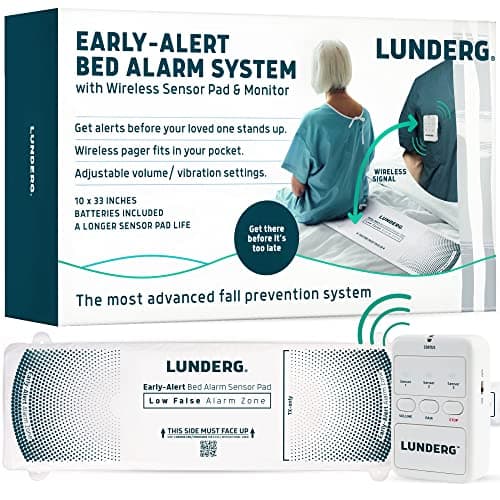
Lunderg Wireless Early Alert Bed Alarm System
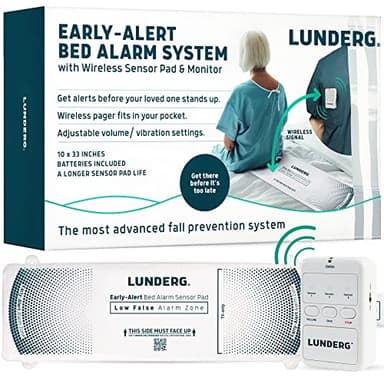
The only brand here that says how long its sensor pad lasts, on a system built around the idea that nothing should make a noise at the person in the bed.
- Pager range
- 400 ft
- Our spec score
- 8.8/10
- Best for
- Alerting a caregiver in another room
As of September 17, 2026. #ad How we’re funded
What works
- Nothing in this system is stated to sound at the bedside — every alert goes to a pager the caregiver carries, which is the distinction the whole category turns on
- The pad sits at hip level and the listing says it alerts before the person is out of bed, rather than once their weight has already gone
- Lunderg is the only brand here that publishes how long its sensor pad lasts — 15 months — on the one part of the system that is a consumable
What doesn’t
- The specification table gives an audible-noise figure of 120 dB and never says which device it describes; the same brand's bed-and-chair set publishes 48 dB for what looks like the same pager, and neither listing resolves the contradiction
- The 15-month pad life is a claim in the bullet points, not a warranty term — no warranty length is published anywhere on the listing
- The pad is a consumable and the listing says nothing about what a replacement costs, so the running cost is knowable in months but not in dollars
Published specifications
| Where the alert goes | Wireless pager carried by the caregiver |
|---|---|
| Sensor pad | 10 x 33 in, foam interior, incontinence-resistant |
| Pad placement | Hip level |
| Published range | Up to 400 ft |
| Sensor pad life | 15 months (seller stated) |
| Pager alert modes | High volume, low volume or vibrate only |
| Batteries | 2 AA, included |
| Wi-Fi or app required | No |
| Expandable with | Lunderg chair alarm and call button |
| Warranty | Not published |
Read from the product listing on 2026-08-28. Blanks are specifications the manufacturer does not publish, not figures we could not be bothered to find.
How the score was reached
| Where the alert landsThe listing states every alert goes to a pager the caregiver holds and that nothing sounds at the bedside. | 10 |
|---|---|
| How early it firesHip placement published, with a stated alert before the person is out of bed. | 10 |
| Published range400 ft published — the longest figure on this page. | 9 |
| Running costs disclosedA 15-month pad life and included batteries are published; no warranty term is. | 8 |
| ExpandabilityA chair alarm and a call button are named as compatible; no supported sensor count is published. | 7 |
| Mean, rounded to one decimal | 8.8 |
3 · Best when you are out of the house
EverNary WiFi Smart Bed Sensor Alarm with App
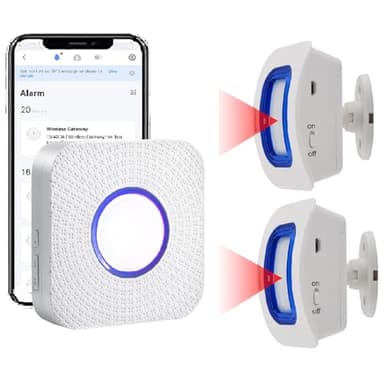
The only system here whose alert can reach a phone that is not in the building. That is the whole reason to buy it, and it is also why it depends on things the other five do not.
- Alert path
- Phone app
- Our spec score
- 6.8/10
- Best for
- A caregiver who is not in the house
As of September 17, 2026. #ad How we’re funded
What works
- The alert reaches a phone rather than a pager, so the caregiver does not have to be within radio range of the bedroom — the listing's own example is being in another city
- The app's share function sends the same alert to more than one phone, which is how a family actually splits this between siblings
- No sensor pad at all, so there is no consumable to replace on a schedule and nothing to slide out from under a sheet
What doesn’t
- The sensor detects a foot approaching the floor, not a shift in the bed. By the time it fires the person is already getting out, which is later than any of the pad systems here
- It depends on 2.4 GHz Wi-Fi and the seller's cloud service. Every other system on this page keeps working when the internet does not
- The listing says the hub itself rings, so where you put the hub decides whether there is a noise near the bed. It also carries by far the fewest customer ratings here, so there is little independent signal on reliability
Published specifications
| Where the alert goes | Phone app, and the hub rings |
|---|---|
| Sensor type | Floor motion sensor, 2 included |
| Pad placement | No pad — the sensor sits on the floor under the bed |
| Published range | 330 ft open area; 30-150 ft indoors |
| Network required | 2.4 GHz Wi-Fi only |
| App | Smart Life, with a share function for extra phones |
| Batteries | 4 AAA required |
| Expandable with | Up to 20 transmitters per hub — call button, door sensor, motion sensor |
| Sensor pad life | No consumable pad |
| Warranty | Not published |
Read from the product listing on 2026-08-28. Blanks are specifications the manufacturer does not publish, not figures we could not be bothered to find.
How the score was reached
| Where the alert landsAlerts reach a phone anywhere, but the listing states the hub also rings. | 7 |
|---|---|
| How early it firesA floor sensor fires as the foot reaches the floor, once the person is already leaving the bed. | 5 |
| Published range330 ft open area, but the listing's own indoor figure is 30-150 ft. | 7 |
| Running costs disclosedNo consumable pad, but batteries are required and not stated as included, and no warranty term is published. | 6 |
| ExpandabilityUp to 20 transmitters per hub published, with the sensor types named and multi-phone sharing. | 9 |
| Mean, rounded to one decimal | 6.8 |
4 · Best lit handhold
Lunderg Bed Assist Rail with Motion-Activated Light
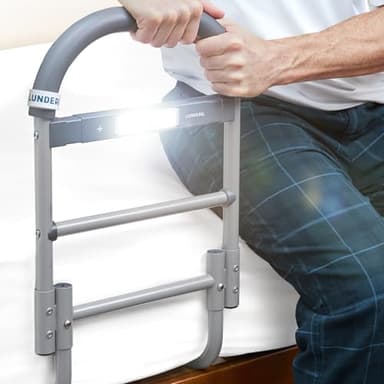
The motion light is the feature. Most bedroom falls happen on the way to the bathroom in the dark, and this one lights the floor as you reach for it.
- Light
- Motion-activated
- Our spec score
- 8.0/10
- Best for
- The 3am bathroom trip
As of September 17, 2026. #ad How we’re funded
What works
- A motion-activated light on the thing you were already going to grab — no switch to find in the dark
- A published non-slip grab bar and a 300 lb load rating, load-tested on a steel frame with four stabilizing bars
- Marketed for post-surgery use, which is often when a rail is a temporary need rather than a permanent one
What doesn’t
- The listing does not state ASTM compliance, and for an adult portable bed rail that is now a legal requirement worth confirming with the seller. It is the only rail here that names no standard at all
- No published height adjustment, so the grip sits where it sits
- The listing rules out adjustable beds, so this is not the rail for a motorized base
Published specifications
| Light | Motion-activated |
|---|---|
| Type | Bed assist rail with non-slip grab bar |
| Standard claimed | Not published |
| Load rating | 300 lb, load-tested |
| Height adjustable | Not published |
| Fits | Twin to king, mattresses 7–13 in thick; not adjustable beds |
Read from the product listing on 2026-08-26. Blanks are specifications the manufacturer does not publish, not figures we could not be bothered to find.
How the score was reached
| Standard complianceNo standard stated on the listing — neutral score. | 5 |
|---|---|
| Grip and reachNon-slip grab bar published; no height adjustment stated. | 8 |
| Load rating300 lb published and described as load-tested. | 8 |
| FitTwin to king with a 7–13 in mattress window published; adjustable beds excluded. | 9 |
| Night useMotion-activated light published — the top band. | 10 |
| Mean, rounded to one decimal | 8.0 |
5 · The one we would skip · we would skip this one
Smart Caregiver Bed Alarm for Elderly Adults (BB45-SYS)
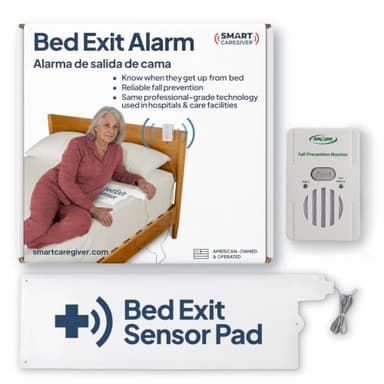
The in-room version, and the only bed alarm we track whose alarm sounds at the person getting up. CMS names an alarm audible to the person as something that can act as a physical restraint, and this listing sells the pager as a separate add-on kit.
- Alarm
- 80 dB in-room
- Our spec score
- 5.8/10
- Best for
- A caregiver in the same room
As of September 17, 2026. #ad How we’re funded
What works
- The simplest form of the product — a pad, a cord and a monitor, with nothing to pair, configure or keep on a network
- Low-battery and sensor status lights, so you can tell at a glance that it is still working, and a reset button that silences it without unplugging anything
- A published one-year warranty and a sealed, wipe-clean pad, from a company that has made only this category for decades
What doesn’t
- The alarm sounds in the room at 80 dB. CMS guidance describes a position change alarm audible to the person as something that can have the effect of a physical restraint, and an alarm going off mid-transfer can startle someone into the fall you were trying to prevent
- The pager that fixes that is an add-on kit sold separately, so the version most people should own costs more than the sticker on this one
- No sensor pad life published, and the monitor is corded to the pad, so the cord runs across the floor beside a bed where someone is getting up in the dark
Published specifications
| Where the alert goes | In-room monitor, corded to the pad |
|---|---|
| Sensor pad | 10 x 30 in vinyl, foam interior, sealed for incontinence |
| Pad placement | Under the shoulder blades or hips |
| Published range | Not published |
| Alarm volume | 80 dB, two volume levels |
| Batteries | One 9 V, included; AC-02 adapter sold separately |
| Sensor pad life | Not published |
| Expandable with | Optional wireless pager add-on kit, sold separately |
| Warranty | 1 year manufacturer |
Read from the product listing on 2026-08-28. Blanks are specifications the manufacturer does not publish, not figures we could not be bothered to find.
How the score was reached
| Where the alert landsThe alarm sounds in the room at a published 80 dB; a pager is only an add-on kit sold separately. | 3 |
|---|---|
| How early it firesPad placement published, with the alarm sounding as pressure is removed. | 8 |
| Published rangeA corded monitor at the bedside — there is no wireless range to publish. | 5 |
| Running costs disclosedA one-year warranty and an included battery are published; no sensor pad life is. | 6 |
| ExpandabilityAn optional wireless pager kit is named; no supported sensor count is published. | 7 |
| Mean, rounded to one decimal | 5.8 |
Our top pick is not the one with the highest score, and the reason is the wandering figure at the top of this page. The Smart Caregiver pager system publishes support for up to six sensors on one pager — chair pad, door exit, floor mat, motion sensor and call button alongside the bed pad — which means the door alarm the Alzheimer's Association recommends can be added to the thing you already own rather than bought as a second, separate gadget with its own pager to carry.
The Lunderg early-alert system is the better bed alarm considered on its own, and it is the one we rank first on the general alarm page: a hip-level pad, a 400-foot published range, vibrate-only mode on the pager, and the only published sensor-pad life in the category at 15 months. If the bedroom is the whole problem and the front door is not, buy that one.
The one we would skip, and why it matters more here
The Smart Caregiver in-room alarm is the only bed alarm we track whose 80-decibel alert sounds beside the person getting up. On any page that would rank last. On this page it is close to a mistake. CMS names an alarm audible to the person as something that can function as a physical restraint, and a person with dementia cannot reason their way to why the bed screamed at them — they experience a loud noise in the dark, which is a recipe for agitation, for resisting the bed at night, and in the worst case for a hurried exit that is exactly what you were trying to prevent. Its pager is sold separately as an add-on kit, so the version that would fix the problem is a second purchase.
What an alarm will not do
It will not prevent a fall. The Shorr trial raised bed alarm use across 16 nursing units and 27,672 hospitalized patients and found no difference in falls, injurious falls or physical restraint use; CMS's surveyor guidance says in its own words that the efficacy of alarms to prevent falls has not been proven, and notes alarm fatigue as a real failure mode. What an alarm does is tell you sooner. In a house where somebody with dementia might be up and out, sooner is the entire point — but it is worth buying with clear eyes about which problem you are solving.
It also will not substitute for the dull, free work: clear the route to the bathroom, light it, take up the throw rugs, and get the bed to the right height. The bedroom fall-prevention checklist is the whole list, and it is still the highest-value thing on this site.

The conversation to have first
Ask the person. In the early stages of dementia this is their decision and they are entitled to make it, and families who ask generally get further than families who install a sensor and hope it goes unnoticed. The framing that tends to land is the true one: this exists so you can stay in your own bedroom, in your own house, for longer. If the dementia has advanced past that conversation, the decision sits with whoever holds legal authority, and the same framing still applies — you are buying time at home, not surveillance.
One more practical thing worth doing on the same day: ask the person's doctor or an occupational therapist to look at the bedroom. Nothing on this page is medical advice and nobody here is a clinician. An occupational therapist can see the actual room, the actual transfer and the actual person, and will tell you in ten minutes whether the bed is the problem, the lighting is the problem, or the route to the bathroom is.
Questions people actually ask
What is the best bed alarm for someone with dementia?
One whose alert reaches you silently and whose system can grow to cover the bedroom door. The Alzheimer's Association recommends a pressure-sensitive mat at the bedside or in front of the door, and six in ten people living with dementia wander at least once — so a bed pad that pages you, on a hub that will also take a door sensor later, is the shape of system worth buying.
Should someone with dementia have a bed rail?
Usually not. A rail is only a reasonable tool for someone who can deliberately choose to move away from it, and confusion is exactly the condition that removes that ability. A rail can also turn a roll out of bed into a climb over a barrier, which is a longer fall onto the same floor. Who should not use a bed rail sets out the FDA's entrapment guidance in full.
Are bed alarms a restraint for someone with dementia?
An alarm the person can hear can act as one. CMS's guidance to nursing home surveyors treats a position-change alarm as a potential physical restraint when someone is afraid to move in case it sounds. For a person with dementia, a sudden 80-decibel noise beside the bed at night is more likely to cause fear and agitation than to help — which is why every pager system on this page ranks above the in-room one.
Do bed alarms stop someone with dementia from falling?
No, and we are not going to suggest they do. A cluster randomized trial across 16 nursing units and 27,672 patients raised alarm use successfully and found no difference in falls, injurious falls or restraint use. What an alarm does is shorten the time someone spends on the floor before anybody knows. That is worth having. It is not fall prevention.
Does the person with dementia need to agree to being monitored?
Ask, every time, as early as possible. Someone in the early stages can absolutely make this decision, and being included in it usually goes better than discovering a sensor later. As dementia advances the decision falls to the people holding legal authority, and the honest framing then is that the alarm exists to let the person stay in their own bedroom rather than to watch them. That framing is also the one most likely to be accepted.
Sources
Every factual claim on this page traces to one of these, or to a product listing cited in the specification table beside it.
- Alzheimer's Association — Wandering
- CMS — State Operations Manual Appendix PP, guidance to surveyors (F604 physical restraints; F689 accidents and supervision)
- Shorr et al. — Effects of an Intervention to Increase Bed Alarm Use to Prevent Falls in Hospitalized Patients: A Cluster Randomized Trial, Annals of Internal Medicine 157(10), 2012
- FDA — Hospital Bed Safety Workgroup FAQ on entrapment issues
Read next
Comparison
Best Bed Alarms
The first question is not which alarm. It is whether the noise happens next to the person getting up, or on a pager in your pocket.
Our top pick — Lunderg Wireless Early Alert Bed Alarm System
$119.95 · Check priceAs of September 17, 2026. #ad How we’re funded
Guide
Who Should Not Use One
Four situations where a rail makes things worse, and the alternatives that work better in each.
Guide
Fall Prevention Checklist
Most of what prevents a bedroom fall is free, dull, and never bought. Here is the list, grounded in the CDC's own falls guidance.
Guide
Floor Beds and Fall Risk
Lowering a bed shortens the fall and makes standing up harder. Both halves of that are true, and the choice is real.
Guide
Parkinson's and Mobility
Bed mobility is often the hard part. A higher firmer edge, a head raise and a grip help you move, with your therapy team, not instead of it.

Nothing here is medical advice. Prices are pulled live and stamped with the date they were checked; scores are our published spec rubric, not a test result. How we pick · How we make money · Corrections