Single review
Able Life Bedside Safety Handle review
A padded stand-assist for getting up, not a guard rail. Read on what the listing publishes — including the 300 lb it is rated to.
By Stephen V.Published Updated How we pick
We earn a commission if you buy through the links on this page, at no extra cost to you. It does not change what we recommend, and we have not tested these products — here is what we do instead.
We rank this one as the best overall handle in our assist handles comparison, and the first thing to be clear about is what it is. It is a padded stand-assist handle, not a full-length guard rail. It is the right tool if the problem is standing up; it is the wrong tool if the problem is rolling out of bed, and it is not designed for the second job at all. Getting that distinction right is the single most useful thing this review can do, because most people who search for a bed rail actually need a handle.
1 · Standing up, not staying in
Able Life Bedside Safety Handle
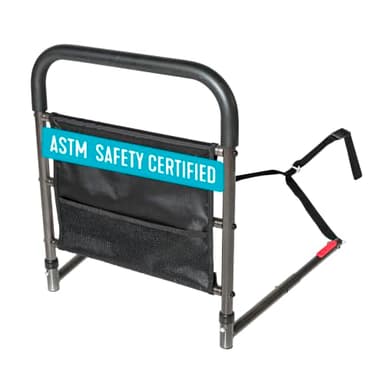
A padded stand-assist handle rather than a guard rail — the right tool if the problem is standing up, not rolling out.
- Type
- Stand assist
- Our spec score
- 8.0/10
- Best for
- Standing up, not staying in
As of September 22, 2026. #ad How we’re funded
What works
- Height adjustable, so the grip can sit where your hand naturally reaches from sitting
- Padded grip, which matters if arthritis makes a bare steel tube unpleasant to hold hard
- A published 300 lb load rating and a published fit across king, queen, full and twin
What doesn’t
- It is a handle, not a rail. It will not stop anyone rolling out of bed, and it is not meant to
- 300 lb is the lowest published rating of the rails here, and standing up loads a handle harder than sitting on it does
- No light, and the listing rules out adjustable beds and extra-soft mattresses
Published specifications
| Type | Stand-assist handle (not a full-length guard rail) |
|---|---|
| Standard claimed | ASTM safety approved |
| Height adjustable | Yes |
| Padding | Padded grip |
| Load rating | 300 lb |
| Fits | King, queen, full and twin beds; mattresses 6–14 in thick |
| Light | Not published |
Read from the product listing on 2026-08-26. Blanks are specifications the manufacturer does not publish, not figures we could not be bothered to find.
How the score was reached
| Standard complianceASTM compliance stated on the listing. | 9 |
|---|---|
| Grip and reachHeight adjustable with a published padded grip. | 9 |
| Load rating300 lb published — the lowest published figure of the rails here. | 8 |
| FitKing, queen, full and twin all published, with a 6–14 in mattress window. | 9 |
| Night useNo light published — neutral score. | 5 |
| Mean, rounded to one decimal | 8.0 |
The case for it
The handle does the one job it is for well, on paper. It is height-adjustable, so the grip can be set where your hand naturally falls when you sit on the edge of the bed — which is usually lower and further forward than people expect, at the start of the push to standing rather than the end. And the grip is padded, which is not a luxury: a bare steel tube is unpleasant to hold hard for arthritic hands and slippery for damp ones, and the moment you most need a good grip is the moment your hand is least able to manage a thin, cold bar. For anyone whose hands are the limiting factor — which is a great many of the people this site is for — the padding is a real, daily-life advantage. Our hip and shoulder pain page covers why the grip, not the strength of the bar, is usually what decides whether a support gets used.
It also does the two administrative things well that most listings skip. It states ASTM compliance — the standard that, since the CPSC's rule took effect on 21 August 2023, is mandatory rather than voluntary for this product class — and it publishes its fit across king, queen, full and twin. That combination, a stated standard and a stated fit on the same listing, is rarer than it should be. It matters here for a reason people miss: the regulation's definition of an adult portable bed rail is broad enough to cover grab bars and assistive bars, so a handle is regulated exactly as a rail is, and a handle that names the standard is one whose seller knows that.
This is a handle, not a rail
This deserves its own heading because it is the mistake we see most often. A full-length rail runs most of the length of the mattress and is meant to stop someone rolling out during sleep; this is a short bedside grip meant to be pulled against while sitting up and standing. It will not stop anyone rolling out of bed, and it is not meant to. If the genuine, frightening event was waking up on the floor, this is the wrong product and a full-length rail is the right category — start with bed rail safety. If the frightening event was a struggle to get up, or hauling yourself off the edge on the furniture, this is squarely the right kind of thing. Rail versus assist handle sets out the distinction in full, and the alternatives page covers the cases where neither is the answer and a height correction does more than either.
The case against it
The reservations are narrow, and two of them are simply the limits of what a handle is. First, 300 lb is the lowest published rating of the rails we track, and standing up loads a handle harder than sitting on it does — a person pushing up puts more through the grip than their body weight alone, so the headroom is smaller than the number suggests. Second, no light — this is a bare handle, so the dark trip to the bathroom is still a dark trip unless you light it some other way, and if a floor light in one object is your priority, the Lunderg assist rail is built around one. Third, and this is a limitation rather than a fault: because it is a handle, it does nothing to stop a roll-out. That is only a mark against it if a roll-out is your actual risk — for the standing-up problem it is designed for, it is exactly the object you want.
How it scores
On our rubric this handle scores well precisely where it publishes something and neutral where it does not, which is the honest shape of a good listing. Standard compliance, grip and reach, and fit all score in the upper band — the stated ASTM claim, the padded height-adjustable grip, and the published four-size fit are each exactly what those criteria reward. Load rating scores well too, though not at the top: 300 lb is published, and it is the lowest published figure of the rails here. Night use is the one criterion at the neutral middle, because no light is published. It is worth remembering that our rubric was written for rails and scores night use as a criterion; a handle with no light is not being marked down for failing at something it never claimed, only scored neutral for not publishing it. The block above shows every score with its one-line reason, and the full rubric is here.
What we could not verify
- How the 300 lb was measured, and whether it is a static or a dynamic figure. Standing up is a dynamic load and the listing does not say which one it tested.
- Any light for night use. None published — it is a bare handle.
- The padding material and how well it holds up under repeated daily use. The grip is published as padded; its composition and durability are not.
- Long-term stability of the height adjustment under daily load — no manufacturer in this category publishes a cycle rating, and we will not estimate one.
How it compares in the category
Among the products we track, this is the purest expression of the handle idea, and that is its strength. The Lunderg assist rail is also functionally a handle but is built around a motion light and states no standard; this one states the standard and publishes its fit but has no light — the mirror-image trade, and which one wins depends on whether the dark trip or the documented standard is your priority. Against the full-length rails, the comparison is not really like-for-like: those stop a roll-out and carry the entrapment length that comes with it, while this presents almost no length to be trapped along and does none of the roll-out job. If standing up is the problem, that is the right trade; if staying in is the problem, it is the wrong one. The full handles roundup sets it against the alternatives with live prices, and rail versus assist handle explains why the two are not interchangeable.
Positioning it
With a handle more than anything else, position beats hardware. Sit on the edge of the bed the way you actually do, feet flat on the floor, and put the grip where your hand falls as you begin to push up — usually further forward and lower than people first fit it, because the useful moment is the push at the start of standing, not the steadying at the end. Set the height while you are sitting there. And check the height of the bed at the same time: if your feet do not sit flat with your knees at roughly a right angle, the handle is compensating for a bed that is the wrong height, and that is a cheaper and better thing to fix first. Because it is a handle rather than a rail, it sits within a single stretch of the bed and does not have to clear an adjustable base's hinge — a quiet point in its favor if your bed is an adjustable one.
Who should buy it
Someone whose hardest moment is standing up rather than staying in bed, who wants a padded, height-adjustable grip that will sit where their hand falls, and who values a stated ASTM claim, a published 300 lb rating and a published bed-size fit. It suits arthritic hands especially well, given the padded grip, and it fits king, queen, full and twin with mattresses 6 to 14 inches thick — though not an adjustable base, which the listing rules out. It is not the pick if the genuine risk is rolling out of bed, because it will not stop that and is not meant to — a full-length rail is the right category there, and bed rail safety is where to start. And if standing up is hard because the bed is simply too low or too high, fix the height first: work out your target, and the handle may become the finishing touch rather than the whole solution.
Questions people actually ask
Is the Able Life Bedside Safety Handle a bed rail?
No. It is a padded stand-assist handle, not a full-length guard rail. It gives you something to grip while sitting up and standing; it will not stop anyone rolling out of bed, and it is not designed to. If a roll-out is the genuine risk, a full-length rail is the right category instead.
Is the Able Life handle good for arthritis?
Its padded grip is aimed squarely at that. A bare steel tube is unpleasant to hold hard for arthritic hands and slippery for damp ones, and the moment you most need a firm grip is when your hand is least able to manage a thin, cold bar. The padding is a real, daily-life advantage for anyone whose hands are the limiting factor.
Is the Able Life handle ASTM approved?
The listing states ASTM compliance, which since 21 August 2023 is mandatory for this product class under 16 CFR part 1270 — the rule's definition covers grab bars and assist handles, not just rails. It also publishes its fit across king, queen, full and twin.
How much weight does the Able Life handle hold?
The listing publishes 300 lb. That is the lowest published figure of the rails we track, so if the person using it is heavy or pulls hard to stand, check the number against the real load rather than assuming headroom.
Will the Able Life handle stop someone falling out of bed?
No, and it is important to be clear about it: this is a handle for standing up, not a barrier for staying in. It presents almost no length for a limb to be trapped along, which is a safety advantage, but the trade is that it does nothing to stop a roll-out.
Sources
Every factual claim on this page traces to one of these, or to a product listing cited in the specification table beside it.
Read next
Comparison
Best Assist Handles
If the difficulty is standing up rather than staying in, this is the product you actually want.
Our top pick — Able Life Bedside Safety Handle
$49.99 · Check priceAs of September 22, 2026. #ad How we’re funded
Head to head
Rail vs Assist Handle
Two products, one search term, completely different jobs. Most people searching for the first one need the second.
Head to head
Alternatives to Rails
Five ways to make getting in and out of bed safer, and the honest test for which problem you actually have before you buy a rail.
Guide
Who Should Not Use One
Four situations where a rail makes things worse, and the alternatives that work better in each.
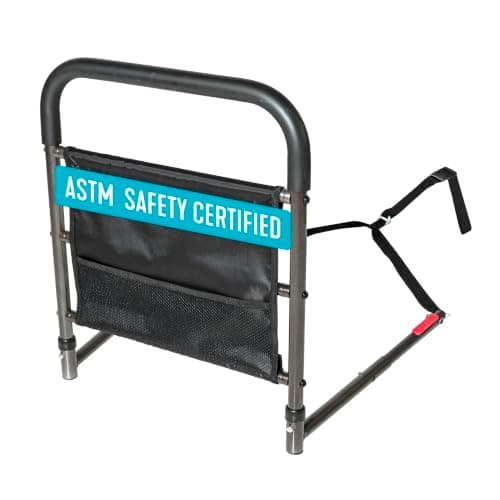


Nothing here is medical advice. Prices are pulled live and stamped with the date they were checked; scores are our published spec rubric, not a test result. How we pick · How we make money · Corrections