Guide
Feeling dizzy when getting out of bed
The cause is a medical question and belongs with your doctor. The bed is the part we can help with: rising in stages, a handhold within reach, and a height your feet can meet.
By Stephen V.Published How we pick
If you feel dizzy standing up from bed, the first thing to do is tell a doctor, because the cause is medical and several of the common ones are treatable or related to when medication is taken. This page does not try to answer that. It answers the part a bed can answer: how to set the bed up so the movement happens in stages, with something to hold and a height your feet can meet. The base we would pick for it is the Amada 01B-Q1 queen, because it publishes four leg heights as actual inches and a wireless remote - the height and the pause, in one product.
What this page is and is not
It is not a diagnosis and it is not a treatment. Dizziness on standing is one of the reasons older adults fall, and falls in this age group are common rather than exotic - the CDC publishes that around one in four adults aged 65 and over falls each year, and that falling once roughly doubles the chance of falling again. That is the reason to take the symptom to a clinician rather than to live around it.
What a bed can do is narrow and genuinely useful. It can turn one abrupt movement into three deliberate ones, it can put a fixed handhold where your hand already falls, and it can sit at a height where sitting on the edge is a stable position rather than a perch. None of that treats anything. All of it makes the riskiest two minutes of the day less risky. The rest of this section covers the conditions people most often change the bed for.
The movement, broken into three
- Get upright while still lying down. On a flat bed this is a sit-up, using your abdomen and your arms. On an adjustable base it is a button: raise the head towards vertical and let the bed do it. The point is that you arrive at sitting without having worked for it.
- Sit on the edge, feet flat, and wait. This is the stage that matters and it is the one a badly set-up bed makes unpleasant. If your feet dangle you are bracing with your arms; if the mattress edge collapses you are sinking as you wait. Neither encourages anybody to wait.
- Stand with a hand on something fixed. Not the mattress, not a walker, not the bedside table. Something bolted to the bed or to the floor, positioned where your hand lands from sitting.
What to look for, in order
- The height, measured. Feet flat, knees level with or just below the hips when sitting on the edge. This is first because it decides whether stage two is possible at all, and because it is the cheapest thing to change. The arithmetic.
- A fixed handhold at the right place. Where your hand falls from sitting, strong enough to pull sideways on, and padded enough to grip with an arthritic hand. The handles we track publish 300 lb load ratings and adjustable heights.
- Edge support on the mattress. A mattress that collapses where you sit drops you below the height you carefully set, every time. It is a mattress property rather than a topper one. Firmness and edge support.
- A way to get upright without a sit-up. A base with head lift, or failing that a wedge and a plan. Three of the bases we track publish both head and foot angles - 65 degrees and 45 degrees - alongside their leg heights.
- Light on the floor you are about to stand on. Ten of the fourteen bases we track publish an under-bed light; a plug-in night light does the same job better and cheaper. What those lights are and are not.
- A clear floor on the exit side. No lead, no rug edge, no slippers out of reach. This is free and it is on every checklist for a reason. The bedroom checklist.
The three things we would buy, in this order
Cheapest first, because the cheapest item on this list changes the mechanics of the movement more than the most expensive one does.
1 · Lets you rise in stages
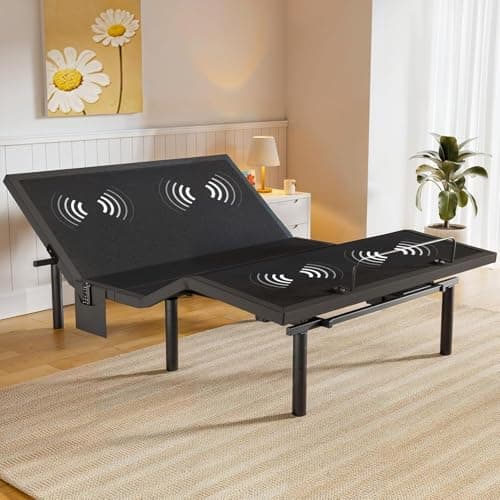
Amada 01B-Q1 Queen Adjustable Bed Frame
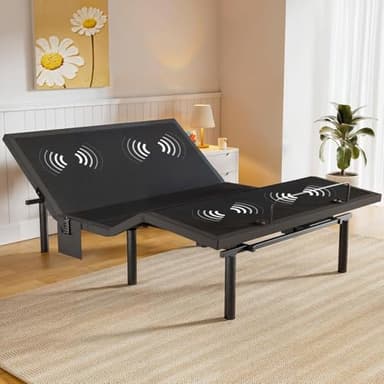
The queen that publishes its leg heights as actual inches — four of them — with an under-frame light alongside, which is the combination that matters if getting out is the problem.
- Leg heights
- 8-13 in
- Our spec score
- 9.0/10
- Best for
- Getting the height right
What works
- Four leg heights published as measurements, not a count, so the sleep surface can be planned to your legs before delivery
- An LED night light under the frame, which is the difference between a lit path to the bathroom and feeling for the wall
- A published 750 lb capacity, and a USB-A and a USB-C on each side so the phone, the hearing aid charger and the lamp do not fight over one outlet
What doesn’t
- The listing publishes the leg heights but never the depth of the deck on top of them, so the finished sleep surface is still an estimate until it arrives
- The zero-gravity preset is named but the angles it drives to are not, so what the button actually does is unknown until you press it
- Queen only in this listing, so a split configuration is not an option here
Published specifications
| Leg height options | 4 — 8, 10, 11 and 13 in, built from 2, 3 and 8 in leg sections |
|---|---|
| Frame height off floor | Not published |
| Remote | Wireless |
| Weight capacity | 750 lb |
| Positions | Head to 65°, foot to 45°, with a zero-gravity preset |
| Massage | Head and foot, 3 intensities and 4 modes |
| USB ports | USB-A and USB-C on each side |
| Under-bed light | LED night light |
| Sizes listed | Queen |
Read from the product listing on 2026-09-23. Blanks are specifications the manufacturer does not publish, not figures we could not be bothered to find.
How the score was reached
| Entry-height controlFour published leg heights, as inches; the deck depth above them is not published. | 9 |
|---|---|
| ControlsWireless remote plus a lit under-frame light for night use. | 9 |
| Weight capacity750 lb published — the top band on /methodology. | 10 |
| Position rangeHead and foot to published angles, plus one named preset — zero gravity. No anti-snore. | 8 |
| Setup and daily useUSB-A and USB-C per side, an LED night light and a published 3-step tool-free build. | 9 |
| Mean, rounded to one decimal | 9.0 |
2 · Something to hold while you wait
Able Life Bedside Safety Handle
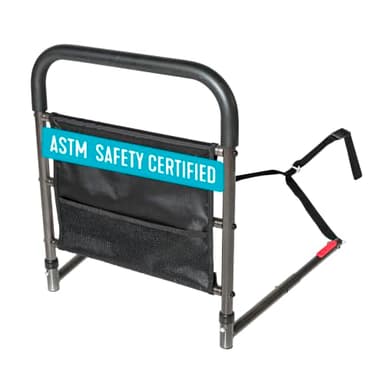
A padded stand-assist handle rather than a guard rail — the right tool if the problem is standing up, not rolling out.
- Type
- Stand assist
- Our spec score
- 8.0/10
- Best for
- Standing up, not staying in
What works
- Height adjustable, so the grip can sit where your hand naturally reaches from sitting
- Padded grip, which matters if arthritis makes a bare steel tube unpleasant to hold hard
- A published 300 lb load rating and a published fit across king, queen, full and twin
What doesn’t
- It is a handle, not a rail. It will not stop anyone rolling out of bed, and it is not meant to
- 300 lb is the lowest published rating of the rails here, and standing up loads a handle harder than sitting on it does
- No light, and the listing rules out adjustable beds and extra-soft mattresses
Published specifications
| Type | Stand-assist handle (not a full-length guard rail) |
|---|---|
| Standard claimed | ASTM safety approved |
| Height adjustable | Yes |
| Padding | Padded grip |
| Load rating | 300 lb |
| Fits | King, queen, full and twin beds; mattresses 6–14 in thick |
| Light | Not published |
Read from the product listing on 2026-08-26. Blanks are specifications the manufacturer does not publish, not figures we could not be bothered to find.
How the score was reached
| Standard complianceASTM compliance stated on the listing. | 9 |
|---|---|
| Grip and reachHeight adjustable with a published padded grip. | 9 |
| Load rating300 lb published — the lowest published figure of the rails here. | 8 |
| FitKing, queen, full and twin all published, with a 6–14 in mattress window. | 9 |
| Night useNo light published — neutral score. | 5 |
| Mean, rounded to one decimal | 8.0 |
3 · Cheapest way to fix the height
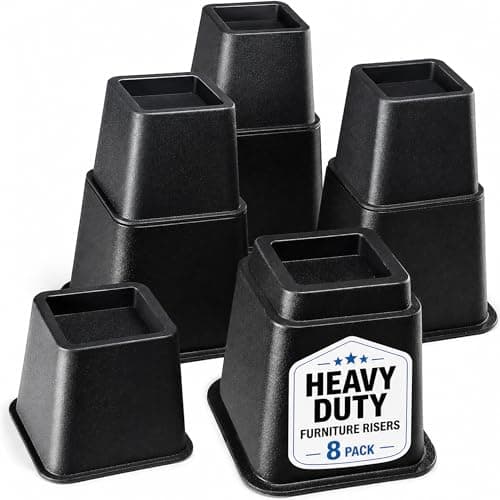
Home It Adjustable Bed Risers, 3/5/8 in
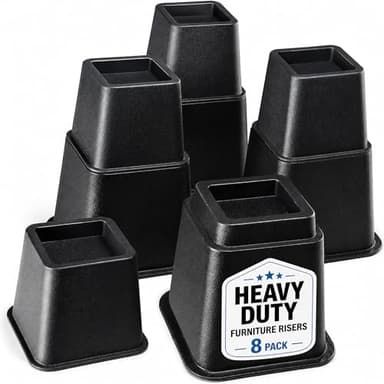
Three published lift heights from one set and a published 1,300 lb rating — the most flexible way to test a height before committing to it.
- Lift
- 3, 5 or 8 in
- Our spec score
- 8.5/10
- Best for
- Trying a height first
What works
- Three heights out of one box, so you can try 3 inches, decide it is not enough, and go to 5 without buying twice
- A published 1,300 lb rating for the set, and a published material — polypropylene, not an unnamed plastic
- Cheap enough that testing a height costs less than being wrong about one
What doesn’t
- Stacked risers are less stable than a single-piece riser of the same height — stack at your own judgment
- No published socket depth, and socket depth is what decides whether your bed leg actually sits in it
- Raising a bed raises the fall distance. Height helps you stand; it does not help you land
Published specifications
| Lift heights | 3, 5 or 8 inches (stackable) |
|---|---|
| Load rating | 1,300 lb |
| Pack | 4 |
| Material | Polypropylene |
| Socket depth | Not published |
Read from the product listing on 2026-08-26. Blanks are specifications the manufacturer does not publish, not figures we could not be bothered to find.
How the score was reached
| Lift rangeThree published heights from 3 to 8 inches. | 10 |
|---|---|
| Load rating1,300 lb published for the set. | 9 |
| StabilityPolypropylene with a broad base published; stackable by design, and no socket depth. | 7 |
| Set sizeFour-pack — one per bed leg. | 8 |
| Mean, rounded to one decimal | 8.5 |
The Home It risers are the item to try first if the bed is too low: three published heights from one box - 3, 5 or 8 inches - a published 1,300 lb rating, and a price that is a small fraction of anything else here. Measure your target, buy the height that closes the gap, and see whether the dizziness is still the limiting factor once the movement itself is easier.
The Able Life bedside safety handle is the handhold rather than the barrier: a padded stand-assist grip with an adjustable height and a published 300 lb rating, listed for mattresses 6 to 14 inches thick. It is the right shape for this problem because the problem is standing up and waiting, not rolling out of bed - and a padded grip can be pulled against with a straight wrist, which matters if the hands are stiff as well.
The Amada queen is the base, and it is on this page for two published specifications rather than for being a bed. Four leg heights given as actual inches - 8, 10, 11 and 13 - mean the sleep surface can be planned against your own measurement before delivery. Head to 65 degrees on a wireless remote means stage one becomes a button. An LED night light under the frame and USB-A and USB-C on each side are the two details that make the rest of the night easier. What it does not publish is the depth of the deck above the legs, so the finished height is still an estimate until it arrives.
What we would not buy for this
- A full-length bed rail, unless rolling out is also a problem. A rail is a barrier; this is a standing-up problem, and an assist handle is the tool shaped for it. The difference.
- A mattress topper, if the bed is already at the right height. A 3-inch topper raises the sleep surface by 3 inches, which can undo a height you got right - and nobody thinks of a topper as a height decision because it arrives in a comfort-shaped box.
- A walker as the handhold. A walker is not a fixed object and is not rated to be pulled against from sitting. Getting out of bed with a walker sets out the sequence and the fixed handhold a walker is not allowed to be.
- Anything at all, before the medical conversation. If a medication review or a treatable cause is behind this, the bed changes are still worth making and they are not the main event.

Nothing on this page is medical advice and nothing here should delay a conversation with a clinician. Every product figure above was read from a live listing on the date stamped on its specification table and scored against the rubric we publish. We have not tested any of these products and we claim no clinical expertise - what we claim is that we read the listings carefully and will not print a number nobody published.
Questions people actually ask
Why do I feel dizzy when I get out of bed?
That is a question for a doctor and not for a bed website - dizziness on standing has a range of causes, several of them treatable and some of them to do with medication timing, and nobody can work out which applies to you from a web page. What we can tell you is that it is worth raising with a clinician rather than working around, because it is one of the recognised reasons older adults fall, and because the answer sometimes turns out to be a prescription review.
Does an adjustable bed help with dizziness on standing?
Indirectly, by letting you break one movement into three. Raise the head to near-vertical, pause there, then swing your legs over and pause again before standing. On a flat bed that first stage is a sit-up; on a base it is a button. What the bed cannot do is address the cause, and the pause is the part that does the work rather than the motor.
How long should you sit on the edge of the bed before standing?
Long enough that you know how you feel before you commit your weight to your legs, and that is a judgement your doctor or physiotherapist should set with you rather than a number we invent. The practical point is that the pause only happens if the bed makes it comfortable - feet flat on the floor, something to hold, no need to brace with your arms behind you.
What height should the bed be if I get dizzy standing up?
The height where your feet are flat on the floor and your knees are level with or just below your hips when you sit on the edge. That position lets you sit and wait without sliding, and it turns standing up into a push rather than a heave. The measurement takes five minutes, and the fix is usually risers or a thinner mattress rather than a new bed.
Should I use a bed rail if I get dizzy?
An assist handle is usually the better tool than a full-length rail. The problem here is standing up and waiting, not rolling out - so what you want is a short padded grip at the point where your hand falls from sitting, positioned so you can pull with a straight wrist. Rail versus assist handle sets out the difference, and the scored handle roundup is the shortlist.
Is sleeping with the head raised a good idea if I get dizzy?
We are not going to tell you to, because the effect of head elevation on blood pressure on standing is a clinical question with more than one answer and it depends on what is causing your symptoms. Raise it with the clinician who knows your history. What we will say is that if you do sleep with the head raised for some other reason - reflux, breathing, a cough - the staged exit described on this page is easier from that position, not harder.
Sources
Every factual claim on this page traces to one of these, or to a product listing cited in the specification table beside it.
Read next
Guide
Best Bed Height for Seniors
A calculator that shows its working, because the right answer depends on your legs and not on an average.
Comparison
Best Assist Handles
If the difficulty is standing up rather than staying in, this is the product you actually want.
Our top pick — Able Life Bedside Safety Handle
Guide
Fall Prevention Checklist
Most of what prevents a bedroom fall is free, dull, and never bought. Here is the list, grounded in the CDC's own falls guidance.
Guide
Sleep Positions
Every position, what it changes, and how to test each one tonight with pillows before you spend anything.
Comparison
Best Bed Risers
The cheapest fix in this subject, scored on the two specs that matter: how much lift, and how much load.
Our top pick — Home It Adjustable Bed Risers, 3/5/8 in
Comparison
Best Adjustable Beds for Seniors
Ranked on leg height, controls and published capacity — not on how the marketing photo looks.
Our top pick — Amada 01B-Q1 Queen Adjustable Bed Frame



Nothing here is medical advice. Prices are pulled live and stamped with the date they were checked; scores are our published spec rubric, not a test result. How we pick · How we make money · Corrections