Guide
Adjustable bed warranties: what they cover
What these warranties really cover, whether an adjustable base voids a mattress warranty, and how to read the terms before you buy.
By Stephen V.Published How we pick
Search the phrase adjustable bed warranty and you will find confident numbers — this many years on the frame, that many on the motor. We are not going to repeat them, because warranty terms vary by seller, by model and by the date you buy, and a figure copied from memory into an article is exactly the kind of thing that goes quietly wrong. The useful skill is not memorizing a number. It is knowing how these documents are structured, what they routinely cover, what they routinely exclude, and which clauses actually decide whether you are protected — so you can read your own warranty before you buy and know what you are looking at.
You are dealing with two warranties, not one
An adjustable bed is really two purchases wearing one name: the base — a motorized frame — and the mattress that sits on it. In almost every case these carry separate warranties, often from separate companies, with separate terms and separate exclusions. A generous frame warranty tells you nothing about the mattress, and a mattress warranty can be quietly voided by the base underneath it. Read both, and read them as two documents rather than one.
What an adjustable base warranty usually covers
Base warranties tend to split the product into parts and give each part a different term. The welded steel frame is the cheapest thing to stand behind, so it usually gets the longest coverage. The motors — the linear actuators that raise the head and feet — and the electronics that drive them are the parts that actually fail, so they usually get shorter coverage, and it is often prorated. The remote, the wired hand control and cosmetic finishes are frequently the shortest of all, or excluded outright.
The pattern to expect, then, is a tiered warranty: a long term on the structure, a middle term on the mechanism, and a short term — or nothing — on the accessories and the surface finish. What actually breaks first is almost always the short-term, prorated end of that list, which is worth holding in mind while you read the headline number on the box.
| Typically covered | Typically excluded | Ask before buying |
|---|---|---|
| The steel frame against manufacturing defects | Normal wear, comfort preference and change of mind | The separate terms on frame, motors and electronics |
| Motors and actuators failing within the covered term | Damage from loading the bed past its weight capacity | Whether motor and electronics cover is prorated, and from which year |
| The control box and wiring, for a defined period | Damage from spills, pets, smoking or misuse | Who pays labor, and shipping of the replacement part |
| Manufacturing defects in the mattress materials and workmanship | Stains, odors and removing the law tag | Whether an adjustable base is an approved foundation |
| Sagging or body impressions past a stated depth threshold | Normal softening and gradual comfort loss over years | The exact impression depth that counts as a defect |
| A replacement remote or hand control, for a short window | Consequential costs, and any bed bought secondhand | Whether registration is required, and the deadline |
What a mattress warranty usually covers
A mattress warranty is not a satisfaction guarantee and it is not a comfort guarantee. It covers manufacturing defects and, above all, sagging beyond a stated depth — the mattress developing a permanent body impression deeper than a threshold the manufacturer names, measured a specific way. Below that threshold, the softening that every mattress goes through is treated as normal wear, not a defect, and it is not covered.
The common exclusions are worth knowing before you file a hopeful claim: a mattress you simply do not find comfortable, the normal loss of firmness over the years, stains — which usually void the whole warranty, because the manufacturer will not accept a soiled return — and, the one that catches people, using the wrong foundation underneath it.
Does an adjustable base void a mattress warranty?
This is the clause that matters most and the one people discover too late. Many mattress warranties require the mattress to sit on a specific kind of support — a rigid foundation, a slatted base with gaps no wider than a stated measurement, or a solid platform. Put the mattress on something the warranty does not sanction and you can void it, even if the mattress later fails for an entirely unrelated reason.
The good news is that a great many modern mattresses explicitly permit use on an adjustable base, precisely because so many people now own one. But permit is the operative word: it has to be stated, and the way it is stated matters. Some warranties allow an adjustable base only if the mattress bends without damage; some require a center support or a particular base construction. Do not assume. Find the foundation clause in the mattress warranty, read it, and confirm the base you are buying meets it before either purchase. Our guide to which mattresses flex on a base covers the physical side of the same question.
Prorated versus full replacement
Two warranties quoting the same number of years can mean very different things, and the word that separates them is prorated. Under full — or non-prorated — coverage, a covered failure is repaired or replaced at no cost to you for the whole term. Under prorated coverage, only an initial window is free; after that, you pay a share of the repair or replacement that rises with each year you have owned the bed, so a failure late in the term can cost most of what a new part would.
This is why the headline warranty length means very little on its own. A long warranty that is full for a short window and prorated for the rest is a weaker promise than a shorter warranty that is full throughout. When you read the terms, find the point where full coverage ends and proration begins — that date, not the final year printed on the box, is the honest measure of the protection you are buying.
Spare parts outlast every warranty
Here is the part almost no listing addresses, and the part that decides whether a base is a long-lived product or a short-lived one. A welded steel frame will outlive its electronics by decades. When the control box or an actuator eventually fails — and on a motorized product, eventually one will — the question is not whether it is still under warranty. It is whether you can buy the replacement part at all.
A base whose remote, control box and actuators are sold as individual spare parts can be kept running almost indefinitely for the cost of a component. A base whose parts are not sold separately becomes scrap the day one small part fails, warranty or no warranty. We raise the same point in how adjustable beds work, because it is more important than any warranty length: ask the seller, in writing, whether replacement parts are available and for how long. Silence on that question is not neutral.
How to read a warranty before you buy
- Find the actual document. Not the marketing bullet that says lifetime warranty — the terms. If the seller cannot produce them before you buy, treat that as the answer it is.
- Separate the base terms from the mattress terms. They are two warranties from, often, two companies. Read each on its own.
- On the base, note the term on the frame, on the motors and electronics, and on the remote separately. They are almost never the same number.
- Find where full coverage ends and proration begins. That is the real length of the protection, whatever the headline says.
- On the mattress, find the sagging threshold and the foundation clause. Confirm your base counts as an approved foundation.
- Check who pays labor and shipping on a covered claim. A free part is not a free repair if you are paying to ship the old one back and to have the new one fitted.
- Check whether registration is required, and the deadline, so a valid claim is never refused on a technicality.
Registration and proof of purchase
Some warranties are automatic; others require you to register the product within a window of the purchase date, and will decline a claim if you did not. You cannot know which you have without reading the terms, so read them — and if registration is required, do it immediately and keep the confirmation somewhere you will find it in five years.
Either way, keep the proof of purchase. Almost every warranty is void without evidence of when and from whom you bought the bed, and a claim can arrive years after the purchase. Save the order confirmation, the invoice and any registration email in one place. On a bed bought through a marketplace, your order history is usually the proof — but export or print it rather than trusting it to still be there later. Live prices and where each base is sold change often; your dated receipt is the one fixed point a warranty claim needs.
Questions people actually ask
How long is an adjustable bed warranty?
It varies by seller and model, so we will not quote a number from memory. The pattern to expect is a tiered warranty: a long term on the steel frame, a shorter term on the motors and electronics, and the shortest term — or none — on the remote. Read the actual document for the exact base you are considering.
Does using a mattress on an adjustable base void the warranty?
Not automatically, but it can. Many mattress warranties require a specific foundation, and some allow an adjustable base only under stated conditions. A great many modern mattresses explicitly permit adjustable bases, but you have to confirm it. Find the foundation clause in the mattress warranty and check it before you buy either item.
What does a mattress warranty actually cover?
Manufacturing defects and sagging beyond a stated depth threshold, measured a specific way. It does not cover a mattress you simply find uncomfortable, the normal softening that happens over years, or stains — which usually void the warranty entirely.
What is a prorated warranty?
Under full or non-prorated coverage, a covered failure is fixed at no cost for the whole term. Under prorated coverage, only an initial window is free; after that you pay a share of the repair or replacement that rises with each year you have owned the bed. Find where full coverage ends and proration begins — that date is the real length of the protection.
Do I have to register my adjustable bed for the warranty?
Some warranties are automatic and some require registration within a window of the purchase date, and will decline a claim if you did not register. You cannot know which you have without reading the terms. If registration is required, do it immediately and keep the confirmation, and keep your proof of purchase either way.
Can I buy replacement parts when the warranty ends?
That depends on the seller, and it matters more than the warranty length. Ask whether the remote, control box and actuators are sold as individual spare parts, and for how long they will be available. A base whose parts are not sold separately becomes scrap the day one small part fails.
Read next
Guide
How They Work
What is inside the frame, what the buttons do, and which parts fail first. No sales pitch, just the mechanism.
Guide
Common Problems
Almost nothing that fails is the frame. It is the electronics, and every one of them is a part rather than the whole bed. Here is what goes wrong and what to do.
Guide
Base Compatibility
No, and the two-minute test to find out about the one you own — before the base is in the room.
Guide
What It Costs
Live prices across every category, plus the four accessory costs that never appear in anyone's total.
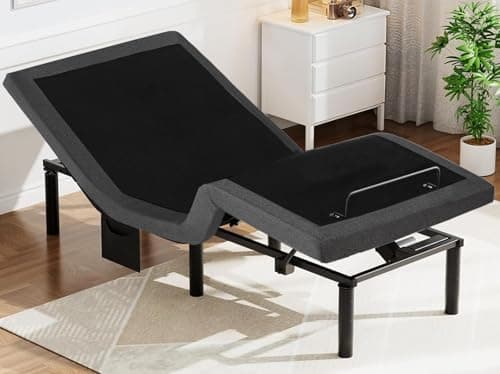
Our top pick — Pipishell Twin XL Adjustable Bed Frame
$339.99 · Check priceAs of September 21, 2026. #ad How we’re funded
Guide
Trials & Returns
The trial and return terms on a heavy motorized bed are not the easy returns you are used to. What to read before you buy.



Nothing here is medical advice. Prices are pulled live and stamped with the date they were checked; scores are our published spec rubric, not a test result. How we pick · How we make money · Corrections