Comparison
Hospital bed alternatives for the home
A hospital bed raises and lowers as a whole, takes fitted rails and has a funding route. Here is what covers the rest of it, and the job nothing on this page replaces.
By Stephen V.Published How we pick
We earn a commission if you buy through the links on this page, at no extra cost to you. It does not change what we recommend, and we have not tested these products — here is what we do instead.
The verdict first. If you are trying to avoid a hospital bed in a bedroom, the combination that covers the most ground is an adjustable base for the angles plus something fixed to hold onto for the transfer. Our pick for the angles is the Amada 01B-Q1 queen, because it is one of the few bases that publishes its leg heights as actual inches, and the height of the bed is what decides whether the transfer works. For the transfer itself, the Stander EZ Adjust rail folds down out of the way and names the ASTM standard it was built to; where the ceiling allows it, the Stander security pole does the job a trapeze bar does on a hospital bed. The budget pick is a riser set, which changes the bedside working height for a fraction of anything else here.
First, the honest part, because the rest of the page is only useful if this is clear. A hospital bed does one thing nothing on this page does: it changes the height of the whole bed, on demand, as often as you like. Low for a transfer to a wheelchair or a standing frame, high so that whoever is helping is not bending double over it. Every alternative here sets a height once. If the daily reality is several assisted transfers and a carer with their own back to protect, that difference outweighs everything else written below, and the right answer is a hospital bed.
The four jobs, and which of them you can buy separately
| The hospital bed job | What replaces it here | What you give up |
|---|---|---|
| Head and knee elevation on a motor | An adjustable base, or an under-mattress wedge if the bed must stay as it is | Nothing much on the angles; a base publishes deeper head lift than most hospital beds |
| Fitted full-length side rails | A portable assist rail, or a fall mat beside the bed instead | The rail is no longer engineered as one system with the mattress and frame |
| A trapeze or pull-up bar | A floor-to-ceiling transfer pole, or a bed-ladder strap | The pole is beside the bed rather than over it, and needs a flat ceiling |
| The whole bed rising and falling | Risers or replacement legs — one height, set once | This is the job that does not transfer. You pick a height and live with it |
| A funding route and a supplier | Nothing. These are retail purchases | No Medicare benefit, no delivery and setup, no engineer when it fails |
The last row is the one people underestimate. A hospital bed supplied through the benefit arrives with somebody responsible for it; a base, a rail and a riser set arrive in three cartons from three sellers and the assembly is yours. For some families — particularly anybody arranging this for a parent in another state — that single point of contact is worth real money, and we would not argue with somebody who decided it was worth theirs.
What Medicare actually says, in its own words
This matters here because the most common reason people look for alternatives is a denial, or the expectation of one. The criteria are specific rather than general, and reading them is usually quicker than arguing about them.
A fixed height hospital bed is covered if the beneficiary has a medical condition which requires positioning of the body in ways not feasible with an ordinary bed; or requires the head of the bed to be elevated more than 30 degrees most of the time due to congestive heart failure, chronic pulmonary disease, or problems with aspiration; or requires traction equipment which can only be attached to a hospital bed.
Note what is not in that list: age, finding it hard to get out of bed, wanting to sleep propped up, or a preference for sitting up to read. Those are real problems and they are exactly what the products on this page are for. They are not what the hospital-bed benefit is for, and chasing it on those grounds usually costs months. If the second clause describes the situation — the head of the bed elevated more than 30 degrees most of the time, for a named condition — then the paperwork route is worth taking seriously, because that is the criterion most often met.
How we chose the substitutes
- It has to replace a named hospital-bed function. Each pick below is here for one specific job in the table above, not because it is a nice thing to own.
- The published record comes first. We score what the manufacturer publishes — load ratings, standards, dimensions — and a specification nobody publishes scores a neutral five rather than being guessed at.
- Safety-critical products are judged on standards, not features. For rails that means the ASTM standard and the published mattress-depth window; for poles it means the ceiling range and what the listing says about where it may not be used.
- Cheaper is better where it works. Three of the six picks here cost a small fraction of an adjustable base, and two of them do more for a difficult transfer than the base does.
Each product is scored against the published bands for its own category — a base against the base rubric, a rail against the rail rubric — so the numbers below are comparable within a category and not across them. The full rubric, category by category.
| # | Pick | Key spec | Score | Price |
|---|---|---|---|---|
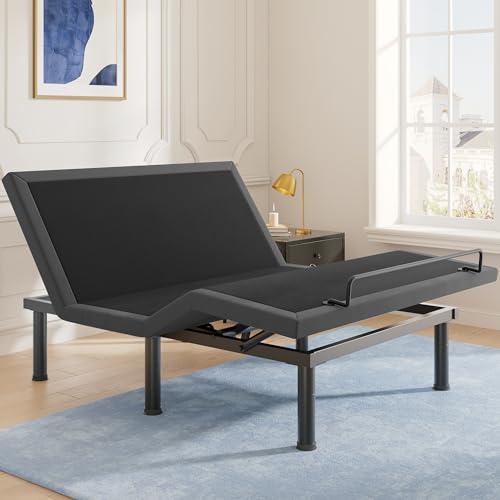
| Rank1 | 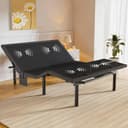 Amada 01B-Q1 Queen Adjustable Bed Frame Closest match for the angles | Key spec8-13 inLeg heights | Score9.0/10 | |
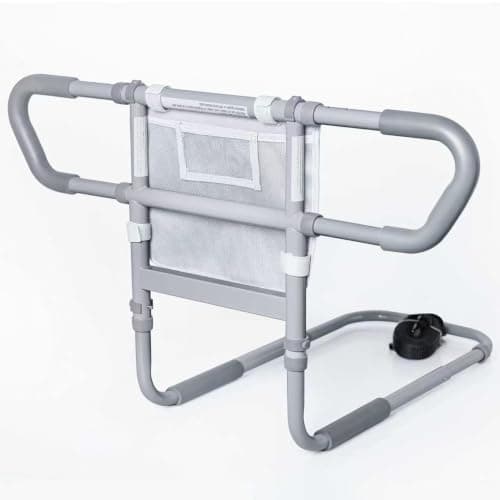
| Rank2 | 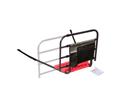 Stander EZ Adjust Bed Rail Closest match for a side rail | Key specASTM F3186-17Standard | Score7.6/10 | |
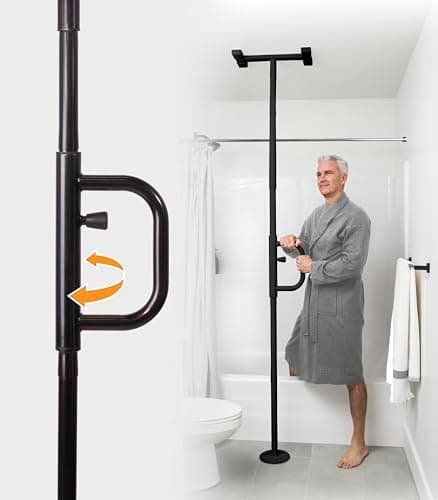
| Rank3 | 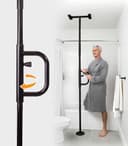 Stander 1100-B Security Pole and Curve Grab Bar Closest match for a trapeze bar | Key spec7-10 ftCeiling range | Score8.8/10 | |
| Rank4 | 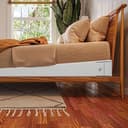 Avana Mattress Elevator 5-Inch, Queen Best if the bed cannot change at all | Key spec5 inRise | Score8.3/10 | |
| Rank5 | 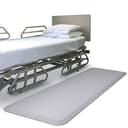 NYOrtho FALLSHIELD Fall Mat, 70" x 24" Best for the risk the rails exist to manage | Key spec1 inThickness | Score8.3/10 | |
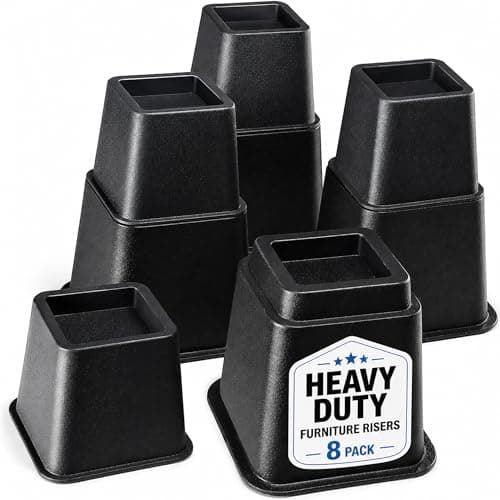
| Rank6 | 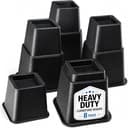 Home It Adjustable Bed Risers, 3/5/8 in Budget pick: the bedside working height | Key spec3, 5 or 8 inLift | Score8.5/10 |
Prices checked November 8, 2026. Scores are our published spec rubric, not a test result — here is exactly how they are calculated.
The rail decision is the one to slow down on
A hospital bed's rails are designed as part of the bed: the rail, the mattress and the frame are engineered together, and the FDA publishes dimensional guidance for the gaps between them because entrapment in those gaps has killed people. A portable rail added to an ordinary bed has none of that engineering. It is a separate consumer product, regulated since August 2023 under 16 CFR part 1270, and getting the fit right is the buyer's job.
Two practical consequences. First, read the published mattress-depth window before you order: our top-ranked rail here publishes a fit for mattresses 10 to 14 inches thick on regular frames, and publishes that it is not for adjustable beds — so if you buy the base on this page, that is not the rail to put on it. The rails that do publish adjustable-frame compatibility. Second, for anybody with dementia or significant confusion, a rail can be the wrong tool entirely, because a rail you climb over is a higher fall. That is the reason a fall mat is on this page at all. Who should not use a bed rail, and the alternatives to rails.

If the bed itself cannot change
Sometimes replacing the bed is not on the table — a rented room, a bed somebody has slept in for forty years, a short recovery that does not justify a new frame. In that case the angle can still be bought without touching the bed: an under-mattress wedge lifts the head of the existing mattress on a foam ramp, and the gentlest of the ones we track publishes a five-inch rise and a one-year warranty. It is not a motor and it does not move, so the angle is permanent until somebody lifts the mattress off again.
Two honest limits. A rigid foam ramp under a mattress is a flat-bed product and does not belong on an adjustable base — a ramp that cannot bend and a deck that does are incompatible. And five inches may simply not be enough for the elevation somebody has been told to achieve. The under-mattress wedges we track, and how head elevation is actually measured.
The order we would buy these in
- Start with the height of the bed you already have. Measure it, work out the target, and price a riser set or replacement legs. This is the cheapest change on the page and for a surprising number of readers it is the only one needed.
- Then buy the thing to hold onto. A rail or an assist handle costs under a hundred dollars at the last check and does more for a hard transfer than any motor. Where the ceiling is flat and the sleeper is getting up unaided, a pole does it better still.
- Then, if the angles are genuinely the problem, buy the base. Reflux, swollen ankles, a cough that is worse lying flat, needing to get up in stages — those are angle problems and a base is the right purchase for them.
- Add the fall mat if the risk is falling rather than transferring, and read the rail safety page first if a rail is going anywhere near somebody confused at night.
Specifications for all six picks were read from their live Amazon listings on the dates stamped in each product's own table, and scored against the published bands for their own categories. We have not tested any of them and we make no claim about how they feel. The coverage statements on this page follow the federal sources named below rather than our opinion, and nothing here is medical advice: if a hospital bed is clinically indicated, the person to ask is the clinician who would have to document it. How we pick, and how we make money.
Questions people actually ask
What can I use instead of a hospital bed at home?
In most cases, a combination rather than a single product: an adjustable base for the angles, something fixed to hold onto for the transfer, and a change of bed height for whoever is helping. Our top pick for the angles is a queen base that publishes four leg heights in inches; the transfer is better served by a rail or a floor-to-ceiling pole than by any bed. What none of it replaces is a bed that lowers to the floor on demand, and if that is what the situation needs, the answer is the hospital bed and the paperwork that comes with it.
Is an adjustable bed the same as a hospital bed?
No, and the difference is not comfort or price. A hospital bed raises and lowers as a whole, accepts fitted full-length side rails and usually takes a trapeze bar; an adjustable base changes the angle of the head and the feet while the frame stays at one height. One is sold as consumer furniture and the other as durable medical equipment, which is also why only one of them has a Medicare route. The full head-to-head.
Will Medicare pay for any of these alternatives?
Almost certainly not. Medicare's hospital-bed benefit under Part B covers equipment that meets the criteria in coverage determination L33820, supplied by an enrolled supplier on a doctor's order. A consumer base, a portable bed rail, a riser set or a fall mat bought online is not that, however similar the function. Bed rails specifically are not covered — the detail is here — and the general rules are on our Medicare coverage page.
Can you put side rails on an ordinary bed?
You can fit an adult portable bed rail, which is a separate consumer product regulated since August 2023 under 16 CFR part 1270. It is not the same as the fitted full-length rail a hospital bed is engineered around, where the rail, the mattress and the frame are designed as one system. The gaps between a rail, a mattress and a frame are where entrapment happens, and the FDA publishes guidance on them precisely because people have died in those gaps. Read rail safety before you buy any rail, and note that our top-ranked rail here publishes that it does not fit adjustable beds.
How do you raise a bed to the height a carer needs?
Risers under the existing legs, or replacement legs, are the cheap way and the budget pick on this page does it in three published steps of 3, 5 or 8 inches. The limitation is real and worth stating plainly: risers set the bed to ONE height. A hospital bed's defining feature is that it moves between heights, high for the carer and low for the transfer, several times a day. Risers give you the carer half and take away the transfer half. The risers we track, and the replacement legs.
Is renting a hospital bed better than buying the alternatives?
It depends entirely on how long the need lasts. Hospital beds are typically supplied as a capped rental rather than a purchase when Medicare is involved, which suits a recovery with an end date; the products on this page are bought outright and stay useful afterwards. If the need is weeks rather than years, price the rental first. Renting versus buying, and what to do if the claim is denied.
Sources
Every factual claim on this page traces to one of these, or to a product listing cited in the specification table beside it.
Read next
Head to head
Adjustable Bed vs Hospital Bed
Two different products that look similar in photographs. One is furniture, one is medical equipment, and only one of them Medicare will help with.
Guide
Getting a Bed Approved
What the physician actually has to document, in what order, and the two mistakes that produce most denials.
Guide
Medicare Coverage
No. It can cover a hospital bed, and here are the actual criteria, quoted, with the codes and what you would pay.
Comparison
Best Bed Rails
Scored on whether the listing states compliance with the standard that became federal law in 2023 — and four other things.
Our top pick — Lesamediio HC035 Bed Assist Rail
$69.99 · Check priceAs of November 8, 2026. #ad How we’re funded
Comparison
Best Transfer Poles
A pole you tension between floor and ceiling and stand up against. Ranked on the ceiling window, the grip, and the material - and every one of them publishes exactly 300 pounds.
Our top pick — Stander 1100-B Security Pole and Curve Grab Bar
Comparison
Best Bed Risers
The cheapest fix in this subject, scored on the two specs that matter: how much lift, and how much load.
Our top pick — Home It Adjustable Bed Risers, 3/5/8 in
Head to head
Rent vs Buy
Rental suits a short or uncertain need. Buying suits a long one. Medicare's capped rental changes the math in a way worth knowing.
Comparison
Best Full Size
The full is the cheapest size you can buy a real head-and-foot base in. It is also shorter than a twin XL, and only one listing of the five tells you how high off the floor it sits.
Our top pick — Tami Tami T450 Full Adjustable Bed Frame
$319.99 · Check priceAs of November 8, 2026. #ad How we’re funded

Nothing here is medical advice. Prices are pulled live and stamped with the date they were checked; scores are our published spec rubric, not a test result. How we pick · How we make money · Corrections