Guide
Bed height after knee replacement
AAOS publishes a seat height for the recovery chair. The bed is the seat you use most, and almost nobody applies the same number to it.
By Stephen V.Published How we pick
There is a number in the AAOS patient guidance for knee replacement that almost nobody applies to the bed. It is given for the chair you will spend the first weeks in, and it is one of the few published heights in this whole subject.
A stable chair for your early recovery with a firm seat cushion (and a height of 18 to 20 inches), a firm back, two arms, and a footstool for intermittent leg elevation.
That figure is on the checklist because standing up from a low seat is the hardest everyday movement after this operation. The bed is a seat too, and in the first weeks it is the one you get up from most often, usually at night, usually half asleep. It is odd that the chair gets a published number and the bed gets nothing.
Why low is the problem, and high is not the answer either
Two things make standing up hard after a knee replacement. The knee is stiff, particularly through the last part of extension, and the quadriceps - the muscle that does the standing - is weakened by the surgery and by swelling. A low seat asks for more of both at once: more bend to rise out of, and more force from the muscle least able to give it. That is the whole mechanism, and it is why AAOS also suggests a toilet seat riser with arms if your toilet is low.
The obvious conclusion - go as high as possible - is wrong, and it fails in a way that is specific to a knee. A bed so tall that your feet dangle when you sit on the edge means you leave it by dropping, and you land on a knee that has just been operated on with your weight already moving. It also means you get into it with a step up, which is the movement your knee is least ready for. The target is the same one the rest of this section uses, taken toward the tall end of your own range: feet flat on the floor when you sit, knees at roughly a right angle, and no drop at the end of the stand. The measurement and the calculator are here.
What a realistic first few weeks looks like
AAOS says most patients can expect to resume most normal activities of daily living within three to six weeks of surgery, and that you will be able to walk with a cane, crutches or a walker soon after surgery while needing help for several weeks with things like cooking, shopping and laundry. Read that as a planning horizon for the bedroom: whatever you change should be easy to undo, because a good many people want the extra height for a month or two and not permanently.
That is the argument for risers over a new frame. A set of risers with published heights goes on in ten minutes, comes off in ten minutes, and costs a small fraction of a bed. A new frame is a decision about the next decade being made in the week you are least able to shop carefully.
What to look for before you buy anything
Three requirements, and they follow from the recovery rather than from general preference:
- Reversible, with published heights. You want a known number of inches you can take back off. A riser set that publishes several lift heights lets you find the right one instead of committing to a guess on the day you get home from hospital.
- Something fixed to push down on. Not to pull yourself up by - to push down on, so your arms carry some of the load your quadriceps cannot. It needs to be solid at hand height beside your hip, and a padded grip is worth having. If you are also using a walker, this matters twice over, because the walker itself must not be pulled on.
- A way to elevate the leg that supports the calf, not the knee. AAOS's checklist includes a footstool for intermittent elevation. In bed the equivalent is something firm and wedge-shaped under the lower leg. Propping directly under the knee encourages it to settle bent, which is the opposite of what most knee rehabilitation is trying to achieve - and if your team has told you otherwise for your knee, follow them.
The three things worth buying
| # | Pick | Key spec | Score | Price |
|---|---|---|---|---|
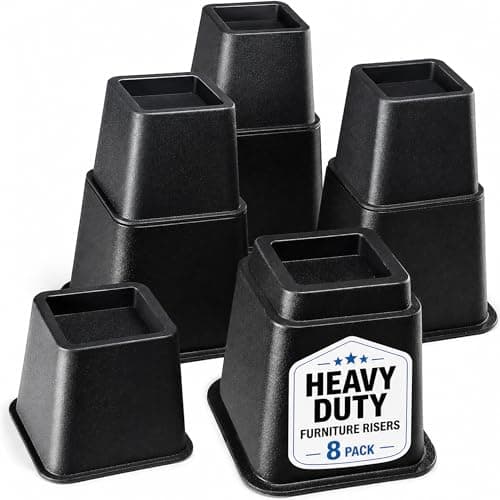
| Rank1 | 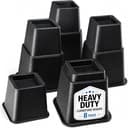 Home It Adjustable Bed Risers, 3/5/8 in Best way to add known height | Key spec3, 5 or 8 inLift | Score8.5/10 | |
| Rank2 | 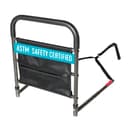 Able Life Bedside Safety Handle Best to push up from | Key specStand assistType | Score8.0/10 | |
| Rank3 | 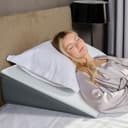 Kolbs Bed Wedge Pillow, 7.5 in Best for elevating the leg | Key spec7.5 inRise | Score8.8/10 |
Prices checked September 17, 2026. Scores are our published spec rubric, not a test result — here is exactly how they are calculated.
1 · Best way to add known height
Home It Adjustable Bed Risers, 3/5/8 in
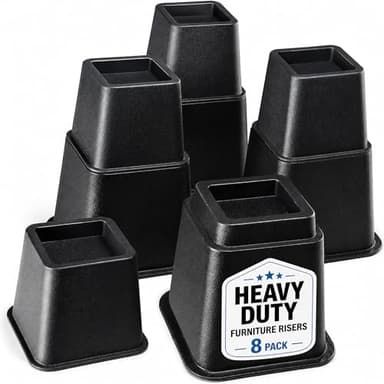
Three published lift heights from one set and a published 1,300 lb rating — the most flexible way to test a height before committing to it.
- Lift
- 3, 5 or 8 in
- Our spec score
- 8.5/10
- Best for
- Trying a height first
What works
- Three heights out of one box, so you can try 3 inches, decide it is not enough, and go to 5 without buying twice
- A published 1,300 lb rating for the set, and a published material — polypropylene, not an unnamed plastic
- Cheap enough that testing a height costs less than being wrong about one
What doesn’t
- Stacked risers are less stable than a single-piece riser of the same height — stack at your own judgment
- No published socket depth, and socket depth is what decides whether your bed leg actually sits in it
- Raising a bed raises the fall distance. Height helps you stand; it does not help you land
Published specifications
| Lift heights | 3, 5 or 8 inches (stackable) |
|---|---|
| Load rating | 1,300 lb |
| Pack | 4 |
| Material | Polypropylene |
| Socket depth | Not published |
Read from the product listing on 2026-08-26. Blanks are specifications the manufacturer does not publish, not figures we could not be bothered to find.
How the score was reached
| Lift rangeThree published heights from 3 to 8 inches. | 10 |
|---|---|
| Load rating1,300 lb published for the set. | 9 |
| StabilityPolypropylene with a broad base published; stackable by design, and no socket depth. | 7 |
| Set sizeFour-pack — one per bed leg. | 8 |
| Mean, rounded to one decimal | 8.5 |
2 · Best to push up from
Able Life Bedside Safety Handle
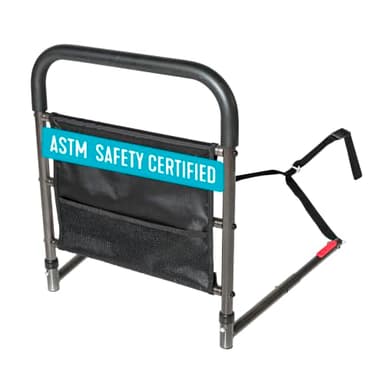
A padded stand-assist handle rather than a guard rail — the right tool if the problem is standing up, not rolling out.
- Type
- Stand assist
- Our spec score
- 8.0/10
- Best for
- Standing up, not staying in
As of September 17, 2026. #ad How we’re funded
What works
- Height adjustable, so the grip can sit where your hand naturally reaches from sitting
- Padded grip, which matters if arthritis makes a bare steel tube unpleasant to hold hard
- A published 300 lb load rating and a published fit across king, queen, full and twin
What doesn’t
- It is a handle, not a rail. It will not stop anyone rolling out of bed, and it is not meant to
- 300 lb is the lowest published rating of the rails here, and standing up loads a handle harder than sitting on it does
- No light, and the listing rules out adjustable beds and extra-soft mattresses
Published specifications
| Type | Stand-assist handle (not a full-length guard rail) |
|---|---|
| Standard claimed | ASTM safety approved |
| Height adjustable | Yes |
| Padding | Padded grip |
| Load rating | 300 lb |
| Fits | King, queen, full and twin beds; mattresses 6–14 in thick |
| Light | Not published |
Read from the product listing on 2026-08-26. Blanks are specifications the manufacturer does not publish, not figures we could not be bothered to find.
How the score was reached
| Standard complianceASTM compliance stated on the listing. | 9 |
|---|---|
| Grip and reachHeight adjustable with a published padded grip. | 9 |
| Load rating300 lb published — the lowest published figure of the rails here. | 8 |
| FitKing, queen, full and twin all published, with a 6–14 in mattress window. | 9 |
| Night useNo light published — neutral score. | 5 |
| Mean, rounded to one decimal | 8.0 |
3 · Best for elevating the leg
Kolbs Bed Wedge Pillow, 7.5 in
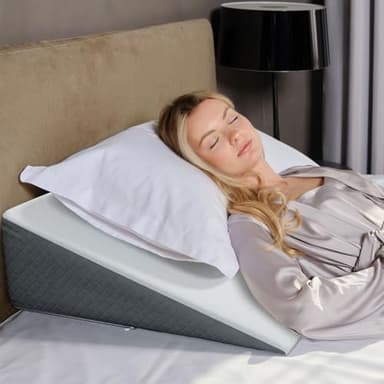
A published 7.5-inch rise and a published FSA eligibility, at roughly one twentieth of what a base costs.
- Rise
- 7.5 in
- Our spec score
- 8.8/10
- Best for
- Trying elevation cheaply
As of September 17, 2026. #ad How we’re funded
What works
- If the problem is reflux, this is the thing to try before a base — and CMS itself points people at elevation before equipment
- FSA eligibility is published, which turns a $36 pillow into a pre-tax $36 pillow
- It publishes what is inside it: a 1.5-inch memory foam top layer over a high-density foam core, on a removable machine-washable cover
What doesn’t
- A wedge raises your chest, not the whole bed. It does nothing at all for getting out of bed
- 7.5 inches is a modest rise; some people need more angle than this gives
- The foam densities themselves are not published, so how much the core will sag over a year is still a guess
Published specifications
| Height | 7.5 inches |
|---|---|
| Width | Standard |
| FSA eligible | Yes (stated on the listing) |
| Cover | Jacquard, removable and machine washable |
| Fill | 1.5 in memory foam over a high-density foam core |
Read from the product listing on 2026-08-26. Blanks are specifications the manufacturer does not publish, not figures we could not be bothered to find.
How the score was reached
| Rise published7.5-inch height published. | 9 |
|---|---|
| CoverageStandard width stated; no length or torso-coverage figure. | 6 |
| Cover and careA removable, machine-washable jacquard cover and a published two-layer fill. | 10 |
| Cost of tryingFSA-eligible and an order of magnitude below a base. | 10 |
| Mean, rounded to one decimal | 8.8 |
The Home It risers publish three separate lift heights in one set, which is the property that matters when you do not yet know how much height you want - you can start at the smallest and work up rather than buying twice. The Able Life handle publishes a 300 lb load rating, a padded grip and a 6 to 14 inch mattress range, and it is a stand aid rather than a guard rail, which is the right tool when the problem is rising rather than rolling out. The Kolbs wedge publishes a 7.5-inch rise and states FSA eligibility on its own listing, which is worth knowing if you have a flexible spending account and a surgery year - what actually decides FSA eligibility.
| What helps | Why | The caution |
|---|---|---|
| A bed toward the tall end of your range | Less knee bend to rise from | Not so tall your feet dangle |
| Bed risers | Reversible, known number of inches | Measure first; seat every leg fully |
| A fixed handhold | Arms share the load the quad cannot | Push down on it, never pull up |
| A firm mattress edge | You do not sink below the height you set | A mattress property, not a frame one |
| Calf elevation for swelling | Part of many recovery plans | Under the calf, not under the knee |
| Your therapist's method | Built around your knee | It overrides every general rule |
The rest of the room, and when to ask
Clear the route you will take at night and light it, because you will be making that trip on a stiff knee in the dark and the CDC's fall-prevention work keeps landing on the same dull list: clutter, cords, rugs, poor lighting. The full bedroom checklist is free and takes an afternoon. If you are recovering from surgery more broadly, what changes about the bed during recovery covers the wider picture.
Ask your surgeon or physical therapist, rather than adjusting things further yourself, if getting out of bed still hurts sharply once the height is right, if the knee gives way or feels unstable, if swelling worsens rather than settles, or if you are unsure how much to elevate. Many hospitals arrange an occupational therapy visit before or shortly after discharge, and an occupational therapist will set the bed against your actual bedroom and your actual knee - which is better than any figure a website can offer, including the one at the top of this page.
Questions people actually ask
What is the best bed height after a knee replacement?
Tall enough that you are not standing up out of a deep bend. AAOS recommends a recovery chair with a firm seat cushion at a height of 18 to 20 inches, and a bed is the seat you use most often in the first weeks - so a sleep surface toward the taller end of the normal range, with your feet still flat on the floor when you sit, is the sensible target. Your physical therapist sets the exact number.
Why are low seats hard after knee surgery?
Standing up from a low seat asks the operated knee to extend through its stiffest range while the quadriceps is at its weakest, and that muscle is the one surgery and swelling knock hardest. A higher surface means less bend to get out of and less range to push through. It is the same reason AAOS suggests a toilet seat riser with arms if the toilet is low.
How do I raise my bed after a knee replacement?
Bed risers under the legs are the cheapest and most reversible method - a set with published lift heights and a published load rating raises an ordinary four-leg frame by a known amount and comes off again when you no longer need it. Measure the gap first and raise the bed by the difference, not by the largest riser in the box.
How do I get my operated leg onto the bed?
Sit on the edge first, then bring the leg up rather than lifting it from standing - many people use the other leg, a hand under the thigh, or a leg lifter strap in the early weeks. Your physical therapist teaches the version that respects your own restrictions, and that is the one to use. A bed at a sensible height makes every version of it easier, because you start from sitting rather than from a crouch.
Should I elevate my leg in bed after a knee replacement?
Elevation is commonly part of a recovery plan for swelling, and AAOS suggests a footstool for intermittent leg elevation as part of the home setup. How much, how often and for how long is a question for your surgical team, not for a website - and elevate under the calf rather than under the knee unless you have been told otherwise, because a pillow directly under the knee encourages it to sit bent.
Sources
Every factual claim on this page traces to one of these, or to a product listing cited in the specification table beside it.
Read next
Guide
After Hip Replacement
After hip surgery a bed that is too low is hard and unsafe to leave - here is why higher usually helps, and how to raise one temporarily.
Guide
Best Bed Height for Seniors
A calculator that shows its working, because the right answer depends on your legs and not on an average.
Comparison
Best Bed Risers
The cheapest fix in this subject, scored on the two specs that matter: how much lift, and how much load.
Our top pick — Home It Adjustable Bed Risers, 3/5/8 in
Guide
Post-Surgery Recovery
Elevation can make recovery more comfortable and getting up safer. What a bed helps with, and what stays with your surgical team.
Guide
Getting Up With a Walker
The walker is not a handhold for standing up - AAOS says so plainly. What to push from instead, and why the bed's height does most of the work.
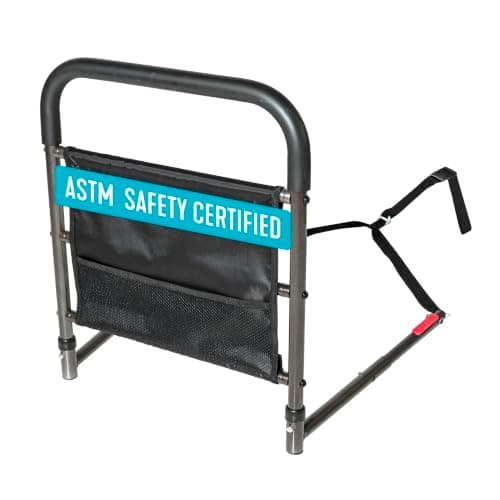
Our top pick — Able Life Bedside Safety Handle
$49.99 · Check priceAs of September 17, 2026. #ad How we’re funded


Nothing here is medical advice. Prices are pulled live and stamped with the date they were checked; scores are our published spec rubric, not a test result. How we pick · How we make money · Corrections