Guide
Bed height after hip replacement
After hip surgery a bed that is too low is hard and unsafe to leave - here is why higher usually helps, and how to raise one temporarily.
By Stephen V.Published Updated How we pick
Getting in and out of bed is one of the transfers a hip-replacement recovery plan is built around, and bed height is a large part of whether that transfer is easy or a struggle. The short version, which the rest of this page unpacks: during recovery a bed that is a little higher than usual is generally easier and safer to get in and out of than a low one, because it asks the new hip to bend less. But a little higher is doing a lot of work in that sentence, and the exact target is one your physical therapist should set.
Why a higher bed is usually easier after hip surgery
Standard hip precautions after a replacement often discourage bending the hip deeply, and low seats are the everyday thing that forces a deep bend. When you sit down onto a low surface, or stand up from one, the hip has to flex well past a right angle - exactly the movement many precautions ask you to avoid in the early weeks. A higher sitting surface means the hip bends less to reach it, so a bed set toward the taller end of the normal range, or slightly above it, usually makes the sit-down and the stand-up gentler on the new joint.
The AAOS notes that after a total hip replacement you may be asked to take special precautions when sitting, bending and sleeping, usually for the first six weeks - and that stiffness with excessive bending is common in that period. Bed height is one of the simplest levers on how much bending a routine transfer demands, which is why occupational therapists so often raise a too-low bed before a patient comes home rather than after.
The target height, and why a bit higher is the idea
The starting point is the same measurement the rest of this section uses: your target sleep-surface height is roughly your own lower-leg length, floor to the back of the knee when you sit with both feet flat. The method and a calculator are here. During hip recovery, the reason to aim for the top of that range, or a little above, is that a slightly higher surface reduces how far the hip has to flex to sit and to stand.
But a little above is a nudge, not a license to go as high as possible. A bed so tall your feet dangle when you sit on the edge reintroduces the drop-and-slide problem this whole section warns about, and after hip surgery a slide is exactly the uncontrolled movement you are trying to avoid. The aim is a controlled sit and a controlled stand, feet reaching the floor, with the hip bending as little as your precautions require. Your physical therapist can set the exact number against your restrictions; the arithmetic here is where to start the conversation.
How to raise a bed that is too low, temporarily
Recovery is often the moment a normally fine bed turns out to be too low, and the fix is usually temporary - you may want the extra height for the weeks of restriction and not after. That points to the reversible options.
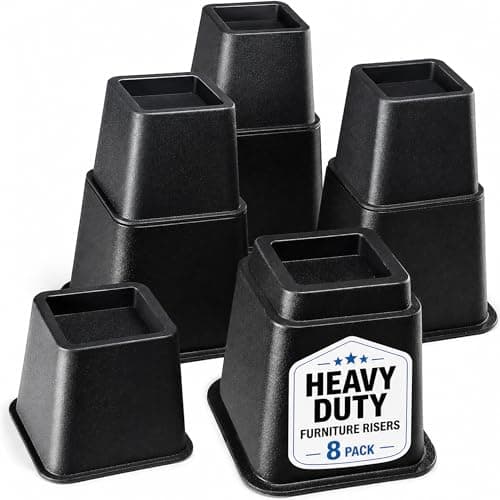
- Bed risers under the legs are the cheapest and most reversible way to raise a bed by a known amount. A set with a published load rating and a wide base lifts an ordinary four-leg frame by 3 to 8 inches and comes back off in minutes when the restriction lifts. The risers we would buy are here - measure the gap first so you raise it by the right amount, not the biggest amount.
- Measure before you buy, the same as always. Work out your target, measure what you have, and raise the bed by the difference - overshooting into a too-tall bed trades one problem for another at exactly the wrong time.
- A firm mattress edge helps more than usual now. If the edge collapses when you sit, you sink below the height you set every single time, and after hip surgery that unplanned drop is worse than an inconvenience. Raising the frame does not fix a soft edge - that is a mattress property, not a frame one.
Add a handhold for the transfer
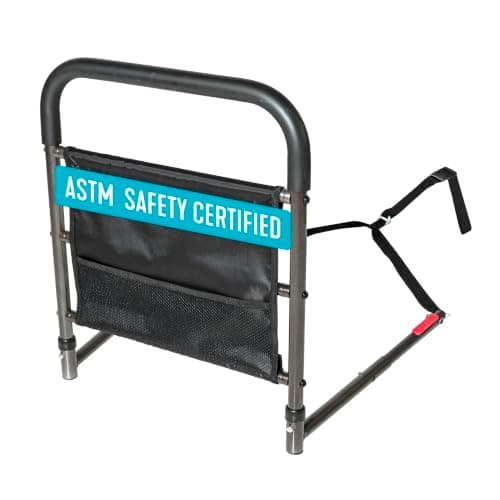
Height gets the surface right; a handhold gets the movement safe. Something solid to push down on - and to push, not pull yourself up by - takes load off the hip during the sit and the stand and gives you a controlled point of contact if your balance is still returning. An assist handle or stand aid fixed by the bed is the common tool; a bed rail is another, though a rail is a fuller structure and worth checking against fit and entrapment guidance before it goes on.
Your physical therapist will teach the specific way to get in and out that respects your precautions - which leg leads, how to pivot without twisting the new hip, where to place your hands. Follow their method over any general sequence, including any you might read here. A handhold supports that method; it does not replace being taught it.
If the operation was a knee rather than a hip, do not apply this page to it. The conclusion about height looks similar and the reasoning is different - there is usually no equivalent list of forbidden movements, and the constraint is stiffness and quadriceps strength in one joint rather than a restricted range at the hip. Bed height after a knee replacement covers that case, including the seat height AAOS publishes for the recovery chair.
| What helps | Why | The caution |
|---|---|---|
| A slightly higher bed | Less hip flexion to sit and stand | Not so high your feet dangle |
| A firm mattress edge | You do not sink below the set height | A mattress fix, not a frame one |
| Bed risers | Reversible way to add known height | Measure first; seat every leg fully |
| An assist handle or rail | A controlled point to push from | Push down, do not pull up; check the fit |
| Your therapist's transfer method | Built around your precautions | It always overrides a general rule |
Pain, and the rest of the recovery
Bed height is one piece of a larger recovery, and the joint you operated on is not the only one that has an opinion about getting out of bed. Pain in a hip or a shoulder changes how you can push and pull during a transfer, and how you sleep - hip and shoulder pain and bed setup covers that alongside the broader picture in recovering after surgery. None of it substitutes for the plan your surgical team gave you; it is context for the questions worth raising with them.
When to stop and ask
Ask your surgeon or physical therapist, rather than adjusting the bed further on your own, if getting in or out still hurts sharply after you have set the height, if your balance feels unreliable, if any movement feels like it strains the new hip, or if you are simply unsure which precautions apply to you. Many hospitals arrange an occupational therapy home visit before or just after discharge, and an occupational therapist will set the bed height against your actual home, your actual transfer and your actual restrictions - which is better than any number a website can give you.
Questions people actually ask
What is the best bed height after a hip replacement?
Generally a bed toward the taller end of the normal range, or slightly above it, so the new hip bends less to sit and to stand - but not so tall your feet dangle when you sit on the edge. Start from your own lower-leg length and let your physical therapist set the exact target against your precautions, which always override any general rule.
Why is a higher bed better after hip surgery?
Standard hip precautions often discourage bending the hip deeply, and low seats force a deep bend to sit and to stand. A higher surface means less flexion at the hip, which usually makes the transfer gentler on the new joint in the early weeks. Your surgeon's specific restrictions decide how high is right for you.
How do I raise a bed that is too low after a hip replacement?
Bed risers under the legs are the cheapest and most reversible way, lifting an ordinary four-leg frame by a known amount and coming off again when the restriction lifts. Measure the gap first and raise the bed by the difference, not the biggest amount - the risers we would buy are here.
Should I use a bed rail or handle after hip surgery?
A solid handhold to push down on - not pull up by - takes load off the hip during the transfer and gives a controlled point of contact. An assist handle or a bed rail is common; check its fit before use, and follow the exact transfer method your physical therapist teaches you.
How long do hip precautions last?
The AAOS notes that special precautions for sitting, bending and sleeping are usually asked for in the first six weeks after surgery, but the details vary by surgical approach and by surgeon. This is general information, not medical advice - your surgical team gives you the timeline and the restrictions that apply to your hip.
Sources
Every factual claim on this page traces to one of these, or to a product listing cited in the specification table beside it.
Read next
Guide
Best Bed Height for Seniors
A calculator that shows its working, because the right answer depends on your legs and not on an average.
Comparison
Best Bed Risers
The cheapest fix in this subject, scored on the two specs that matter: how much lift, and how much load.
Our top pick — Home It Adjustable Bed Risers, 3/5/8 in
Comparison
Best Assist Handles
If the difficulty is standing up rather than staying in, this is the product you actually want.
Our top pick — Able Life Bedside Safety Handle
$49.99 · Check priceAs of September 22, 2026. #ad How we’re funded
Guide
Hip and Shoulder Pain
Side-sleeping concentrates your weight on the hip and shoulder. The fix is as much the surface as the angle — here is what to try tonight.
Gift guide
Gifts After Hip or Knee Surgery
Recovery is a few months of temporary problems: a bed at the wrong height, nothing to push up on, sleeping propped. Five gifts that solve them, none of which needs to stay.
Our top pick — Home It Adjustable Bed Risers, 3/5/8 in


Nothing here is medical advice. Prices are pulled live and stamped with the date they were checked; scores are our published spec rubric, not a test result. How we pick · How we make money · Corrections